 VIPSolutions
Act like a helpful tutor and exlain me : Give step-by-step solution with explanation and final answer:give complete and detailed answerProblem 2.8. Consider the flow of a fluid parallel to a flat and smooth plate. (a) Assume that the fluid is air at 100-kPa pressure, with Ux, = 1 m/s. The entire system is at 350 K. The surface of the plate is slightly wet, such that water vapor is transferred from the surface to the fluid. Estimate the thick- ness of the velocity and concentration boundary layers at 1-, 10-, and 30-cm distances from the leading edge of the plate. (b) Repeat part (a), this time assuming that Uy. = 2.5 cm/s, the fluid is water and the transferred species is chlorine.
Question:
Act like a helpful tutor and exlain me :
Give step-by-step solution with explanation and final answer:give complete and detailed answer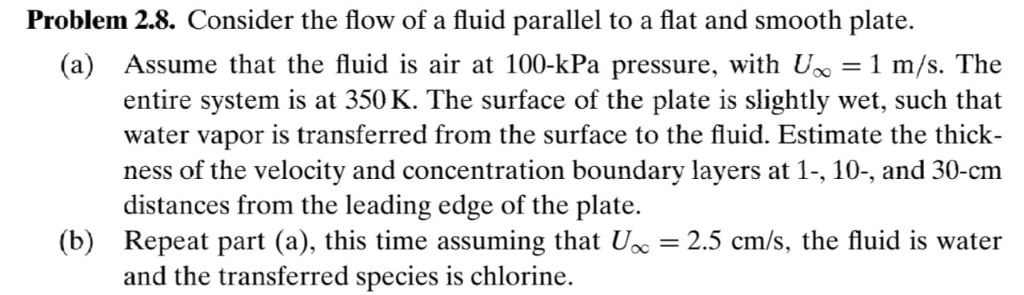 Problem 2.8. Consider the flow of a fluid parallel to a flat and smooth plate.
(a) Assume that the fluid is air at 100-kPa pressure, with Ux, = 1 m/s. The
entire system is at 350 K. The surface of the plate is slightly wet, such that
water vapor is transferred from the surface to the fluid. Estimate the thick-
ness of the velocity and concentration boundary layers at 1-, 10-, and 30-cm
distances from the leading edge of the plate.
(b) Repeat part (a), this time assuming that Uy. = 2.5 cm/s, the fluid is water
and the transferred species is chlorine.
This is AI generated Response.
Asked by: manish kumar
Created at: 2025-09-30 20:33:50
Asked by: manish kumar
Created at: 2025-09-30 20:33:50
Final Answer:
Rendered
Raw Text
Did you like this answer?
Let's solve **Problem 2.8** step by step.
---
## **Given Data**
### **Part (a):**
- Fluid: Air
- Pressure: 100 kPa
- Free stream velocity (\(U_\infty\)): 1 m/s
- Temperature: 350 K
- Plate is slightly wet (water vapor transferred to air)
- Find: Thickness of **velocity boundary layer** (\(\delta\)) and **concentration boundary layer** (\(\delta_c\)) at:
- \(x = 1\) cm = .01 m
- \(x = 10\) cm = .10 m
- \(x = 30\) cm = .30 m
---
## **Step 1: Calculate Properties of Air at 350 K**
From tables (approximate values at 350 K, 100 kPa):
- **Kinematic viscosity (\(\nu\))**: \( \approx 2.4 \times 10^{-5} \) m\(^2\)/s
- **Diffusion coefficient of water vapor in air (\(D_{AB}\))**: \( \approx 2.6 \times 10^{-5} \) m\(^2\)/s
---
## **Step 2: Boundary Layer Thickness Formulae**
### **(a) Velocity Boundary Layer (\(\delta\))**
For laminar flow over a flat plate:
\[
\delta(x) \approx \frac{5.x}{\sqrt{Re_x}}
\]
where:
\[
Re_x = \frac{U_\infty x}{\nu}
\]
### **(b) Concentration Boundary Layer (\(\delta_c\))**
\[
\delta_c(x) \approx \frac{\delta(x)}{\sqrt{Sc}}
\]
where:
\[
Sc = \frac{\nu}{D_{AB}}
\]
is the **Schmidt number**.
---
## **Step 3: Calculate at Each Location**
### **Calculate Reynolds Number at Each \(x\):**
\[
Re_x = \frac{U_\infty x}{\nu}
\]
| \(x\) (m) | \(Re_x\) |
|---|---|
| .01 | \(\frac{1 \times .01}{2.4 \times 10^{-5}} = 417\) |
| .10 | \(\frac{1 \times .10}{2.4 \times 10^{-5}} = 4167\) |
| .30 | \(\frac{1 \times .30}{2.4 \times 10^{-5}} = 12500\) |
---
### **Compute Schmidt Number**
\[
Sc = \frac{\nu}{D_{AB}} = \frac{2.4 \times 10^{-5}}{2.6 \times 10^{-5}} \approx .92
\]
---
### **Compute Boundary Layer Thicknesses**
#### **For \(x = .01\) m:**
**Velocity boundary layer:**
\[
\delta = \frac{5 \times .01}{\sqrt{417}} = \frac{.05}{20.4} = .00245 \text{ m} = 2.45 \text{ mm}
\]
**Concentration boundary layer:**
\[
\delta_c = \frac{\delta}{\sqrt{Sc}} = \frac{.00245}{\sqrt{.92}} = \frac{.00245}{.96} = .00255 \text{ m} = 2.55 \text{ mm}
\]
---
#### **For \(x = .10\) m:**
**Velocity boundary layer:**
\[
\delta = \frac{5 \times .10}{\sqrt{4167}} = \frac{.5}{64.5} = .00775 \text{ m} = 7.75 \text{ mm}
\]
**Concentration boundary layer:**
\[
\delta_c = \frac{.00775}{.96} = .00807 \text{ m} = 8.07 \text{ mm}
\]
---
#### **For \(x = .30\) m:**
**Velocity boundary layer:**
\[
\delta = \frac{5 \times .30}{\sqrt{12500}} = \frac{1.5}{111.8} = .0134 \text{ m} = 13.4 \text{ mm}
\]
**Concentration boundary layer:**
\[
\delta_c = \frac{.0134}{.96} = .01396 \text{ m} = 14. \text{ mm}
\]
---
## **Summary Table (Part a)**
| \(x\) (cm) | \(\delta\) (mm) | \(\delta_c\) (mm) |
|---|---|---|
| 1 | 2.45 | 2.55 |
| 10 | 7.75 | 8.07 |
| 30 | 13.4 | 14. |
---
## **Part (b): Water and Chlorine**
### **Given:**
- \(U_\infty = 2.5\) cm/s = .025 m/s
- Fluid: **Water**
- Transferred species: **Chlorine**
### **Typical Properties for Water at 350 K:**
- \(\nu \approx .4 \times 10^{-6}\) m\(^2\)/s
- \(D_{AB}\) (chlorine in water) \( \approx 1.5 \times 10^{-9} \) m\(^2\)/s
---
### **Calculate \(Re_x\):**
| \(x\) (m) | \(Re_x\) |
|---|---|
| .01 | \(\frac{.025 \times .01}{.4 \times 10^{-6}} = 625\) |
| .10 | \(\frac{.025 \times .10}{.4 \times 10^{-6}} = 625\) |
| .30 | \(\frac{.025 \times .30}{.4 \times 10^{-6}} = 18750\) |
---
### **Calculate Schmidt Number:**
\[
Sc = \frac{\nu}{D_{AB}} = \frac{.4 \times 10^{-6}}{1.5 \times 10^{-9}} \approx 267
\]
---
### **Compute Thicknesses**
#### **For \(x = .01\) m:**
**Velocity boundary layer:**
\[
\delta = \frac{5 \times .01}{\sqrt{625}} = \frac{.05}{25} = .002 \ \text{m} = 2. \ \text{mm}
\]
**Concentration boundary layer:**
\[
\delta_c = \frac{.002}{\sqrt{267}} = \frac{.002}{16.34} = .000122 \ \text{m} = .122 \ \text{mm}
\]
---
#### **For \(x = .10\) m:**
**Velocity boundary layer:**
\[
\delta = \frac{5 \times .10}{\sqrt{625}} = \frac{.5}{79.1} = .00632 \ \text{m} = 6.32 \ \text{mm}
\]
**Concentration boundary layer:**
\[
\delta_c = \frac{.00632}{16.34} = .000387 \ \text{m} = .387 \ \text{mm}
\]
---
#### **For \(x = .30\) m:**
**Velocity boundary layer:**
\[
\delta = \frac{5 \times .30}{\sqrt{18750}} = \frac{1.5}{136.9} = .01095 \ \text{m} = 10.95 \ \text{mm}
\]
**Concentration boundary layer:**
\[
\delta_c = \frac{.01095}{16.34} = .00067 \ \text{m} = .67 \ \text{mm}
\]
---
## **Summary Table (Part b)**
| \(x\) (cm) | \(\delta\) (mm) | \(\delta_c\) (mm) |
|---|---|---|
| 1 | 2. | .12 |
| 10 | 6.3 | .39 |
| 30 | 11. | .67 |
---
## **Final Answers**
### (a) **Air/Water Vapor System** (at 350 K, \(U_\infty = 1\) m/s):
| Distance from Leading Edge | Velocity BL Thickness (\(\delta\)) | Concentration BL Thickness (\(\delta_c\)) |
|:---:|:---:|:---:|
| 1 cm | 2.45 mm | 2.55 mm |
| 10 cm | 7.75 mm | 8.07 mm |
| 30 cm | 13.4 mm | 14. mm |
### (b) **Water/Chlorine System** (at 350 K, \(U_\infty = 2.5\) cm/s):
| Distance from Leading Edge | Velocity BL Thickness (\(\delta\)) | Concentration BL Thickness (\(\delta_c\)) |
|:---:|:---:|:---:|
| 1 cm | 2. mm | .12 mm |
| 10 cm | 6.3 mm | .39 mm |
| 30 cm | 11. mm | .67 mm |
---
### **Key Explanations**
- **Velocity boundary layer** is thicker when the fluid is less viscous or the velocity is higher.
- **Concentration boundary layer** is much thinner when the species diffuses slowly (higher \(Sc\)).
- For gases, \(\delta\) and \(\delta_c\) are similar due to \(Sc \approx 1\); for liquids, \(\delta_c\) is much thinner due to large \(Sc\).
If you need more details or explanation of the steps, just ask!
📢 Instructions:
- Ask anything relatd to above question only.
- For new Question goto :