 VIPSolutions
Act like a helpful tutor and exlain me : Give step-by-step solution with explanation and final answer:Problem 2.7. Consider steady-state, axisymmetric, and laminar flow of an incom- pressible, constant-property fluid in a heated tube. Perform a scaling analysis on the energy equation, and show that axial conduction in the fluid can be neglected when Pe = RepPr > 1.
Question:
Act like a helpful tutor and exlain me :
Give step-by-step solution with explanation and final answer: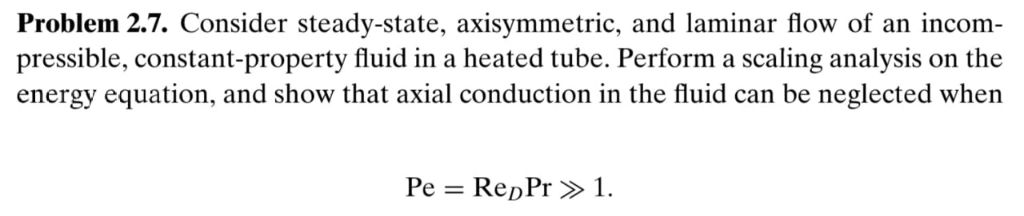 Problem 2.7. Consider steady-state, axisymmetric, and laminar flow of an incom-
pressible, constant-property fluid in a heated tube. Perform a scaling analysis on the
energy equation, and show that axial conduction in the fluid can be neglected when
Pe = RepPr > 1.
This is AI generated Response.
Asked by: manish kumar
Created at: 2025-09-30 20:16:30
Asked by: manish kumar
Created at: 2025-09-30 20:16:30
Final Answer:
Rendered
Raw Text
Did you like this answer?
## Step-by-Step Solution
Let's break down the problem and perform the required scaling analysis.
---
### **1. Write the Energy Equation**
For steady-state, axisymmetric, laminar flow of an incompressible, constant-property fluid in a tube, the energy equation (in cylindrical coordinates) is:
\[
\rho c_p \left( u \frac{\partial T}{\partial z} + v \frac{\partial T}{\partial r} \right) = k \left( \frac{\partial^2 T}{\partial z^2} + \frac{1}{r} \frac{\partial }{\partial r} \left( r \frac{\partial T}{\partial r} \right) \right)
\]
where:
- \( u \) = axial velocity,
- \( v \) = radial velocity (usually much smaller or zero for fully developed flow),
- \( T \) = temperature,
- \( z \) = axial coordinate,
- \( r \) = radial coordinate,
- \( \rho \) = density,
- \( c_p \) = specific heat,
- \( k \) = thermal conductivity.
For fully developed flow, \( v \approx \), so the equation simplifies to:
\[
\rho c_p u \frac{\partial T}{\partial z} = k \left( \frac{\partial^2 T}{\partial z^2} + \frac{1}{r} \frac{\partial }{\partial r} \left( r \frac{\partial T}{\partial r} \right) \right)
\]
---
### **2. Identify Terms to Compare**
We want to compare:
- **Axial convection**: \( \rho c_p u \frac{\partial T}{\partial z} \)
- **Axial conduction**: \( k \frac{\partial^2 T}{\partial z^2} \)
- **Radial conduction**: \( k \frac{1}{r} \frac{\partial}{\partial r} \left( r \frac{\partial T}{\partial r} \right) \)
The question asks when we can **neglect axial conduction** compared to axial convection.
---
### **3. Scaling Analysis**
Let:
- Tube diameter = \( D \)
- Tube length = \( L \)
- Typical velocity = \( U \)
- Typical temperature difference = \( \Delta T \)
**Order-of-magnitude estimates:**
- \( \frac{\partial T}{\partial z} \sim \frac{\Delta T}{L} \)
- \( \frac{\partial^2 T}{\partial z^2} \sim \frac{\Delta T}{L^2} \)
- \( \frac{\partial^2 T}{\partial r^2} \sim \frac{\Delta T}{D^2} \)
**Compare the two terms:**
- Axial convection: \( \rho c_p U \frac{\Delta T}{L} \)
- Axial conduction: \( k \frac{\Delta T}{L^2} \)
**Ratio:**
\[
\text{Ratio} = \frac{\text{Axial conduction}}{\text{Axial convection}}
= \frac{k \frac{\Delta T}{L^2}}{\rho c_p U \frac{\Delta T}{L}}
= \frac{k}{\rho c_p U L}
= \frac{1}{Pe}
\]
where the **Péclet number** is:
\[
Pe = \frac{\rho c_p U L}{k} = Re \cdot Pr
\]
- **Reynolds number:** \( Re = \frac{\rho U D}{\mu} \)
- **Prandtl number:** \( Pr = \frac{\mu c_p}{k} \)
If \( L \sim D \) (typical for tubes), then \( Pe = Re \cdot Pr \).
---
### **4. Final Condition**
- **Axial conduction can be neglected when** \( Pe \gg 1 \), i.e., when **convection dominates over axial conduction**.
### **5. Answer**
\[
\boxed{
\text{Axial conduction can be neglected in the energy equation when } Pe = Re \cdot Pr \gg 1.
}
\]
---
#### **Summary Table**
| Term | Magnitude | Scaling Ratio |
|---------------------|----------------------------------|------------------------|
| Axial Convection | \( \rho c_p U \frac{\Delta T}{L} \) | \( \frac{1}{Pe} \) |
| Axial Conduction | \( k \frac{\Delta T}{L^2} \) | |
> **Neglect axial conduction if** \( Pe = Re \cdot Pr \gg 1 \).
---
Let me know if you want to see more about the physical meaning, or how this relates to real engineering applications!
📢 Instructions:
- Ask anything relatd to above question only.
- For new Question goto :