 VIPSolutions
Act like a helpful tutor and exlain me : Give step-by-step solution with explanation and final answer:4- The robot arm is elevating and extending simultaneously. At a given instant, 8 = 30°, 6 = 10 deg/s = constant, / = 0.5 m, [=0.2m/s, and [= - 0.3 m / s2. Compute the magnitudes of the velocity v and acceleration a of the gripped part P. In addition, express v and a in terms of the unit vectors i and j. I oN | \ P | " [:] A
Question:
Act like a helpful tutor and exlain me :
Give step-by-step solution with explanation and final answer: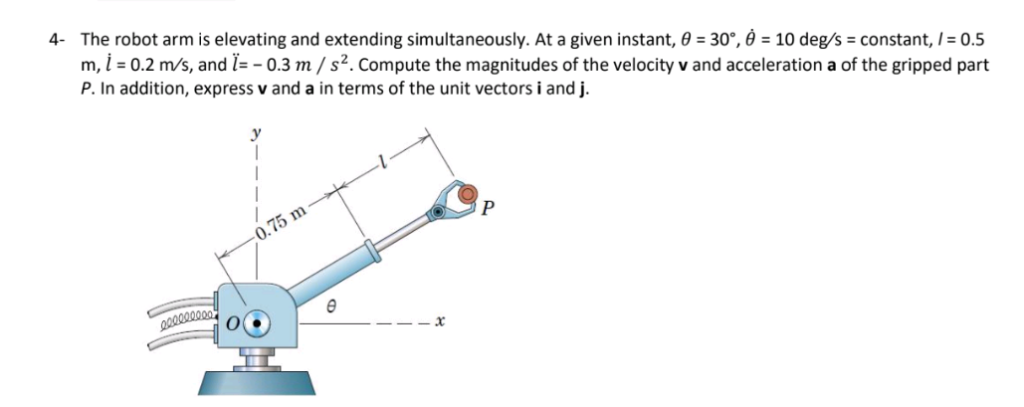 4- The robot arm is elevating and extending simultaneously. At a given instant, 8 = 30°, 6 = 10 deg/s = constant, / = 0.5
m, [=0.2m/s, and [= - 0.3 m / s2. Compute the magnitudes of the velocity v and acceleration a of the gripped part
P. In addition, express v and a in terms of the unit vectors i and j.
I oN
| \
P
|
"
[:]
A
This is AI generated Response.
Asked by: manish kumar
Created at: 2025-09-30 16:39:11
Asked by: manish kumar
Created at: 2025-09-30 16:39:11
Final Answer:
Rendered
Raw Text
Did you like this answer?
Let's solve the problem **step-step**.
---
## **Given**
- \(\theta = 30^\circ\)
- \(\dot{\theta} = 10^\circ/\text{s} = .1745\, \text{rad/s}\) *(convert degrees to radians: \(\frac{10 \pi}{180}\))*
- \(l = .5\, \text{m}\)
- \(\dot{l} = .2\, \text{m/s}\)
- \(\ddot{l} = -.3\, \text{m/s}^2\)
- \(\ddot{\theta} = \) (since \(\dot{\theta}\) is constant)
---
## **1. Position Vector of Point P**
Relative to the origin \(O\):
\[
\vec{r}_P = l \cos \theta\, \mathbf{i} + l \sin \theta\, \mathbf{j}
\]
---
## **2. Velocity of P**
Differentiate \(\vec{r}_P\) with respect to time:
\[
\vec{v}_P = \frac{d\vec{r}_P}{dt}
\]
\[
\frac{d}{dt}(l \cos\theta) = \dot{l}\cos\theta - l\sin\theta\,\dot{\theta}
\]
\[
\frac{d}{dt}(l \sin\theta) = \dot{l}\sin\theta + l\cos\theta\,\dot{\theta}
\]
So,
\[
\boxed{
\vec{v}_P = [\dot{l}\cos\theta - l\sin\theta\,\dot{\theta}]\, \mathbf{i} + [\dot{l}\sin\theta + l\cos\theta\,\dot{\theta}]\, \mathbf{j}
}
\]
---
### **Plug in the Values**
- \(\cos 30^\circ = .866\)
- \(\sin 30^\circ = .5\)
- \(l = .5\)
- \(\dot{l} = .2\)
- \(\dot{\theta} = .1745\)
#### **i-component:**
\[
\dot{l}\cos\theta - l\sin\theta\,\dot{\theta} = (.2)(.866) - (.5)(.5)(.1745)
= .1732 - .0436
= .1296
\]
#### **j-component:**
\[
\dot{l}\sin\theta + l\cos\theta\,\dot{\theta} = (.2)(.5) + (.5)(.866)(.1745)
= .1 + .0755
= .1755
\]
\[
\boxed{
\vec{v}_P = .1296\, \mathbf{i} + .1755\, \mathbf{j}\ \text{m/s}
}
\]
#### **Magnitude of \(\vec{v}_P\):**
\[
|\vec{v}_P| = \sqrt{(.1296)^2 + (.1755)^2}
= \sqrt{.0168 + .0308}
= \sqrt{.0476}
= .218\ \text{m/s}
\]
---
## **3. Acceleration of P**
Differentiate \(\vec{v}_P\) with respect to time:
\[
\vec{a}_P = \frac{d\vec{v}_P}{dt}
\]
Calculate each term (using product and chain rules):
### **i-component:**
\[
\frac{d}{dt}[\dot{l}\cos\theta - l\sin\theta\,\dot{\theta}]
\]
Expand:
- \(\frac{d}{dt}[\dot{l}\cos\theta] = \ddot{l}\cos\theta - \dot{l}\sin\theta\,\dot{\theta}\)
- \(\frac{d}{dt}[l\sin\theta\,\dot{\theta}] = \dot{l}\sin\theta\,\dot{\theta} + l\cos\theta\,\dot{\theta}^2\) (*since \(\ddot{\theta} = \)*)
So,
\[
a_{P,x} = \ddot{l}\cos\theta - \dot{l}\sin\theta\,\dot{\theta} - \left[ \dot{l}\sin\theta\,\dot{\theta} + l\cos\theta\,\dot{\theta}^2 \right]
\]
\[
= \ddot{l}\cos\theta - 2\dot{l}\sin\theta\,\dot{\theta} - l\cos\theta\,\dot{\theta}^2
\]
### **j-component:**
\[
\frac{d}{dt}[\dot{l}\sin\theta + l\cos\theta\,\dot{\theta}]
\]
Expand:
- \(\frac{d}{dt}[\dot{l}\sin\theta] = \ddot{l}\sin\theta + \dot{l}\cos\theta\,\dot{\theta}\)
- \(\frac{d}{dt}[l\cos\theta\,\dot{\theta}] = \dot{l}\cos\theta\,\dot{\theta} - l\sin\theta\,\dot{\theta}^2\)
So,
\[
a_{P,y} = \ddot{l}\sin\theta + 2\dot{l}\cos\theta\,\dot{\theta} - l\sin\theta\,\dot{\theta}^2
\]
---
### **Plug in the Values**
\[
\ddot{l} = -.3,\, \cos\theta = .866,\, \sin\theta = .5,\, \dot{l} = .2,\, \dot{\theta} = .1745,\, l = .5
\]
#### **i-component:**
\[
a_{P,x} = (-.3)(.866) - 2(.2)(.5)(.1745) - .5(.866)(.1745^2)
\]
\[
= -.2598 - .0349 - .0132
\]
\[
= -.3079
\]
#### **j-component:**
\[
a_{P,y} = (-.3)(.5) + 2(.2)(.866)(.1745) - .5(.5)(.1745^2)
\]
\[
= -.15 + .0604 - .0076
\]
\[
= -.0972
\]
\[
\boxed{
\vec{a}_P = -.3079\, \mathbf{i} - .0972\, \mathbf{j}\ \text{m/s}^2
}
\]
#### **Magnitude of \(\vec{a}_P\):**
\[
|\vec{a}_P| = \sqrt{(-.3079)^2 + (-.0972)^2}
= \sqrt{.0948 + .00945}
= \sqrt{.1042}
= .323\ \text{m/s}^2
\]
---
## **Final Answers**
### **(a) Velocity (in unit vectors):**
\[
\boxed{
\vec{v}_P = .1296\, \mathbf{i} + .1755\, \mathbf{j}\ \text{m/s}
}
\]
### **(b) Velocity Magnitude:**
\[
\boxed{
|\vec{v}_P| = .218\ \text{m/s}
}
\]
### **(c) Acceleration (in unit vectors):**
\[
\boxed{
\vec{a}_P = -.3079\, \mathbf{i} - .0972\, \mathbf{j}\ \text{m/s}^2
}
\]
### **(d) Acceleration Magnitude:**
\[
\boxed{
|\vec{a}_P| = .323\ \text{m/s}^2
}
\]
---
**Let me know if you need clarification on any step!**
📢 Instructions:
- Ask anything relatd to above question only.
- For new Question goto :