 VIPSolutions
Act like a helpful tutor and exlain me : Give step-by-step solution with explanation and final answer:12.4 (a) For the solidification of nickel, calculate the critical radius r* and the activations free energy AG* if nucleation is homogeneous. Values for the latent heat of fusion and« surface free energy are —2.53 x 10⁹ J/m3 and 0.255 J/m2, respectively. Use the< supercooling value found in Table 12.1. (b) Now calculate the number of atoms found in a nucleus of critical size. Assume a lattice parameter of 0.360 nm for solid nickel at its melting temperature.< @ = Table 12.1 Degree of Supercooling AT (Homogeneous Nucleation) for Several Metals< a I EC | meer wm semen ar | EL I GR es wm EC I J EL IS IE I JN ewe ow | wee [we
Question:
Act like a helpful tutor and exlain me :
Give step-by-step solution with explanation and final answer: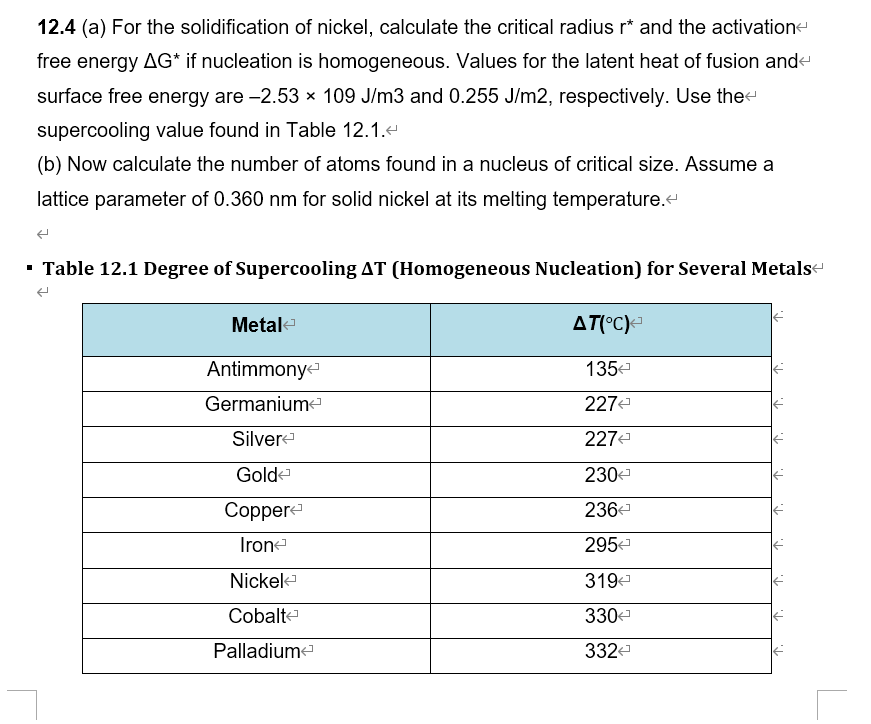 12.4 (a) For the solidification of nickel, calculate the critical radius r* and the activations
free energy AG* if nucleation is homogeneous. Values for the latent heat of fusion and«
surface free energy are —2.53 x 10⁹ J/m3 and 0.255 J/m2, respectively. Use the<
supercooling value found in Table 12.1.
(b) Now calculate the number of atoms found in a nucleus of critical size. Assume a
lattice parameter of 0.360 nm for solid nickel at its melting temperature.<
@
= Table 12.1 Degree of Supercooling AT (Homogeneous Nucleation) for Several Metals<
a
I EC |
meer wm
semen ar |
EL I GR
es wm
EC I J
EL IS
IE I JN
ewe ow |
wee [we
This is AI generated Response.
Asked by: manish kumar
Created at: 2025-09-30 13:14:21
Asked by: manish kumar
Created at: 2025-09-30 13:14:21
Final Answer:
Rendered
Raw Text
Did you like this answer?
Let's break the problem into parts and solve each step-by-step.
---
## **Part (a): Critical Radius \( r^* \) and Activation Free Energy \( \Delta G^* \)**
### **Given Data**
- Latent heat of fusion, \( \Delta H_f = -2.53 \times 10^9 \) J/m³
- Surface free energy, \( \gamma = .255 \) J/m²
- Degree of supercooling for Nickel, \( \Delta T = 319^\circ C \) (from table)
- Melting temperature of Nickel, \( T_m = 1455^\circ C = 1728 \) K (standard value for Ni)
### **Formulas**
#### **Critical Radius (\( r^* \)):**
\[
r^* = \frac{2 \gamma}{|\Delta G_v|}
\]
Where \( \Delta G_v \) is the free energy change per unit volume:
\[
|\Delta G_v| = \frac{\Delta H_f \Delta T}{T_m}
\]
#### **Activation Free Energy (\( \Delta G^* \)):**
\[
\Delta G^* = \frac{16 \pi \gamma^3}{3 (\Delta G_v)^2}
\]
---
### **Step 1: Calculate \( |\Delta G_v| \)**
\[
|\Delta G_v| = \frac{2.53 \times 10^9 \times 319}{1728}
\]
\[
|\Delta G_v| = \frac{2.53 \times 10^9 \times 319}{1728}
\]
\[
= \frac{807.07 \times 10^9}{1728}
\]
\[
= 4.67 \times 10^8 \text{ J/m}^3
\]
---
### **Step 2: Calculate Critical Radius \( r^* \)**
\[
r^* = \frac{2 \times .255}{4.67 \times 10^8}
\]
\[
= \frac{.51}{4.67 \times 10^8}
\]
\[
= 1.09 \times 10^{-9} \text{ m} = 1.09 \text{ nm}
\]
---
### **Step 3: Calculate Activation Free Energy \( \Delta G^* \)**
\[
\Delta G^* = \frac{16 \pi (.255)^3}{3 \times (4.67 \times 10^8)^2}
\]
\[
= \frac{16 \times 3.1416 \times .0166}{3 \times 2.18 \times 10^{17}}
\]
\[
= \frac{.834}{6.54 \times 10^{17}}
\]
\[
= 1.28 \times 10^{-18} \text{ J}
\]
---
## **Part (b): Number of Atoms in the Critical Nucleus**
### **Given Data**
- Lattice parameter \( a = .360 \) nm = \( .360 \times 10^{-9} \) m
- Assume fcc structure for nickel (\( 4 \) atoms per unit cell)
### **Step 1: Volume of Critical Nucleus**
\[
V^* = \frac{4}{3} \pi (r^*)^3
\]
\[
V^* = \frac{4}{3} \pi (1.09 \times 10^{-9})^3
\]
\[
= \frac{4}{3} \pi \times 1.30 \times 10^{-27}
\]
\[
= 5.44 \times 10^{-27} \text{ m}^3
\]
### **Step 2: Volume of Unit Cell**
\[
V_{cell} = a^3 = (.36 \times 10^{-9})^3 = 4.66 \times 10^{-29} \text{ m}^3
\]
### **Step 3: Number of Unit Cells in Critical Nucleus**
\[
\text{Number of unit cells} = \frac{V^*}{V_{cell}} = \frac{5.44 \times 10^{-27}}{4.66 \times 10^{-29}} = 116.7
\]
### **Step 4: Number of Atoms**
\[
\text{Number of atoms} = 116.7 \times 4 \approx 467
\]
---
## **Final Answers**
### **(a)**
- **Critical radius, \( r^* \) = 1.09 nm**
- **Activation free energy, \( \Delta G^* = 1.28 \times 10^{-18} \) J**
### **(b)**
- **Number of atoms in critical nucleus ≈ 467**
---
Let me know if you need a more detailed breakdown or clarification!
📢 Instructions:
- Ask anything relatd to above question only.
- For new Question goto :