 VIPSolutions
Act like a helpful tutor and exlain me : Give step-by-step solution with explanation and final answer:Skip Extension Tip: Double click to open in new tab Skip Extension Tip: Double click to open in new tab
Question:
Act like a helpful tutor and exlain me :
Give step-by-step solution with explanation and final answer: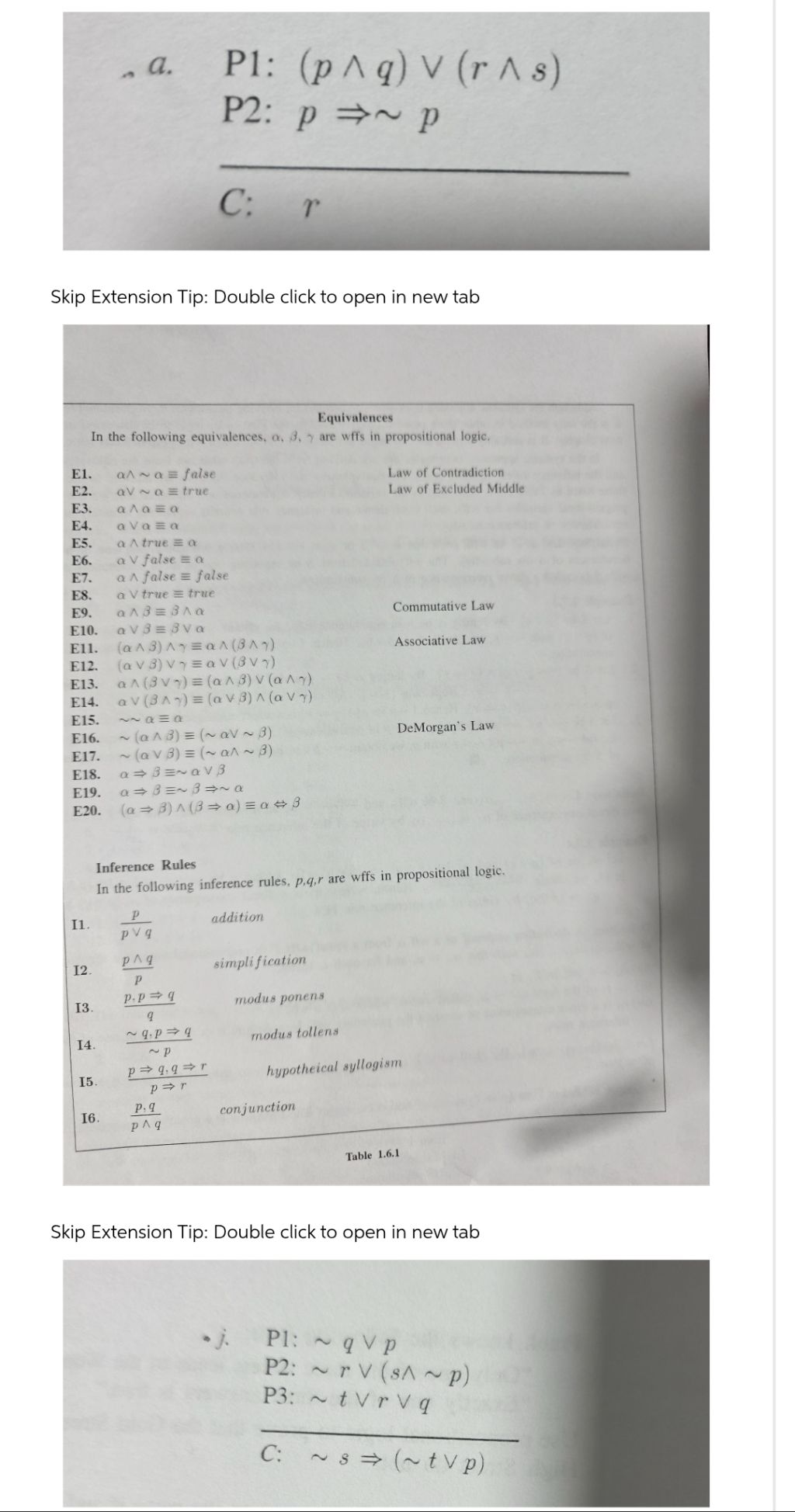 Skip Extension Tip: Double click to open in new tab
This is AI generated Response.
Asked by: 3quin0xx
Created at: 2025-09-28 13:09:14
Asked by: 3quin0xx
Created at: 2025-09-28 13:09:14
Final Answer:
Rendered
Raw Text
Did you like this answer?
Let's solve **problem a** step by step using the equivalence and rules from the.
---
##Given**
-P1:**((p \ q) \lor (r \land s)\)
- **P2:** \(p \Rightarrow \sim p\)
- **Conclusion (C):** \(r\)
---
## **Step-by-Step Solution**
#### **Step 1: Analyze P2 \(p \Rightarrow \sim p\)**
- \(p \Rightarrow \sim p\) is only true if \(p\) is false.
- Let's see why:
- If \(p\) is true, then \(\sim p\) is false, so \(p \Rightarrow \sim p\) is false.
- If \(p\) is false, then \(\sim p\) is true, so \(p \Rightarrow \sim p\) is true.
Thus, from P2, we can infer:
- \(\sim p\) must be true.
---
#### **Step 2: Substitute \(\sim p\) into P1**
Recall:
- **P1:** \((p \land q) \lor (r \land s)\)
Since \(p\) is false (\(\sim p\) is true):
- \((p \land q)\) is false (because \(p\) is false).
- Therefore, P1 simplifies to:
- \(\text{false} \lor (r \land s)\)
- \((r \land s)\)
So, **P1 becomes:** \(r \land s\)
---
#### **Step 3: What can we infer from \(r \land s\)?**
From the simplification rule (I2):
- From \(r \land s\), we can infer \(r\).
---
## **Final Answer**
\[
\boxed{r}
\]
---
### **Summary Table**
| Step | Statement | Reason/Rule |
|------|-----------|-------------|
| 1 | \(p \Rightarrow \sim p\) | P2 |
| 2 | \(\sim p\) | Only possibility for P2 to be true |
| 3 | \((p \land q) \lor (r \land s)\) | P1 |
| 4 | \(r \land s\) | Since \(p\) is false (\(\sim p\) is true) |
| 5 | \(r\) | From \(r \land s\) (Simplification, I2) |
---
### **Explanation**
- P2 forces \(p\) to be false.
- This makes the first part of P1 (\(p \land q\)) false, so only \((r \land s)\) remains.
- From \(r \land s\), we can use the simplification rule to get \(r\).
---
**If you have questions about any step, let me know!**
Question:
can someone please solve these with formal proof and only the given rules, please indicate i n each line what line are you using and what rule
This is AI generated Response.
Asked by: 3quin0xx
Created at: 2025-09-28 13:10:58
Asked by: 3quin0xx
Created at: 2025-09-28 13:10:58
Final Answer:
Rendered
Raw Text
Did you like this answer?
## Formal Proof Using Given Rules
### **Given:**
- **P1:** \((p \land q) \lor (r \land s)\)
- **P2:** \(p \Rightarrow \sim p\)
- **Conclusion (C):** \(r\)
---
### **Step-by-Step Formal Proof**
#### **Step 1: Analyze P2**
- **Line 1:** \(p \Rightarrow \sim p\) (P2)
- **Rule:** Given premise
**Conclusion:** \(p\) must be false.
#### **Step 2: Infer \(\sim p\)**
- **Line 2:** \(\sim p\)
- **Rule:** Modus Tollens on Line 1
#### **Step 3: Substitute \(\sim p\) into P1**
- **Line 3:** \((p \land q) \lor (r \land s)\) (P1)
- **Rule:** Given premise
- **Line 4:** \(p \land q\) is false
- **Rule:** By definition, if \(p\) is false, \(p \land q\) is false.
- **Line 5:** \((p \land q) \lor (r \land s) \equiv \text{false} \lor (r \land s)\) (Substitution from Line 2)
- **Rule:** Substitution based on the evaluation of \(p\)
- **Line 6:** \(r \land s\)
- **Rule:** Identity Law (false or A is A)
#### **Step 4: Simplify \(r \land s\)**
- **Line 7:** \(r\)
- **Rule:** Simplification (from \(r \land s\))
---
### **Final Answer**
\[
\boxed{r}
\]
### **Summary Table**
| Line | Statement | Reason/Rule |
|------|----------------------------------|--------------------------------------|
| 1 | \(p \Rightarrow \sim p\) | P2 (Given premise) |
| 2 | \(\sim p\) | Modus Tollens on Line 1 |
| 3 | \((p \land q) \lor (r \land s)\)| P1 (Given premise) |
| 4 | \(p \land q\) is false | Definition of conjunction |
| 5 | \((p \land q) \lor (r \land s) \equiv \text{false} \lor (r \land s)\)| Substitution from Line 2 |
| 6 | \(r \land s\) | Identity Law (false or A is A) |
| 7 | \(r\) | Simplification (from \(r \land s\)) |
---
### **Explanation of Proof Steps**
1. **P2** establishes that \(p\) must be false.
2. This leads to the first part of **P1** being false, allowing us to focus on \(r \land s\).
3. From \(r \land s\), we can conclude \(r\) using the simplification rule.
If you have any questions or need further clarification on any step, feel free to ask!
📢 Instructions:
- Ask anything relatd to above question only.
- For new Question goto :