 VIPSolutions
Act like a helpful tutor and exlain me : Give step-by-step solution with explanation and final answer:Suppose that the scale factor has a power-law behaviour as function of time, a(t) = aot", with ag, n constants, and n < 1. Compute the value of the particle horizon. Before starting, notice that in this case the Hubble parameter results H(t) = a/a = n/t. Then, we compute the integral giving Ry, (t) Ba t gf dt dt t Ry(t) = alt) / — =" 7 - = — (2.44) 0 a(t) oh tt" 1—n n 1 _ 2.45 1—n H(t) ( ) So for power-law expansion, the particle horizon is inversely proportional to the Hubble parameter, which then controls the size of the observable universe.
Question:
Act like a helpful tutor and exlain me :
Give step-by-step solution with explanation and final answer: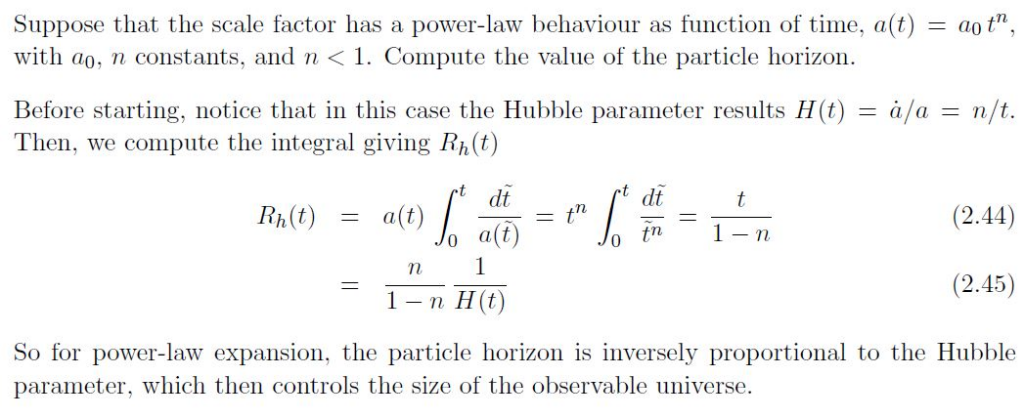 Suppose that the scale factor has a power-law behaviour as function of time, a(t) = aot",
with ag, n constants, and n < 1. Compute the value of the particle horizon.
Before starting, notice that in this case the Hubble parameter results H(t) = a/a = n/t.
Then, we compute the integral giving Ry, (t)
Ba t gf
dt dt t
Ry(t) = alt) / — =" 7 - = — (2.44)
0 a(t) oh tt" 1—n
n 1
_ 2.45
1—n H(t) ( )
So for power-law expansion, the particle horizon is inversely proportional to the Hubble
parameter, which then controls the size of the observable universe.
This is AI generated Response.
Asked by: Sathya
Created at: 2025-09-27 21:08:49
Asked by: Sathya
Created at: 2025-09-27 21:08:49
Final Answer:
Rendered
Raw Text
Did you like this answer?
Let's break down the solution step-by-step as a helpful tutor:
---
## **Step 1: Write the Scale Factor**
The scale factor is given as:
\[
a(t) = a_ t^n
\]
where \(a_\) and \(n\) are constants, and \(n < 1\).
---
## **Step 2: Calculate the Hubble Parameter**
The Hubble parameter is defined as:
\[
H(t) = \frac{\dot{a}}{a}
\]
Calculate \(\dot{a}\):
\[
\dot{a}(t) = \frac{d}{dt}(a_ t^n) = a_ n t^{n-1}
\]
So,
\[
H(t) = \frac{a_ n t^{n-1}}{a_ t^n} = \frac{n}{t}
\]
---
## **Step 3: Write the Particle Horizon Formula**
The comoving particle horizon is:
\[
R_h(t) = a(t) \int_{}^{t} \frac{d\tilde{t}}{a(\tilde{t})}
\]
---
## **Step 4: Substitute the Scale Factor**
\[
R_h(t) = a_ t^n \int_{}^{t} \frac{d\tilde{t}}{a_ \tilde{t}^n}
= t^n \int_{}^{t} \tilde{t}^{-n} d\tilde{t}
\]
---
## **Step 5: Integrate**
\[
\int_{}^{t} \tilde{t}^{-n} d\tilde{t} = \left[ \frac{\tilde{t}^{1-n}}{1-n} \right]_{}^{t}
= \frac{t^{1-n}}{1-n} -
\]
(Because \(n < 1\), the lower limit at does not diverge.)
---
## **Step 6: Combine Results**
\[
R_h(t) = t^n \cdot \frac{t^{1-n}}{1-n} = \frac{t}{1-n}
\]
---
## **Step 7: Final Answer**
\[
\boxed{R_h(t) = \frac{t}{1-n}}
\]
---
## **Explanation**
- The particle horizon \(R_h(t)\) tells us the maximum distance from which particles could have traveled to the observer in the age of the universe at time \(t\).
- For power-law expansion (\(a(t) \propto t^n\)), the horizon grows as \(t/(1-n)\).
- The result is inversely proportional to the Hubble parameter, \(H(t)\), since \(H(t) = n/t\).
---
**Summary:**
The value of the particle horizon for a scale factor \(a(t) = a_ t^n\) is \(\boxed{R_h(t) = \frac{t}{1-n}}\), assuming \(n < 1\).
📢 Instructions:
- Ask anything relatd to above question only.
- For new Question goto :