 VIPSolutions
Act like a helpful tutor and exlain me : Give step-by-step solution with explanation and final answer:explain in detailQuestion 1 120) 1. An aluminium spacer used in a machine frame is being assessed for elastic deformation under service conditions. During a proof test, the bar is subjected to significant tensile forces, and the engineer must estimate its dimensional changes to ensure proper fit and maintain clearances with adjacent components. Determine the dimensional change of an aluminium bar that is 1m long, 95mm wide, and 180mm thick when subjected to a unidirectional stretch of 750 kN along its length and thickness direction. Assume that E
Question:
Act like a helpful tutor and exlain me :
Give step-by-step solution with explanation and final answer:explain in detail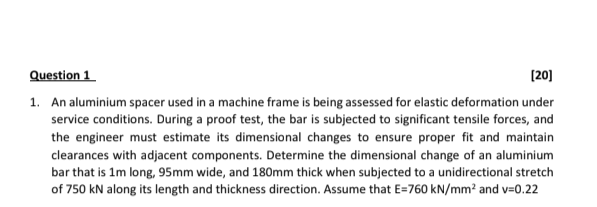 Question 1 120)
1. An aluminium spacer used in a machine frame is being assessed for elastic deformation under
service conditions. During a proof test, the bar is subjected to significant tensile forces, and
the engineer must estimate its dimensional changes to ensure proper fit and maintain
clearances with adjacent components. Determine the dimensional change of an aluminium
bar that is 1m long, 95mm wide, and 180mm thick when subjected to a unidirectional stretch
of 750 kN along its length and thickness direction. Assume that E
This is AI generated Response.
Asked by: manish kumar
Created at: 2025-09-26 11:33:27
Asked by: manish kumar
Created at: 2025-09-26 11:33:27
Final Answer:
Rendered
Raw Text
Did you like this answer?
# Step-by-Step Solution
Let's break down the problem and solve it step by step.
---
## **Given Data**
- **Length (\( L \)):** 1 m = 100 mm
- **Width (\( b \)):** 95 mm
- **Thickness (\( t \)):** 180 mm
- **Applied Force (\( F \)):** 750 kN = 750,000 N
- **Young's Modulus (\( E \)):** 760 kN/mm² = 760,000 N/mm²
- **Poisson's Ratio (\( \nu \)):** .22
The force is applied **along the length and thickness**.
---
## **1. Calculate Cross-Sectional Area**
Since force is applied along the length,
- **Area normal to force:** \( = \text{width} \times \text{thickness} \)
- \( A = b \times t = 95\, \text{mm} \times 180\, \text{mm} = 17,100\, \text{mm}^2 \)
---
## **2. Calculate Stress (\( \sigma \))**
\[
\sigma = \frac{F}{A}
\]
\[
\sigma = \frac{750,000\, \text{N}}{17,100\, \text{mm}^2}
\]
Since \(1\, \text{N} = .001\, \text{kN}\):
\[
\sigma = \frac{750\, \text{kN}}{17,100\, \text{mm}^2}
\]
\[
\sigma = .04386\, \text{kN/mm}^2
\]
---
## **3. Calculate Longitudinal Strain (\( \epsilon \))**
\[
\epsilon = \frac{\sigma}{E}
\]
\[
\epsilon = \frac{.04386\, \text{kN/mm}^2}{760\, \text{kN/mm}^2}
\]
\[
\epsilon = 5.77 \times 10^{-5}
\]
---
## **4. Calculate Change in Length (\( \Delta L \))**
\[
\Delta L = \epsilon \times L
\]
\[
\Delta L = 5.77 \times 10^{-5} \times 100\, \text{mm}
\]
\[
\Delta L = .0577\, \text{mm}
\]
---
## **5. Calculate Lateral (Width & Thickness) Strain using Poisson's Ratio**
\[
\text{Lateral strain} = -\nu \times \epsilon
\]
\[
\text{Lateral strain} = -.22 \times 5.77 \times 10^{-5} = -1.27 \times 10^{-5}
\]
---
### **Change in Width (\( \Delta b \))**
\[
\Delta b = \text{lateral strain} \times b = -1.27 \times 10^{-5} \times 95\, \text{mm} = -.0012\, \text{mm}
\]
---
### **Change in Thickness (\( \Delta t \))**
\[
\Delta t = \text{lateral strain} \times t = -1.27 \times 10^{-5} \times 180\, \text{mm} = -.0023\, \text{mm}
\]
---
## **Summary Table**
| Dimension | Initial Value (mm) | Change (mm) | Final Value (mm) |
|-----------|-------------------|---------------|------------------|
| Length | 100 | +.0577 | 100.0577 |
| Width | 95 | -.0012 | 94.9988 |
| Thickness | 180 | -.0023 | 179.9977 |
---
## **Final Answers**
**1. Change in Length:**
\[
\Delta L = .0577\, \text{mm}
\]
**2. Change in Width:**
\[
\Delta b = -.0012\, \text{mm}
\]
**3. Change in Thickness:**
\[
\Delta t = -.0023\, \text{mm}
\]
---
### **Explanation**
- The bar **elongates** slightly in the direction of the applied force (length increases).
- It **contracts** slightly in the transverse directions (width and thickness decrease) due to Poisson's effect.
- These changes are small but important for high-precision engineering.
Let me know if you need clarification on any step!
📢 Instructions:
- Ask anything relatd to above question only.
- For new Question goto :