 VIPSolutions
Act like a helpful tutor and exlain me : Give step-by-step solution with explanation and final answer:Which of the following orbitals are ungerade? i) ii) iii) sans cars Sizzseaiiieoa imi (Rita ail =RER GHEY . Hak tana 1 1%) HERE msl iv) Vv) vi) ii, iii, and vi i, ii, iii, and v 0 i,iv,and v : © i, ii, and iv
Question:
Act like a helpful tutor and exlain me :
Give step-by-step solution with explanation and final answer: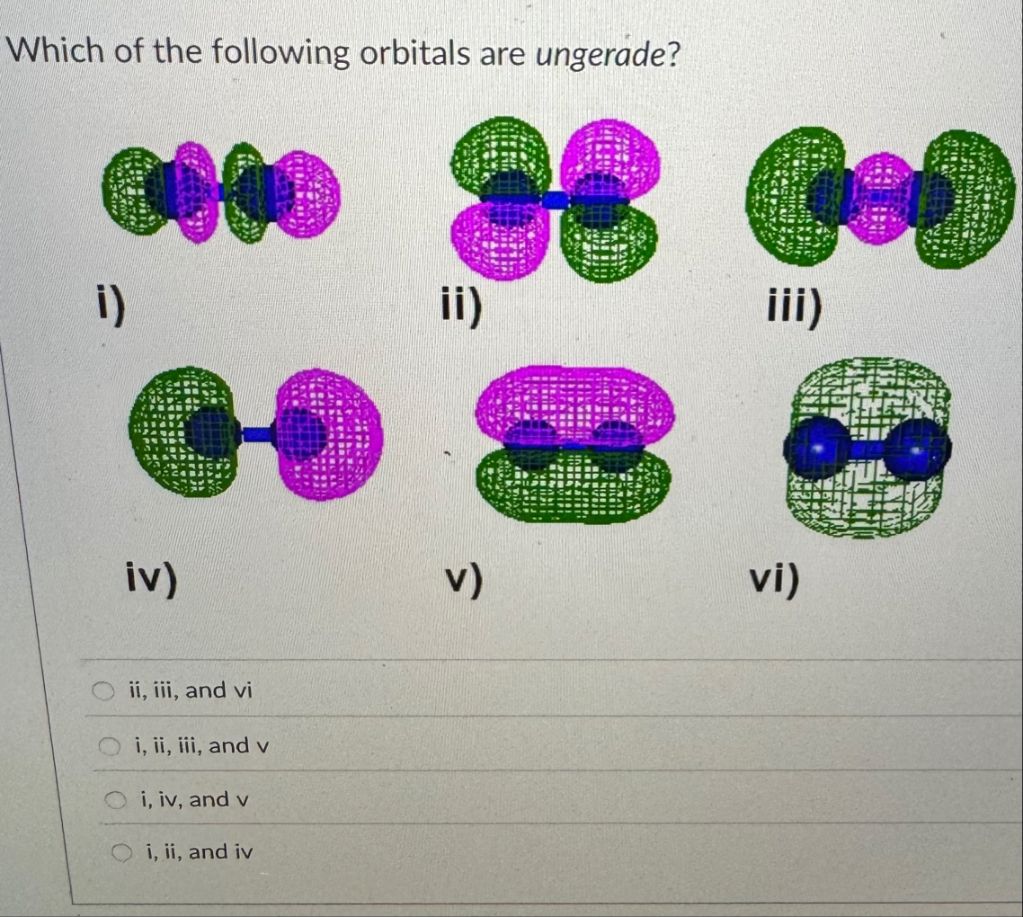 Which of the following orbitals are ungerade?
i) ii) iii)
sans cars Sizzseaiiieoa imi
(Rita ail =RER
GHEY . Hak tana 1 1%)
HERE msl
iv) Vv) vi)
ii, iii, and vi
i, ii, iii, and v
0 i,iv,and v :
© i, ii, and iv
This is AI generated Response.
Asked by: 3quin0xx
Created at: 2025-09-26 08:52:44
Asked by: 3quin0xx
Created at: 2025-09-26 08:52:44
Final Answer:
Rendered
Raw Text
Did you like this answer?
## Step-by-Step Solution
### 1. **Understanding "Ungerade" Orbitals**
- **Ungerade (u)**: An orbital is called **ungerade** if, upon inversion through the center of symmetry, its wavefunction changes sign (i.e., it is antisymmetric with respect to inversion).
- **Gerade (g)**: An orbital is called **gerade** if, upon inversion, its wavefunction does **not** change sign (i.e., it is symmetric).
### 2. **How to Identify**
- **Inversion**: Imagine a point at the center (origin). Every part of the orbital is mapped to the opposite side through the origin.
- If colors (representing phase/sign) are swapped after inversion, it is **ungerade**.
- If colors remain the same, it is **gerade**.
### 3. **Analyzing Each Orbital**
#### **i)**
- The lobes switch colors (green ↔ magenta) when inverted.
- **Ungerade**
#### **ii)**
- The lobes switch colors (green ↔ magenta) upon inversion.
- **Ungerade**
#### **iii)**
- The lobes do **not** switch colors—the pattern remains the same on inversion.
- **Gerade**
#### **iv)**
- The two lobes are different colors, and these swap places upon inversion.
- **Ungerade**
#### **v)**
- The top and bottom lobes are different colors and switch upon inversion.
- **Ungerade**
#### **vi)**
- The orbital is symmetric (the colors don't change), so it is **gerade**.
### 4. **Final Answer**
**The ungerade orbitals are: i, ii, iv, and v.**
### 5. **Mark the Correct Option**
- The answer is: **i, ii, iv, and v**
---
## **Final Answer**
**Option: i, ii, iv, and v**
---
### **Summary Table**
| Orbital | Symmetry | Ungerade/Gerade |
|---------|---------------|-----------------|
| i | Changes sign | Ungerade |
| ii | Changes sign | Ungerade |
| iii | Symmetric | Gerade |
| iv | Changes sign | Ungerade |
| v | Changes sign | Ungerade |
| vi | Symmetric | Gerade |
---
**Let me know if you need an explanation of why a specific orbital is ungerade!**
📢 Instructions:
- Ask anything relatd to above question only.
- For new Question goto :