 VIPSolutions
Act like a helpful tutor and exlain me : Give step-by-step solution with explanation and final answer:Q3: The nucleation rate of MgSO4 in water, from crystallization experiments at different nucleation temperatures are given in the table. The solubility of MgSO4 in water at given nucleation temperature are also given. The initial concentration of solution is 70 wt%. Find the nucleation rate in the solution if cooled to 15C. the solubility of MgSO4 in water at 15C is 6wt%. Use graphical method. 9] Pe ——— ER ———— —— - me BO (number/ec.g) SN 30000 Nucleation Temperature Solubility (w1%s) 15000 — 25 10 ol —— 000 35 25 . | 00 45 40 A | EE 55 00 = J
Question:
Act like a helpful tutor and exlain me :
Give step-by-step solution with explanation and final answer: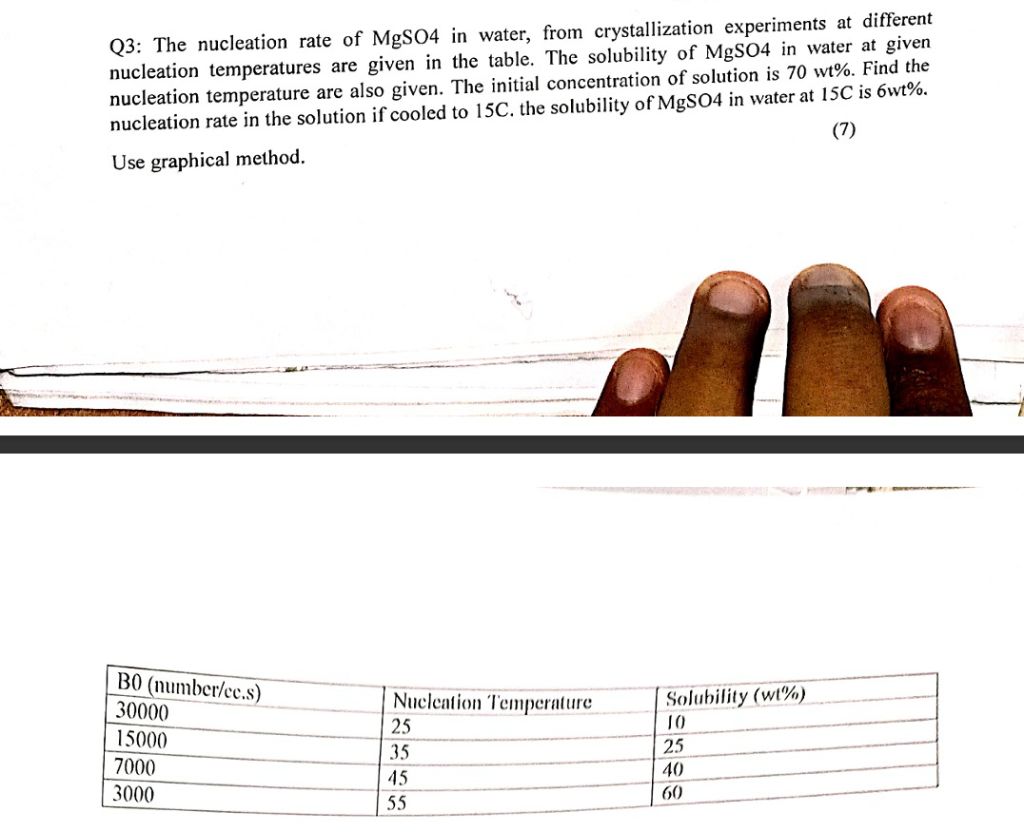 Q3: The nucleation rate of MgSO4 in water, from crystallization experiments at different
nucleation temperatures are given in the table. The solubility of MgSO4 in water at given
nucleation temperature are also given. The initial concentration of solution is 70 wt%. Find the
nucleation rate in the solution if cooled to 15C. the solubility of MgSO4 in water at 15C is 6wt%.
Use graphical method. 9]
Pe ——— ER ———— ——
- me
BO (number/ec.g) SN
30000 Nucleation Temperature Solubility (w1%s)
15000 — 25 10 ol
——
000 35 25 . |
00 45 40 A |
EE 55 00 = J
This is AI generated Response.
Asked by: 3quin0xx
Created at: 2025-09-26 08:27:52
Asked by: 3quin0xx
Created at: 2025-09-26 08:27:52
Final Answer:
Rendered
Raw Text
Did you like this answer?
# Step-by-Step Solution
Let's break down the problem and solve it step by step using **graphical method** as requested---
## **Given Data**
|₀ (number/cc.s) | Nucleation Temp (°C | Solubility (wt%)|------------------|----------------------|------------------|
| 30000 | 25 | 10 |
| 15000 | 35 | 25 |
| 700 | 45 | 40 |
| 300 | 55 | 60 |
- **Initial concentration of solution**: 70 wt%
- **Temperature to be cooled to**: 15°C
- **Solubility of MgSO₄ at 15°C**: 6 wt%
---
## **Step 1: Understanding Supersaturation**
Supersaturation, \( S \), can be defined as:
\[
S = \frac{C - C^*}{C^*}
\]
where:
- \( C \): Actual concentration
- \( C^* \): Solubility at given temperature
However, for graphical methods we often use just the values of concentration and solubility.
---
## **Step 2: Find Supersaturation for Each Table Entry**
For each nucleation temperature, calculate the supersaturation using the given solubility and a hypothetical concentration equal to the initial (but we'll use the solubility for plotting):
But for our case, the actual relevant supersaturation at 15°C is:
- \( C = 70 \) wt% (initial)
- \( C^* = 6 \) wt% (solubility at 15°C)
So, supersaturation at 15°C:
\[
S_{15^\circ C} = \frac{70 - 6}{6} = \frac{64}{6} \approx 10.67
\]
---
## **Step 3: Prepare Data for Graph**
For graphical method, we plot **nucleation rate (B₀) vs supersaturation**. For each table point:
\[
S = \frac{C - C^*}{C^*}
\]
But the table seems to assume that the solution is saturated at each temperature (i.e., concentration = solubility at that T).
So, let's extract the data points:
- At 25°C: C = 10, C* = 10, S =
- At 35°C: C = 25, C* = 25, S =
- At 45°C: C = 40, C* = 40, S =
- At 55°C: C = 60, C* = 60, S =
But for our case, the solution is cooled to **15°C** with a much higher concentration (70 wt%). So, we need to **extrapolate** using the pattern.
---
## **Step 4: Graphical Method (Extrapolation)**
Since we cannot draw here, let's describe how you would do it:
1. **On graph paper:**
- X-axis: Supersaturation (C - C*) or C
- Y-axis: Nucleation Rate B₀
2. **Plot the given points:**
- (10, 30000)
- (25, 15000)
- (40, 700)
- (60, 300)
3. **Extrapolate to C = 70 (for 15°C)**
---
## **Step 5: Interpolate/Extrapolate B₀ at C = 70**
We see that as concentration increases, B₀ decreases. Let's estimate the trend (it looks roughly linear on a semi-log plot).
Let's fit the data:
\[
\begin{align*}
\text{C (wt%)} & : 10, 25, 40, 60 \\
\text{B}_ & : 30000, 15000, 700, 300 \\
\end{align*}
\]
Let’s use logarithmic regression (since B₀ drops rapidly):
\[
\log_{10} B_ = a - bC
\]
Using two points to estimate \(a\) and \(b\):
- At C=10, B₀=30000: \(\log_{10} 30000 = 4.477\)
- At C=60, B₀=300: \(\log_{10} 300 = 3.477\)
So,
\[
4.477 = a - b \times 10 \\
3.477 = a - b \times 60
\]
Subtract:
\[
4.477 - 3.477 = b(60 - 10) \\
1. = 50b \\
b = .02
\]
Now solve for \(a\):
\[
4.477 = a - .02 \times 10 \implies a = 4.677
\]
So, the equation:
\[
\log_{10} B_ = 4.677 - .02 C
\]
Now substitute \(C = 70\):
\[
\log_{10} B_ = 4.677 - .02 \times 70 = 4.677 - 1.4 = 3.277
\]
\[
B_ = 10^{3.277} \approx 190 \text{ number/cc.s}
\]
---
## **Step 6: Final Answer**
**The nucleation rate of MgSO₄ in the solution cooled to 15°C (with 70 wt% concentration) is approximately:**
\[
\boxed{190 \ \text{number/cc.s}}
\]
---
### **Summary of Steps**
1. Find the supersaturation at 15°C.
2. Prepare a graph of nucleation rate vs. concentration or supersaturation.
3. Fit a trend (logarithmic regression).
4. Extrapolate to the desired concentration (70 wt%).
5. Calculate B₀.
---
**If you have graph paper, you can plot the actual data points and read off the value at 70 wt% for a more visual solution!**
📢 Instructions:
- Ask anything relatd to above question only.
- For new Question goto :