Act like a helpful tutor and exlain me :
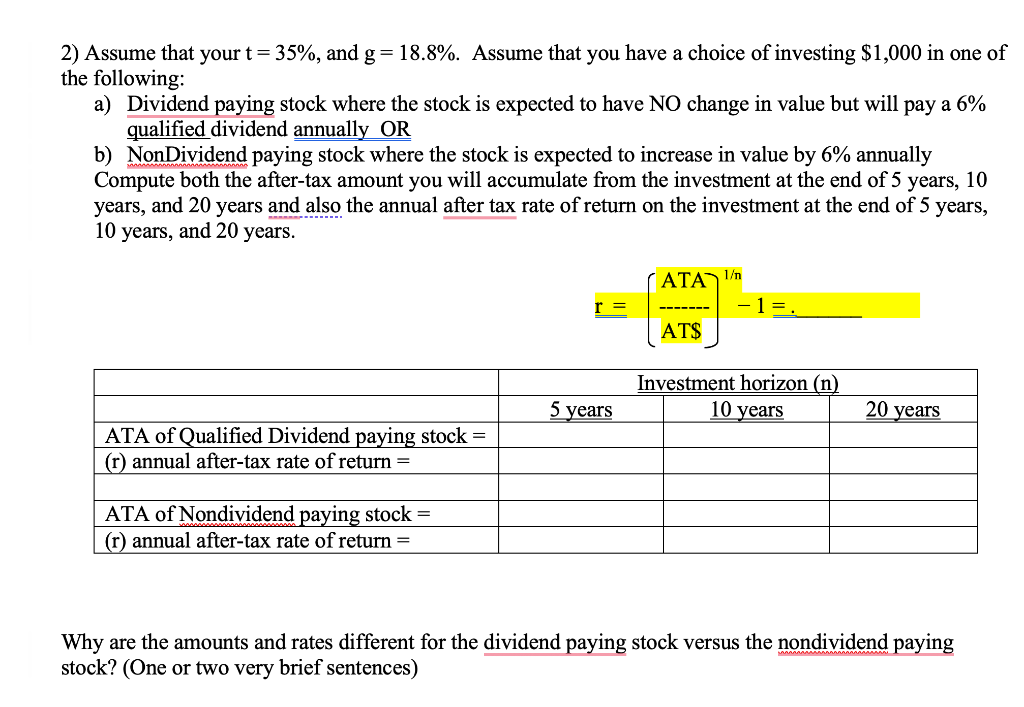
Give step-by-step solution with explanation and final answer:2) Assume that your t = 35%, and g = 18.8%. Assume that you have a choice of investing $1,000 in one of
the following:
a) Dividend paying stock where the stock is expected to have NO change in value but will pay a 6%
qualified dividend annually OR
b) NonDividend paying stock where the stock is expected to increase in value by 6% annually
Compute both the after-tax amount you will accumulate from the investment at the end of 5 years, 10
years, and 20 years and also the annual after tax rate of return on the investment at the end of 5 years,
10 years, and 20 years.
rr [ Investmenthorign(m) |
| sys [ loys [| 20years |
| ATA of Qualified Dividend paying stock= | [|]
| @ annual after-tax rate of ewmn= ~~ | [| |
I A EE
| ATA of Nondividend payingstock= | [| ~~ |
[@ annual after-tax rate of retwmn= ~~ [| | |
‘Why are the amounts and rates different for the dividend paying stock versus the nondividend paying
stock? (One or two very brief sentences)
Question:
Act like a helpful tutor and exlain me :
Give step-by-step solution with explanation and final answer:2) Assume that your t = 35%, and g = 18.8%. Assume that you have a choice of investing $1,000 in one of
the following:
a) Dividend paying stock where the stock is expected to have NO change in value but will pay a 6%
qualified dividend annually OR
b) NonDividend paying stock where the stock is expected to increase in value by 6% annually
Compute both the after-tax amount you will accumulate from the investment at the end of 5 years, 10
years, and 20 years and also the annual after tax rate of return on the investment at the end of 5 years,
10 years, and 20 years.
rr [ Investmenthorign(m) |
| sys [ loys [| 20years |
| ATA of Qualified Dividend paying stock= | [|]
| @ annual after-tax rate of ewmn= ~~ | [| |
I A EE
| ATA of Nondividend payingstock= | [| ~~ |
[@ annual after-tax rate of retwmn= ~~ [| | |
‘Why are the amounts and rates different for the dividend paying stock versus the nondividend paying
stock? (One or two very brief sentences)
This is AI generated Response.
Asked by: Smart Tv
Created at: 2025-09-25 11:52:41
Final Answer:
RenderedRaw Text
Did you like this answer?
To solve this problem, we'll calculate the after-tax amount (ATA) and the annual after-tax rate of return for both types of stocks over different investment horizons (5, 10, and 20 years).
### Given:
- Investment: $1,000
- Tax rate \( t \): 35%
- Capital gains tax rate \( g \): 18.8%
- Dividend rate: 6%
### a) Dividend-Paying Stock
#### After-Tax Amount (ATA)
1. **Annual Dividend**:
\[
\text{Dividend} = 6\% \times 100 = \$60
\]
2. **After-Tax Dividend**:
\[
\text{After-Tax Dividend} = \$60 \times (1 - .35) = \$39
\]
3. **Total After-Tax Amount (ATA)**:
\[
\text{ATA} = 100 + 5 \times 39 = 100 + 195 = \$1195
\]
\[
\text{ATA} = 100 + 10 \times 39 = 100 + 390 = \$139
\]
\[
\text{ATA} = 100 + 20 \times 39 = 100 + 780 = \$178
\]
#### Annual After-Tax Rate of Return (r)
Using the formula:
\[
r = \left( \frac{\text{ATA}}{\text{ATS}} \right)^{\frac{1}{n}} - 1
\]
Where ATS = 100 (initial investment).
For 5, 10, and 20 years, calculate \( r \).
### b) Non-Dividend Paying Stock
#### After-Tax Amount (ATA)
1. **Value After n Years**:
\[
\text{Value} = 100 \times (1 + .06)^n
\]
2. **After-Tax Capital Gains**:
\[
\text{Capital Gain} = \text{Value} - 100
\]
\[
\text{After-Tax Capital Gain} = \text{Capital Gain} \times (1 - .188)
\]
3. **Total After-Tax Amount (ATA)**:
\[
\text{ATA} = 100 + \text{After-Tax Capital Gain}
\]
#### Annual After-Tax Rate of Return (r)
Again, use the formula:
\[
r = \left( \frac{\text{ATA}}{\text{ATS}} \right)^{\frac{1}{n}} - 1
\]
### Results
Fill in the table with calculated values for each scenario:
| Investment Horizon (n) | 5 years | 10 years | 20 years |
|------------------------|---------|----------|----------|
| **ATA of Qualified Dividend Paying Stock** | \$1195 | \$139 | \$178 |
| **(r) Annual After-Tax Rate of Return** | | | |
| **ATA of Non-Dividend Paying Stock** | | | |
| **(r) Annual After-Tax Rate of Return** | | | |
### Explanation
The amounts and rates differ due to the way dividends and capital gains are taxed. Dividends are taxed annually, reducing the reinvestment potential, while capital gains are taxed upon realization, allowing for tax-deferred growth.
VIPSolutions focuses on clear, step‑by‑step explanations so you can learn quickly. Whether you need an AI‑generated walkthrough or a short hint to get unstuck, each solution is organized for fast reading and easy review later.
Search similar questions, compare approaches, and bookmark the best answers for revision. Our goal is simple: quick, reliable study help that feels natural—not noisy.
 VIPSolutions
 2) Assume that your t = 35%, and g = 18.8%. Assume that you have a choice of investing $1,000 in one of
the following:
a) Dividend paying stock where the stock is expected to have NO change in value but will pay a 6%
qualified dividend annually OR
b) NonDividend paying stock where the stock is expected to increase in value by 6% annually
Compute both the after-tax amount you will accumulate from the investment at the end of 5 years, 10
years, and 20 years and also the annual after tax rate of return on the investment at the end of 5 years,
10 years, and 20 years.
rr [ Investmenthorign(m) |
| sys [ loys [| 20years |
| ATA of Qualified Dividend paying stock= | [|]
| @ annual after-tax rate of ewmn= ~~ | [| |
I A EE
| ATA of Nondividend payingstock= | [| ~~ |
[@ annual after-tax rate of retwmn= ~~ [| | |
‘Why are the amounts and rates different for the dividend paying stock versus the nondividend paying
stock? (One or two very brief sentences)