 VIPSolutions
Act like a helpful tutor and exlain me : Give step-by-step solution with explanation and final answer: Data (from the table): time (s) [CH₃I] (mol/L) 0 0.01 650 0.0069 2100 0.0044 2600 0.0035 3100 0.0031 4000 0.00264 = E Jahan ht bie cpl Concordat Coe tlonig ord (chy (edi) we hey Bde ad iE ee coy RE meld coconut, dirredvance of — 9 Prove that dis yoaction; fot evel reaction = For both renclants’ & BR celulabe eh Ee SNEEIEEL ey
Question:
Act like a helpful tutor and exlain me :
Give step-by-step solution with explanation and final answer:
Data (from the table): time (s) [CH₃I] (mol/L) 0 0.01 650 0.0069 2100 0.0044 2600 0.0035 3100 0.0031 4000 0.0026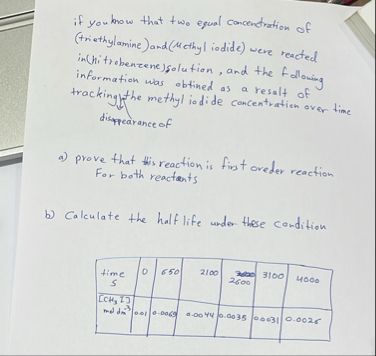 4
= E Jahan ht bie cpl Concordat
Coe tlonig ord (chy (edi) we hey
Bde ad iE
ee coy
RE meld coconut,
dirredvance of
— 9 Prove that dis yoaction; fot evel reaction
= For both renclants’ &
BR celulabe eh Ee
SNEEIEEL
ey
This is AI generated Response.
Asked by: 3quin0xx
Created at: 2025-09-25 02:07:00
Asked by: 3quin0xx
Created at: 2025-09-25 02:07:00
Final Answer:
Rendered
Raw Text
Did you like this answer?
To solve this problem, we will address each part separately.
### Part A: Prove the Reaction is First Order
To prove that the reaction is first order, we need to verify that the reaction follows first-order kinetics. For a first-order reaction, the rate law is given by:
\[
\text{Rate} = k[\text{CH}_3\text{I}]
\]
The integrated rate law for a first-order reaction is:
\[
\ln[\text{CH}_3\text{I}] = -kt + \ln[\text{CH}_3\text{I}]_
\]
Where:
- \( [\text{CH}_3\text{I}]_ \) is the initial concentration.
- \( k \) is the rate constant.
- \( t \) is time.
#### Steps:
1. **Calculate \(\ln[\text{CH}_3\text{I}]\) for each time point.**
- At \( t = \), \([\text{CH}_3\text{I}] = .01\), so \(\ln(.01) = -4.605\)
- At \( t = 650 \), \([\text{CH}_3\text{I}] = .0069\), so \(\ln(.0069) = -4.975\)
- At \( t = 210 \), \([\text{CH}_3\text{I}] = .0044\), so \(\ln(.0044) = -5.424\)
- At \( t = 260 \), \([\text{CH}_3\text{I}] = .0035\), so \(\ln(.0035) = -5.655\)
- At \( t = 310 \), \([\text{CH}_3\text{I}] = .0031\), so \(\ln(.0031) = -5.774\)
- At \( t = 400 \), \([\text{CH}_3\text{I}] = .0026\), so \(\ln(.0026) = -5.953\)
2. **Plot \(\ln[\text{CH}_3\text{I}]\) vs. \( t \).**
- If the plot is a straight line, the reaction is first order.
3. **Calculate the slope of the line.**
- The slope of the line is equal to \(-k\).
The plot should show a linear relationship, indicating a first-order reaction. The negative slope will give the rate constant \( k \).
### Part B: Calculate the Half-Life
For a first-order reaction, the half-life (\( t_{1/2} \)) is independent of the initial concentration and is given by:
\[
t_{1/2} = \frac{.693}{k}
\]
1. **Use the slope from Part A to find \( k \).**
2. **Calculate the half-life using the formula above.**
### Final Answer
- **First-Order Reaction:** Confirmed by the linear plot of \(\ln[\text{CH}_3\text{I}]\) vs. \( t \).
- **Rate Constant \( k \):** Calculated from the slope of the line.
- **Half-Life \( t_{1/2} \):** \(\frac{.693}{k}\)
This approach confirms the reaction order and calculates the half-life under the given conditions.
📢 Instructions:
- Ask anything relatd to above question only.
- For new Question goto :