 VIPSolutions
Act like a helpful tutor and exlain me : Give step-by-step solution with explanation and final answer:Which pair(s) do not form a chemical bond? Write down the answer in the format of #, #, #, etc. in sequence (i.e, a number followed by a comma and a space, and then the next number.) DYCY] 2G ca 83 “3 §
Question:
Act like a helpful tutor and exlain me :
Give step-by-step solution with explanation and final answer: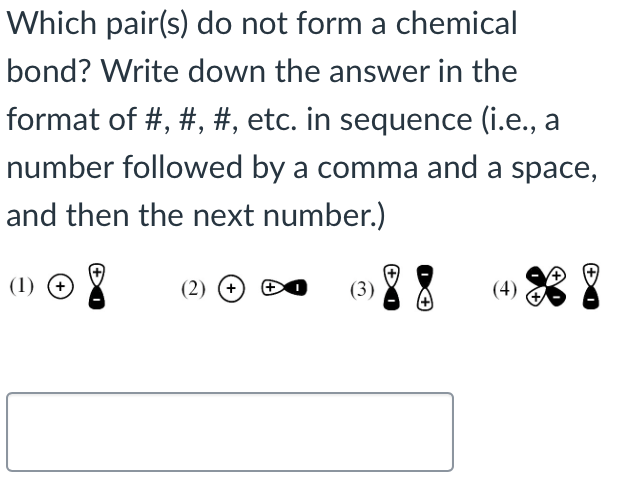 Which pair(s) do not form a chemical
bond? Write down the answer in the
format of #, #, #, etc. in sequence (i.e, a
number followed by a comma and a space,
and then the next number.)
DYCY] 2G ca 83 “3 §
This is AI generated Response.
Asked by: Sagar
Created at: 2025-09-24 19:17:11
Asked by: Sagar
Created at: 2025-09-24 19:17:11
Final Answer:
Rendered
Raw Text
Did you like this answer?
To determine which pairs do not form a chemical bond, we need to consider the types of charges involved. Chemical bonds generally form between opposite charges due to electrostatic attraction.
Let's examine each pair:
### Pair (1)
- **Charges:** Positive (+) and Negative (-)
- **Explanation:** Opposite charges attract each other, so they are likely to form a bond.
### Pair (2)
- **Charges:** Positive (+) and Negative (-)
- **Explanation:** Opposite charges attract each other, so they are likely to form a bond.
### Pair (3)
- **Charges:** Both Negative (-) and Negative (-)
- **Explanation:** Like charges repel each other, so they do not form a bond.
### Pair (4)
- **Charges:** Positive (+) and Negative (-)
- **Explanation:** Opposite charges attract each other, so they are likely to form a bond.
### Conclusion
The pair that does not form a bond is the one with like charges that repel each other.
### Final Answer
3
📢 Instructions:
- Ask anything relatd to above question only.
- For new Question goto :