 VIPSolutions
Act like a helpful tutor and exlain me : Give step-by-step solution with explanation and final answer: give detailed answer with explanation of incorrect options alsoQuestion 25 of 92 Which of the following is NOT a way to override Rule #1? O When a straightness control is applied to a feature of size. O When a note, such as "NON-RIGID FEATURE - PERFECT FORM AT MMC IS NOT REQUIRED", is added to the drawing. O When the Independency symbol is placed next to the applicable feature control frame. O When a flatness control is applied to a feature of size. O When the surface straightness tolerance listed is larger than the size tolerance.
Question:
Act like a helpful tutor and exlain me :
Give step-by-step solution with explanation and final answer:
give detailed answer with explanation of incorrect options also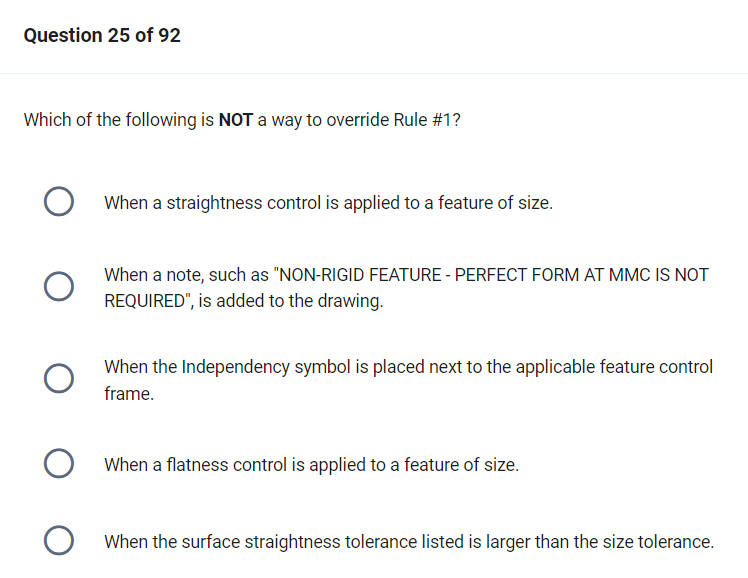 Question 25 of 92
Which of the following is NOT a way to override Rule #1?
O When a straightness control is applied to a feature of size.
O When a note, such as "NON-RIGID FEATURE - PERFECT FORM AT MMC IS NOT
REQUIRED", is added to the drawing.
O When the Independency symbol is placed next to the applicable feature control
frame.
O When a flatness control is applied to a feature of size.
O When the surface straightness tolerance listed is larger than the size tolerance.
This is AI generated Response.
Asked by: manish kumar
Created at: 2025-09-24 10:28:29
Asked by: manish kumar
Created at: 2025-09-24 10:28:29
Final Answer:
Rendered
Raw Text
Did you like this answer?
## Step-by-Step Solution
### **Understanding Rule #1 (Perfect Form at MMC)**
Rule #1 in GD&T (Geometric Dimensioning and Tolerancing), also known as the "Envelope Principle," states:
- A feature of size must have perfect form at Maximum Material Condition (MMC).
- This means: at the largest allowed material condition, the feature must be perfectly straight, flat, round, etc.
**Rule #1 can be overridden** in some cases, such as:
- By using the Independency symbol (⏊).
- By using specific notes.
- By applying certain geometric controls.
---
### **Analyzing Each Option**
#### **Option 1:**
> When a straightness control is applied to a feature of size.
- **Explanation:**
Applying a straightness control to a feature of size *at MMC* can override Rule #1 by allowing deviations in form beyond perfect form at MMC.
- **Is this a way to override Rule #1?**
**Yes, it is.**
---
#### **Option 2:**
> When a note, such as "NON-RIGID FEATURE - PERFECT FORM AT MMC IS NOT REQUIRED", is added to the drawing.
- **Explanation:**
This note *explicitly* states that perfect form at MMC is **not required**, which directly overrides Rule #1.
- **Is this a way to override Rule #1?**
**Yes, it is.**
---
#### **Option 3:**
> When the Independency symbol is placed next to the applicable feature control frame.
- **Explanation:**
The Independency symbol (⏊) tells us that the feature does *not* have to follow Rule #1, thus overriding the envelope principle.
- **Is this a way to override Rule #1?**
**Yes, it is.**
---
#### **Option 4:**
> When a flatness control is applied to a feature of size.
- **Explanation:**
Applying a flatness control to a feature of size overrides Rule #1 by allowing flatness deviation even at MMC.
- **Is this a way to override Rule #1?**
**Yes, it is.**
---
#### **Option 5:**
> When the surface straightness tolerance listed is larger than the size tolerance.
- **Explanation:**
Rule #1 says perfect form at MMC is required, and form deviation cannot exceed the size tolerance. If the surface straightness tolerance is *larger* than the size tolerance, it does **not** override Rule #1 — it's simply incorrect or redundant, as the size tolerance already restricts form.
- **Is this a way to override Rule #1?**
**NO, this does NOT override Rule #1.**
---
## **Final Answer**
### **The correct answer is:**
> **When the surface straightness tolerance listed is larger than the size tolerance.**
---
## **Summary Table**
| Option | Overrides Rule #1? | Explanation |
|--------|--------------------|-------------|
| 1. Straightness control on feature of size | **Yes** | Overrides rule by specifying form tolerance |
| 2. Note: "PERFECT FORM AT MMC IS NOT REQUIRED" | **Yes** | Explicitly overrides Rule #1 |
| 3. Independency symbol | **Yes** | Overrides envelope requirement |
| 4. Flatness control on feature of size | **Yes** | Overrides rule by specifying flatness tolerance |
| 5. Surface straightness tolerance > size tolerance | **No** | Does NOT override Rule #1 |
### **Incorrect Options Explained:**
- Options 1, 2, 3, and 4 all provide explicit means to override Rule #1 by GD&T standards.
- Option 5 does NOT override Rule #1; it is either redundant or results in an impossible scenario according to the envelope principle.
---
**If you need more examples or visual explanations, let me know!**
📢 Instructions:
- Ask anything relatd to above question only.
- For new Question goto :