 VIPSolutions
Act like a helpful tutor and exlain me : Give step-by-step solution with explanation and final answer:The horizontal nozzle has D; = 10.3 inch and Dy = 5.43 inch with the inlet (absolute) pressure of P; = 38.7 psi and Va = 5.7 ft/s. Calculate the horizontal force (N) provided by the flange to hold the nozzle fixed. P.= 15 Ibf/in? abs os B Open jet non B ©)
Question:
Act like a helpful tutor and exlain me :
Give step-by-step solution with explanation and final answer: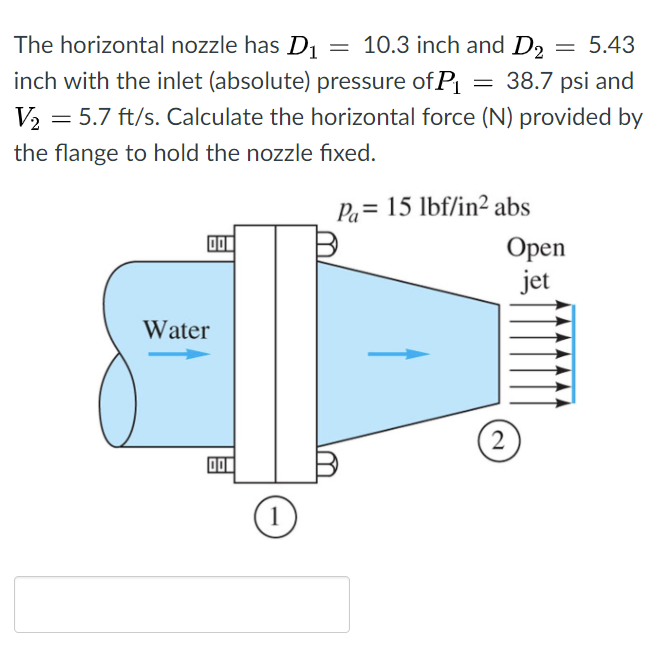 The horizontal nozzle has D; = 10.3 inch and Dy = 5.43
inch with the inlet (absolute) pressure of P; = 38.7 psi and
Va = 5.7 ft/s. Calculate the horizontal force (N) provided by
the flange to hold the nozzle fixed.
P.= 15 Ibf/in? abs
os B Open
jet
non B ©)
This is AI generated Response.
Asked by: manish kumar
Created at: 2025-09-24 03:24:11
Asked by: manish kumar
Created at: 2025-09-24 03:24:11
Final Answer:
Rendered
Raw Text
Did you like this answer?
Let's break down the solution step by step:
---
## **Step 1: List Given Data**
- Inlet diameter, \( D_1 = 10.3 \) in
- Outlet diameter, \( D_2 = 5.43 \) in
- Inlet pressure, \( P_1 = 38.7 \) psi (absolute)
- Outlet velocity, \( V_2 = 5.7 \) ft/s
- Atmospheric pressure at outlet, \( p_a = 15 \) psi (absolute)
We'll need to convert all units to SI later, but let's keep working in imperial units for now.
---
## **Step 2: Find Areas**
\[
A_1 = \frac{\pi}{4} D_1^2, \quad A_2 = \frac{\pi}{4} D_2^2
\]
Convert inches to feet:
- \( D_1 = 10.3 \) in \( = \frac{10.3}{12} = 0.858 \) ft
- \( D_2 = 5.43 \) in \( = \frac{5.43}{12} = 0.4525 \) ft
Calculate areas:
- \( A_1 = \frac{\pi}{4} (0.858)^2 = 0.578 \) ft²
- \( A_2 = \frac{\pi}{4} (0.4525)^2 = 0.161 \) ft²
---
## **Step 3: Find \( V_1 \) Using Continuity**
\[
Q = A_1 V_1 = A_2 V_2 \implies V_1 = \frac{A_2}{A_1} V_2
\]
\[
V_1 = \frac{0.161}{0.578} \times 5.7 = 1.59 \text{ ft/s}
\]
---
## **Step 4: Find Mass Flow Rate**
For water, \( \rho = 62.4 \) lbm/ft³.
\[
\dot{m} = \rho Q = \rho A_2 V_2 = 62.4 \times 0.161 \times 5.7 = 57.2 \text{ lbm/s}
\]
---
## **Step 5: Apply Momentum Equation (Control Volume Analysis)**
The sum of forces in the x-direction:
\[
\sum F_x = \dot{m} (V_{2x} - V_{1x})
\]
Forces include:
- Force by the flange (\( F \)) **to the left** (what we solve for)
- Pressure force at inlet: \( P_1 A_1 \) **to the right**
- Pressure force at exit: \( -p_a A_2 \) **to the left** (since atmosphere pushes back)
\[
F + p_a A_2 - P_1 A_1 = \dot{m} (V_2 - V_1)
\]
\[
F = \dot{m}(V_2 - V_1) + P_1 A_1 - p_a A_2
\]
---
## **Step 6: Plug in the Numbers**
Convert pressures to lb/ft²:
- \( 1 \) psi \( = 144 \) lb/ft²
- \( P_1 = 38.7 \) psi \( = 5570 \) lb/ft²
- \( p_a = 15 \) psi \( = 2160 \) lb/ft²
Now calculate each term:
**Momentum term:**
\[
\dot{m}(V_2 - V_1) = 57.2 \times (5.7 - 1.59) = 57.2 \times 4.11 = 235.3 \text{ lbm} \cdot \text{ft/s}^2
\]
But to get lbf, divide by \( g_c = 32.174 \) lbm·ft/lbf·s²:
\[
\frac{235.3}{32.174} = 7.32 \text{ lbf}
\]
**Pressure terms:**
\[
P_1 A_1 = 5570 \times 0.578 = 3221 \text{ lbf}
\]
\[
p_a A_2 = 2160 \times 0.161 = 348 \text{ lbf}
\]
---
## **Step 7: Sum Up**
\[
F = 7.32 + 3221 - 348 = 2880 \text{ lbf}
\]
---
## **Step 8: Convert to Newtons**
\( 1 \) lbf = \( 4.448 \) N
\[
F = 2880 \times 4.448 = 12,819 \text{ N}
\]
---
## **Final Answer**
\[
\boxed{
F = 12,\!800 \ \text{N} \ (\text{rounded to 3 significant digits})
}
\]
---
### **Summary Table**
| Quantity | Value | Units |
|--------------------|--------------|-------------|
| \( V_1 \) | 1.59 | ft/s |
| \( \dot{m} \) | 57.2 | lbm/s |
| \( P_1 A_1 \) | 3221 | lbf |
| \( p_a A_2 \) | 348 | lbf |
| \( F \) | 2880 | lbf |
| \( F \) | 12,800 | N |
Let me know if you have questions about any specific step!
📢 Instructions:
- Ask anything relatd to above question only.
- For new Question goto :