 VIPSolutions
Act like a helpful tutor and exlain me : Give step-by-step solution with explanation and final answer:Multiple Answer 5 points The following proof is wrong. Please select all the mistakes in the proof. a L1 ={w|w has the same number of a's and b's} * Lets = ab, and we have abe L1 * We decompose s into xyz, withx =a,y=b,z=¢ * Leti=0,thenxyz =xz=a ¢ L1 * Therefore, L1 is not regular The strings is too short. We must choose a string s longer than any arbitrary number p. It considers only one possible decomposition of string s. We must consider all possible decompositions of s into xyz with |xy|0
Question:
Act like a helpful tutor and exlain me :
Give step-by-step solution with explanation and final answer: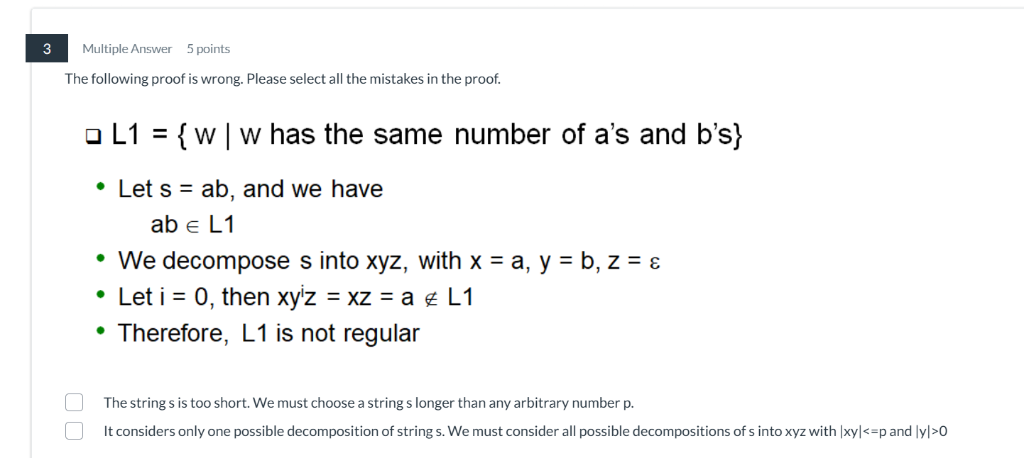 Multiple Answer 5 points
The following proof is wrong. Please select all the mistakes in the proof.
a L1 ={w|w has the same number of a's and b's}
* Lets = ab, and we have
abe L1
* We decompose s into xyz, withx =a,y=b,z=¢
* Leti=0,thenxyz =xz=a ¢ L1
* Therefore, L1 is not regular
The strings is too short. We must choose a string s longer than any arbitrary number p.
It considers only one possible decomposition of string s. We must consider all possible decompositions of s into xyz with |xy|0
This is AI generated Response.
Asked by: Sagar
Created at: 2025-09-24 02:00:33
Asked by: Sagar
Created at: 2025-09-24 02:00:33
Final Answer:
Rendered
Raw Text
Did you like this answer?
# Step-by-Step Solution
Let's **analyze the proof** and the **multiple choice options** given.
## **Proof Summary**
The proof tries to prove that the language
\[ L_1 = \{ w \mid w \text{ has the same number of a's and b's} \} \]
is **not regular**, using the **Pumping Lemma** for regular languages.
The steps are:
1. **Let \( s = ab \), and we have \( ab \in L_1 \)**
2. **We decompose \( s \) into \( xyz \), with \( x = a, y = b, z = \epsilon \)**
3. **Let \( i = 0 \), then \( xy^0z = xz = a \notin L_1 \)**
4. **Therefore, \( L_1 \) is not regular**
---
## **Step-by-Step Explanation**
### **Step 1: Understanding the Pumping Lemma**
The **Pumping Lemma for regular languages** states:
>If \( L \) is regular, then there exists a number \( p \) (the pumping length) such that for every string \( s \) in \( L \), with \( |s| \geq p \), \( s \) can be split into \( s = xyz \), where
>- \( |xy| \leq p \)
>- \( |y| > 0 \)
>- For all \( i \geq 0 \), \( xy^iz \in L \)
### **Step 2: Analyzing the Mistakes**
#### **Mistake 1: The string \( s \) is too short**
- The proof picks \( s = ab \), which has length 2.
- The pumping lemma requires us to pick **any string of length at least \( p \)**, where \( p \) is an arbitrary (but fixed) number.
- This proof doesn't allow for **arbitrarily long strings**.
- Therefore, this is a mistake.
#### **Mistake 2: Only one decomposition is considered**
- The proof only considers **one way** to split \( s \) into \( x, y, z \): \( x = a, y = b, z = \epsilon \).
- The pumping lemma **must work for all possible decompositions** that satisfy \( |xy| \leq p \) and \( |y| > 0 \).
- So this is another mistake.
---
## **Final Answer**
The mistakes in the proof are:
- **The string \( s \) is too short. We must choose a string \( s \) longer than any arbitrary number \( p \).**
- **It considers only one possible decomposition of string \( s \). We must consider all possible decompositions of \( s \) into \( xyz \) with \( |xy| \leq p \) and \( |y| > 0 \).**
**So, you should check both boxes.**
---
### **Summary Table**
| Option | Should you select? | Reason |
|--------|--------------------|--------|
| The string s is too short... | ✅ | Must choose \( s \) longer than any \( p \) |
| It considers only one possible decomposition... | ✅ | Must consider **all** decompositions |
---
### **Extra Note**
The conclusion (that \( L_1 \) is not regular) is actually correct, but the **proof is invalid** for the reasons above.
📢 Instructions:
- Ask anything relatd to above question only.
- For new Question goto :