 VIPSolutions
Act like a helpful tutor and exlain me : Give step-by-step solution with explanation and final answer:Problem 4-10 pts A 20-cm long rod (k = 50 W/mK) protrudes from a wall. The wall has a base temperature of 200 °C, end the rod is circular with a diameter of 5 cm. The rod is exposed to a fluid at 40 °C with a heat transfer coefficient of 25 W/mK. «Part (a) 5 pts — Determine the heat transfer dissipated from the rod (W) «Part (b) 5 pts — Determine the fin efficiency of the rod (%)
Question:
Act like a helpful tutor and exlain me :
Give step-by-step solution with explanation and final answer: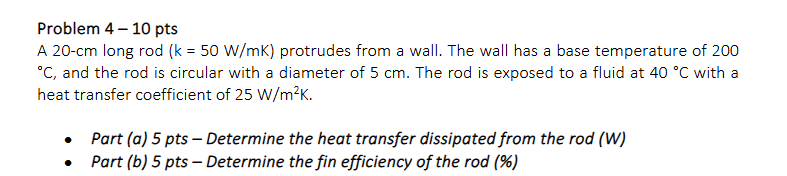 Problem 4-10 pts
A 20-cm long rod (k = 50 W/mK) protrudes from a wall. The wall has a base temperature of 200
°C, end the rod is circular with a diameter of 5 cm. The rod is exposed to a fluid at 40 °C with a
heat transfer coefficient of 25 W/mK.
«Part (a) 5 pts — Determine the heat transfer dissipated from the rod (W)
«Part (b) 5 pts — Determine the fin efficiency of the rod (%)
This is AI generated Response.
Asked by: manish kumar
Created at: 2025-09-24 01:39:43
Asked by: manish kumar
Created at: 2025-09-24 01:39:43
Final Answer:
Rendered
Raw Text
Did you like this answer?
Let's break down the problem step by step:
---
## **Given Data**
- Rod length, \( L = 20 \) cm = **0.2 m**
- Thermal conductivity, \( k = 50 \) W/m·K
- Wall temperature, \( T_b = 200^\circ \)C
- Ambient fluid temperature, \( T_\infty = 40^\circ \)C
- Rod diameter, \( D = 5 \) cm = **0.05 m**
- Heat transfer coefficient, \( h = 25 \) W/m²·K
---
## **Step 1: Area and Perimeter of the Rod**
- **Perimeter, \( P \):**
\[
P = \pi D = \pi \times 0.05 = 0.1571 \text{ m}
\]
- **Cross-sectional Area, \( A_c \):**
\[
A_c = \frac{\pi D^2}{4} = \frac{\pi (0.05)^2}{4} = 0.00196 \text{ m}^2
\]
---
## **Step 2: Fin Parameter, \( m \)**
\[
m = \sqrt{\frac{hP}{kA_c}}
\]
Plug in the values:
\[
m = \sqrt{ \frac{25 \times 0.1571}{50 \times 0.00196} }
\]
Calculate numerator and denominator:
- Numerator: \( 25 \times 0.1571 = 3.9275 \)
- Denominator: \( 50 \times 0.00196 = 0.098 \)
So:
\[
m = \sqrt{ \frac{3.9275}{0.098} } = \sqrt{40.14} = 6.34 \text{ m}^{-1}
\]
---
## **Step 3: Heat Transfer from the Fin (Rod)**
Since the rod is **long** and exposed at the tip, use the following formula for a fin with an **adiabatic tip**:
\[
q_{\text{fin}} = \sqrt{hPkA_c}(T_b - T_\infty) \tanh(mL)
\]
First, calculate \(\sqrt{hPkA_c}\):
- \( h P k A_c = 25 \times 0.1571 \times 50 \times 0.00196 \)
- \( = 3.9275 \times 50 \times 0.00196 \)
- \( = 196.375 \times 0.00196 = 0.3849 \), then \( \sqrt{0.3849} = 0.6204 \)
Now, calculate \( mL \):
\[
mL = 6.34 \times 0.2 = 1.268
\]
\[
\tanh(1.268) \approx 0.852
\]
Plug in all values:
\[
q_{\text{fin}} = 0.6204 \times (200 - 40) \times 0.852
\]
\[
= 0.6204 \times 160 \times 0.852
\]
\[
= 0.6204 \times 136.32
\]
\[
= 84.6 \text{ W}
\]
---
### **Final Answer for Part (a):**
\[
\boxed{q_{\text{fin}} = 84.6 \text{ W}}
\]
---
## **Step 4: Fin Efficiency (\( \eta_{\text{fin}} \))**
Fin efficiency:
\[
\eta_{\text{fin}} = \frac{q_{\text{fin}}}{h P L (T_b - T_\infty)}
\]
First, calculate denominator:
\[
h P L (T_b - T_\infty) = 25 \times 0.1571 \times 0.2 \times 160
\]
- \( 25 \times 0.1571 = 3.9275 \)
- \( 3.9275 \times 0.2 = 0.7855 \)
- \( 0.7855 \times 160 = 125.68 \)
So,
\[
\eta_{\text{fin}} = \frac{84.6}{125.68} = 0.673 \text{ or } 67.3\%
\]
---
### **Final Answer for Part (b):**
\[
\boxed{\eta_{\text{fin}} = 67.3\%}
\]
---
## **Summary Table**
| Part | Formula Used | Answer |
|-------------|--------------|--------|
| (a) Heat transfer dissipated, \(q_{\text{fin}}\) | \( q_{\text{fin}} = \sqrt{hPkA_c}(T_b - T_\infty) \tanh(mL) \) | \( \boxed{84.6 \text{ W}} \) |
| (b) Fin efficiency, \( \eta_{\text{fin}} \) | \( \eta_{\text{fin}} = \frac{q_{\text{fin}}}{h P L (T_b - T_\infty)} \) | \( \boxed{67.3\%} \) |
---
If you need clarification on any of the steps or formulas, let me know!
📢 Instructions:
- Ask anything relatd to above question only.
- For new Question goto :