 VIPSolutions
Act like a helpful tutor and exlain me : Give step-by-step solution with explanation and final answer:Problem 1: 3.6.21 (WP) Water (assumed inviscid and incompressible) flows steadily in the vertical variable-area pipe shown in Fig. P3.6.21. Determine the flowrate if the pressure in each of the gages reads 50 kPa. — 10m p=50kPa — [4 Part 2: Consider the same flowrate but in the opposite direction (flowing upward). Conditions are still such that the lower pressure gage (that measuring static pressure at the narrowed neck) is reading 50 kPa. What pressure will be indicated by the upper gage?
Question:
Act like a helpful tutor and exlain me :
Give step-by-step solution with explanation and final answer: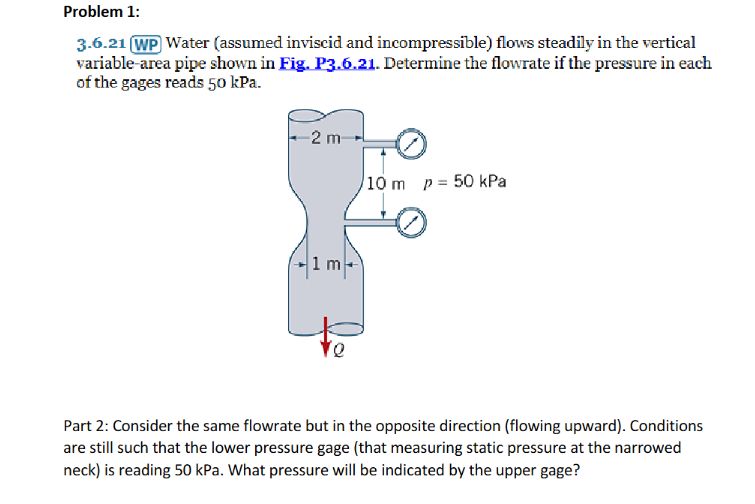 Problem 1:
3.6.21 (WP) Water (assumed inviscid and incompressible) flows steadily in the vertical
variable-area pipe shown in Fig. P3.6.21. Determine the flowrate if the pressure in each
of the gages reads 50 kPa.
—
10m p=50kPa
—
[4
Part 2: Consider the same flowrate but in the opposite direction (flowing upward). Conditions
are still such that the lower pressure gage (that measuring static pressure at the narrowed
neck) is reading 50 kPa. What pressure will be indicated by the upper gage?
This is AI generated Response.
Asked by: manish kumar
Created at: 2025-09-24 01:20:25
Asked by: manish kumar
Created at: 2025-09-24 01:20:25
Final Answer:
Rendered
Raw Text
Did you like this answer?
## Step-by-Step Solution
Let's solve each part step by step using the **Bernoulli Equation** and the **Continuity Equation**.
---
### **Given Data**
- **Pipe diameters:**
- Top: \( D_1 = 2\, \text{m} \)
- Bottom: \( D_2 = 1\, \text{m} \)
- **Heights:**
- Top: \( z_1 = 10\, \text{m} \)
- Bottom: \( z_2 = 0\, \text{m} \) (choose bottom as reference)
- **Pressures:**
- Both gages: \( p_1 = p_2 = 50\, \text{kPa} \)
- **Fluid:** Water (incompressible, inviscid)
- **Find:** Flow rate \( Q \)
---
## **Part 1: Flow Downward**
### 1. **Continuity Equation**
\[
Q = A_1 v_1 = A_2 v_2
\]
where
\( A_1 = \frac{\pi}{4} D_1^2 \), \( A_2 = \frac{\pi}{4} D_2^2 \)
\[
A_1 = \frac{\pi}{4} (2^2) = \pi \, \text{m}^2
\]
\[
A_2 = \frac{\pi}{4} (1^2) = \frac{\pi}{4} \, \text{m}^2
\]
So,
\[
v_2 = \frac{A_1}{A_2} v_1 = \frac{\pi}{\pi/4} v_1 = 4v_1
\]
---
### 2. **Bernoulli's Equation (from top to bottom):**
\[
\frac{p_1}{\rho g} + \frac{v_1^2}{2g} + z_1 = \frac{p_2}{\rho g} + \frac{v_2^2}{2g} + z_2
\]
Given \( p_1 = p_2 \), so those terms cancel.
\[
\frac{v_1^2}{2g} + z_1 = \frac{v_2^2}{2g} + z_2
\]
Since \( z_2 = 0 \):
\[
\frac{v_1^2}{2g} + 10 = \frac{v_2^2}{2g}
\]
Recall \( v_2 = 4v_1 \):
\[
\frac{v_1^2}{2g} + 10 = \frac{(4v_1)^2}{2g}
\]
\[
\frac{v_1^2}{2g} + 10 = \frac{16v_1^2}{2g}
\]
\[
10 = \frac{16v_1^2}{2g} - \frac{v_1^2}{2g}
\]
\[
10 = \frac{15v_1^2}{2g}
\]
\[
v_1^2 = \frac{2g \times 10}{15} = \frac{20g}{15} = \frac{4g}{3}
\]
\[
v_1 = \sqrt{\frac{4g}{3}}
\]
With \( g = 9.81 \, \text{m/s}^2 \):
\[
v_1 = \sqrt{\frac{4 \times 9.81}{3}} = \sqrt{\frac{39.24}{3}} = \sqrt{13.08} \approx 3.62\, \text{m/s}
\]
So,
\[
v_2 = 4v_1 = 4 \times 3.62 \approx 14.48 \, \text{m/s}
\]
---
### 3. **Flow Rate:**
\[
Q = A_1 v_1 = \pi \times 3.62 \approx 11.4\, \text{m}^3/\text{s}
\]
---
### **Final Answer (Part 1):**
\[
\boxed{Q \approx 11.4\ \text{m}^3/\text{s}}
\]
---
## **Part 2: Flow Upward**
Now flow is **upward** (from 1 m section to 2 m section).
The **lower gage** (narrow section) is reading \( 50\, \text{kPa} \).
We are to find the pressure indicated at the **upper gage**.
#### Let:
- \( p_2 = 50\, \text{kPa} \) (bottom/narrow/1 m section)
- \( v_2 = 14.48\, \text{m/s} \) (from previous calculation)
- \( z_2 = 0 \)
- \( v_1 = 3.62\, \text{m/s} \)
- \( z_1 = 10 \)
- \( p_1 = ? \)
Apply Bernoulli (from bottom to top):
\[
\frac{p_2}{\rho g} + \frac{v_2^2}{2g} + z_2 = \frac{p_1}{\rho g} + \frac{v_1^2}{2g} + z_1
\]
Plug in values (\( z_2 = 0 \)):
\[
\frac{p_2}{\rho g} + \frac{v_2^2}{2g} = \frac{p_1}{\rho g} + \frac{v_1^2}{2g} + 10
\]
\[
\frac{p_1}{\rho g} = \frac{p_2}{\rho g} + \frac{v_2^2 - v_1^2}{2g} - 10
\]
\[
p_1 = p_2 + \rho \left( \frac{v_2^2 - v_1^2}{2} - g \times 10 \right)
\]
Water: \( \rho = 1000\, \text{kg/m}^3 \)
- \( p_2 = 50,000\, \text{Pa} \)
- \( v_2 = 14.48 \, \text{m/s} \), \( v_1 = 3.62\, \text{m/s} \)
Plug in:
\[
p_1 = 50,000 + 1000 \left[ \frac{(14.48)^2 - (3.62)^2}{2} - 9.81 \times 10 \right]
\]
Calculate each term:
- \( (14.48)^2 = 209.72 \)
- \( (3.62)^2 = 13.10 \)
- Difference: \( 209.72 - 13.10 = 196.62 \)
- Half: \( 196.62/2 = 98.31 \)
- \( 9.81 \times 10 = 98.1 \)
- Difference: \( 98.31 - 98.1 = 0.21 \)
So,
\[
p_1 = 50,000 + 1000 \times 0.21 = 50,000 + 210 = 50,210 \, \text{Pa}
\]
**So the upper gage will read:**
\[
\boxed{50.2\, \text{kPa}}
\]
---
## **Summary Table**
| Part | Flow Direction | Gage Readings | Flowrate (\(Q\)) / Pressure (\(p_1\)) |
|------|-------------------|------------------------------|---------------------------------------|
| 1 | Downward | Both 50 kPa | \( Q = 11.4\ \text{m}^3/\text{s} \) |
| 2 | Upward | Lower: 50 kPa, Upper: ? | \( p_1 = 50.2\ \text{kPa} \) |
---
### **Let me know if you'd like further clarification!**
📢 Instructions:
- Ask anything relatd to above question only.
- For new Question goto :