 VIPSolutions
Act like a helpful tutor and exlain me : Give step-by-step solution with explanation and final answer:Water flows up through the vertical pipe that is connected to the transition shown below. If the volumetric flow rate is 0.02 m*/s, determine the height h to which the water will rise in the Pitot tube at B. The static pressure tap at Ais as indicated. 200mm | ] 00mm fies mm 100mm,
Question:
Act like a helpful tutor and exlain me :
Give step-by-step solution with explanation and final answer: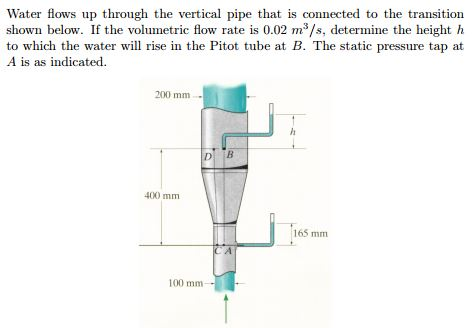 Water flows up through the vertical pipe that is connected to the transition
shown below. If the volumetric flow rate is 0.02 m*/s, determine the height h
to which the water will rise in the Pitot tube at B. The static pressure tap at
Ais as indicated.
200mm |
]
00mm
fies mm
100mm,
This is AI generated Response.
Asked by: manish kumar
Created at: 2025-09-24 00:13:03
Asked by: manish kumar
Created at: 2025-09-24 00:13:03
Final Answer:
Rendered
Raw Text
Did you like this answer?
Let's solve the problem **step by step**:
---
## **Given Data**
- Volumetric flow rate, \( Q = 0.02 \, \mathrm{m^3/s} \)
- Diameter at A, \( D_A = 100 \, \mathrm{mm} = 0.1 \, \mathrm{m} \)
- Diameter at B, \( D_B = 165 \, \mathrm{mm} = 0.165 \, \mathrm{m} \)
- The Pitot tube at B measures the **stagnation (total) pressure**.
- The static tap at A measures the **static pressure**.
---
## **Step 1: Find Velocities at A and B**
### **Area Calculation**
\[
A = \frac{\pi}{4} D^2
\]
- At A:
\[
A_A = \frac{\pi}{4} (0.1^2) = 0.00785 \, \mathrm{m^2}
\]
- At B:
\[
A_B = \frac{\pi}{4} (0.165^2) = 0.0214 \, \mathrm{m^2}
\]
### **Velocity Calculation**
\[
V = \frac{Q}{A}
\]
- At A:
\[
V_A = \frac{0.02}{0.00785} = 2.548 \, \mathrm{m/s}
\]
- At B:
\[
V_B = \frac{0.02}{0.0214} = 0.935 \, \mathrm{m/s}
\]
---
## **Step 2: Apply Bernoulli's Equation**
Bernoulli's Equation between point A (static tap) and point B (Pitot tube):
\[
P_A + \frac{1}{2}\rho V_A^2 + \rho g z_A = P_{B,\text{static}} + \frac{1}{2}\rho V_B^2 + \rho g z_B
\]
**But:**
- The Pitot tube at B measures **stagnation pressure** (\(P_{B,\text{stag}}\)):
\[
P_{B,\text{stag}} = P_{B,\text{static}} + \frac{1}{2} \rho V_B^2
\]
So, Bernoulli's equation becomes:
\[
P_A + \frac{1}{2}\rho V_A^2 + \rho g z_A = P_{B,\text{stag}} + \rho g z_B
\]
Assume \(z_A = 0\), \(z_B = 0.4\,\mathrm{m}\) (since B is 400 mm above A):
\[
P_A + \frac{1}{2}\rho V_A^2 = P_{B,\text{stag}} + \rho g (0.4)
\]
---
## **Step 3: Find the Height h in the Pitot Tube**
The **height \(h\)** is the difference in pressure head between the stagnation pressure at B and the static pressure at A, as read by the Pitot tube:
\[
h = \frac{P_{B,\text{stag}} - P_A}{\rho g}
\]
From previous step:
\[
P_A + \frac{1}{2}\rho V_A^2 = P_{B,\text{stag}} + \rho g (0.4)
\]
\[
P_{B,\text{stag}} - P_A = \frac{1}{2}\rho V_A^2 - \rho g (0.4)
\]
\[
h = \frac{\frac{1}{2}\rho V_A^2 - \rho g (0.4)}{\rho g}
\]
\[
h = \frac{V_A^2}{2g} - 0.4
\]
---
## **Step 4: Plug in the Values**
- \(V_A = 2.548\,\mathrm{m/s}\)
- \(g = 9.81\,\mathrm{m/s^2}\)
\[
h = \frac{(2.548)^2}{2 \times 9.81} - 0.4
\]
\[
h = \frac{6.494}{19.62} - 0.4
\]
\[
h = 0.331 - 0.4 = -0.069\,\mathrm{m}
\]
---
## **Step 5: Interpret the Result**
A negative value means the Pitot tube at B will be **lower** than the static tap at A by 0.069 m (6.9 cm). This makes sense because the static pressure at A is higher than the stagnation pressure at B plus the elevation difference.
---
## **Final Answer**
\[
\boxed{
h = -0.069 \text{ m} \approx -6.9 \text{ cm}
}
\]
**The water in the Pitot tube at B will rise to a level 6.9 cm below the static pressure tap at A.**
---
### **Summary of Steps**
1. Calculated areas and velocities at A and B.
2. Applied Bernoulli’s equation, accounting for elevation difference.
3. Related the pressure difference to the height in the Pitot tube.
4. Substituted values and solved for \( h \).
📢 Instructions:
- Ask anything relatd to above question only.
- For new Question goto :