 VIPSolutions
Act like a helpful tutor and exlain me : Give step-by-step solution with explanation and final answer:A symmetric airfoil and a cambered airfoil are tested at 6° angle of attack in 15 m/s low speed wind tunnel, respectively. Figure shows the obtained variations of lift coefficient with respect 10 cle of tack. Th considered sols produce ft coefcents of 1.5 anc 1. their ica Mech numbers, resectvh, What woukl beth ati of the aace pressure coeficients of ml 3] A a
Question:
Act like a helpful tutor and exlain me :
Give step-by-step solution with explanation and final answer: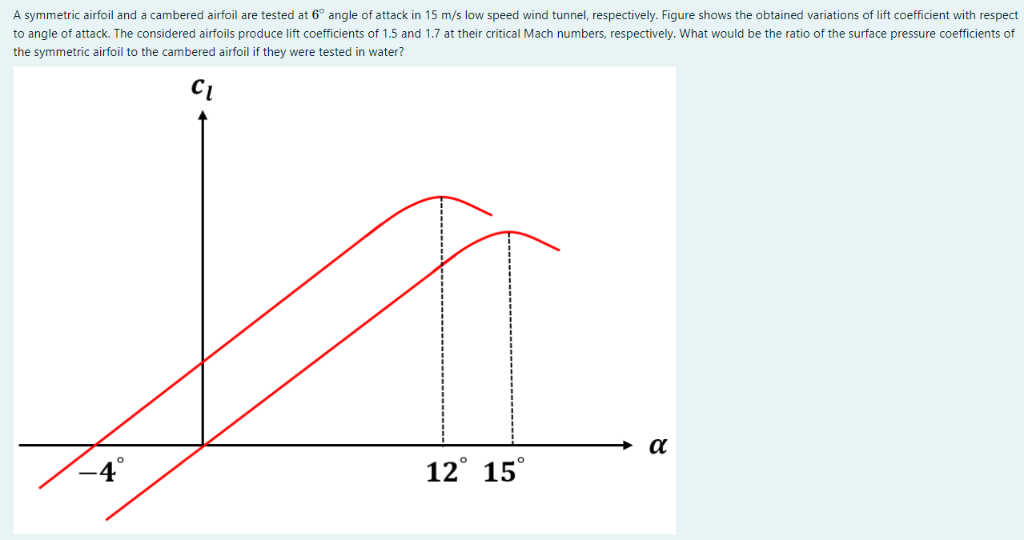 A symmetric airfoil and a cambered airfoil are tested at 6° angle of attack in 15 m/s low speed wind tunnel, respectively. Figure shows the obtained variations of lift coefficient with respect
10 cle of tack. Th considered sols produce ft coefcents of 1.5 anc 1. their ica Mech numbers, resectvh, What woukl beth ati of the aace pressure coeficients of
ml
3]
A a
This is AI generated Response.
Asked by: manish kumar
Created at: 2025-09-24 00:02:03
Asked by: manish kumar
Created at: 2025-09-24 00:02:03
Final Answer:
Rendered
Raw Text
Did you like this answer?
Let's solve the problem step by step:
---
## **Step 1: Understand the Problem**
- **Given:**
- Symmetric and cambered airfoils tested at 6° angle of attack, 15 m/s wind tunnel.
- Lift coefficients at critical Mach numbers:
- Symmetric: \( c_{l, \text{crit}} = 1.5 \)
- Cambered: \( c_{l, \text{crit}} = 1.7 \)
- **Question:**
What is the ratio of the surface pressure coefficients (\( C_p \)) of the symmetric airfoil to the cambered airfoil if tested in **water**?
---
## **Step 2: Relevant Formulas**
### **Lift Coefficient**
\[
c_L = \frac{L}{\frac{1}{2} \rho V^2 S}
\]
### **Pressure Coefficient**
\[
C_p = \frac{p - p_\infty}{\frac{1}{2} \rho V^2}
\]
### **Relationship**
Lift is generated by the pressure difference over the airfoil, which is related to the surface pressure coefficients. For similar shapes and flow regimes, the ratio of \( c_L \) in different fluids depends on the ratio of dynamic pressures, which is related to density.
---
## **Step 3: What Changes in Water?**
When moving from air to water:
- The **velocity** and **angle of attack** are unchanged.
- The **density** of the fluid changes significantly.
**Air density (\( \rho_{air} \))**: ~1.225 kg/m³
**Water density (\( \rho_{water} \))**: ~1000 kg/m³
---
## **Step 4: Surface Pressure Coefficient Ratio**
The pressure coefficient distribution over the surface gives rise to the lift coefficient. For geometrically similar flows (same \( \alpha \), \( V \)), the ratio of pressure coefficients will be proportional to the ratio of lift coefficients (since dynamic pressure is accounted for in both).
\[
\left( \frac{C_{p,\text{sym}}}{C_{p,\text{cambered}}} \right)_{water} = \frac{c_{l,\text{sym}}}{c_{l,\text{cambered}}}
\]
Given:
- \( c_{l,\text{sym}} = 1.5 \)
- \( c_{l,\text{cambered}} = 1.7 \)
---
## **Step 5: Calculate the Ratio**
\[
\text{Ratio} = \frac{c_{l,\text{sym}}}{c_{l,\text{cambered}}} = \frac{1.5}{1.7}
\]
\[
\boxed{0.88}
\]
---
## **Step 6: Final Answer**
### **The ratio of the surface pressure coefficients of the symmetric airfoil to the cambered airfoil, if tested in water, is:**
\[
\boxed{0.88}
\]
---
### **Summary Table**
| Airfoil Type | Lift Coefficient (\(c_l\)) | Pressure Coefficient Ratio (\(C_p\)) |
|-------------------|---------------------------|--------------------------------------|
| Symmetric | 1.5 | 0.88 |
| Cambered | 1.7 | 1 |
---
**If you have any doubts or want to see the effect of density or velocity, let me know!**
📢 Instructions:
- Ask anything relatd to above question only.
- For new Question goto :