Act like a helpful tutor and exlain me :
Give step-by-step solution with explanation and final answer:
explain in detailYou are designing a new diagnostic instrument for cancer patients. Unfortunately, the
instrument has a high temperature at the diagnostic surface (i.e. the surface in contact
with the skin), 7 = 57.0°C". The information that can be extracted using your device is
valuable enough that some damage to the patient's skin is acceptable, but it needs to
stay within the epidermis, which is the outer layer of skin, and is approximately
x = 1.0 mm thick. Cell death occurs if the temperature is above T" > 47°C" for
more than A¢ > 10. s. You may assume that the body temperature is Tj, = 37°C".
How quickly does your instrument need to collect the diagnostic information to avoid
unacceptable damage to the patient's skin?
You may assume that the tissue thermal properties are similar to water with
a=15x 10-7 ang Cp =4.0x 10°.
s kg K
Question:
Act like a helpful tutor and exlain me :
Give step-by-step solution with explanation and final answer:
explain in detailYou are designing a new diagnostic instrument for cancer patients. Unfortunately, the
instrument has a high temperature at the diagnostic surface (i.e. the surface in contact
with the skin), 7 = 57.0°C". The information that can be extracted using your device is
valuable enough that some damage to the patient's skin is acceptable, but it needs to
stay within the epidermis, which is the outer layer of skin, and is approximately
x = 1.0 mm thick. Cell death occurs if the temperature is above T" > 47°C" for
more than A¢ > 10. s. You may assume that the body temperature is Tj, = 37°C".
How quickly does your instrument need to collect the diagnostic information to avoid
unacceptable damage to the patient's skin?
You may assume that the tissue thermal properties are similar to water with
a=15x 10-7 ang Cp =4.0x 10°.
s kg K
This is AI generated Response.
Asked by: manish kumar
Created at: 2025-09-20 16:37:48
Final Answer:
RenderedRaw Text
Did you like this answer?
Let's break down the problem and solve step by step.
---
## **Step 1: Restate Key Information**
- **Surface temperature, \( T_s = 57.0^\circ C \)**
- **Body (initial) temperature, \( T_b = 37.0^\circ C \)**
- **Critical temperature for cell death, \( T_c = 47.0^\circ C \)**
- **Maximum allowed time above \( T_c \): \( \Delta t = 10 \) s**
- **Thickness of epidermis, \( x = 1.0 \) mm \( = 1.0 \times 10^{-3} \) m**
- **Thermal diffusivity, \( \alpha = 1.5 \times 10^{-7} \) m²/s**
- **Specific heat, \( C_p = 4.0 \times 10^3 \) J/(kg·K)**
---
## **Step 2: Which Equation to Use?**
This is a **transient heat conduction** problem with a sudden change in surface temperature.
We want to know **how long it takes for the temperature at \( x = 1.0 \) mm to reach \( 47^\circ C \)**.
For a semi-infinite solid with initial temperature \( T_b \), suddenly exposed to \( T_s \) at the surface at \( t = 0 \):
\[
\frac{T(x,t) - T_s}{T_b - T_s} = \text{erf}\left( \frac{x}{2\sqrt{\alpha t}} \right)
\]
Or rewritten:
\[
T(x, t) = T_s + (T_b - T_s) \cdot \text{erf}\left( \frac{x}{2\sqrt{\alpha t}} \right)
\]
We want to find \( t \) such that \( T(x, t) = T_c \).
---
## **Step 3: Plug in the Numbers**
Rearrange for the error function:
\[
T_c = T_s + (T_b - T_s) \cdot \text{erf}\left( \frac{x}{2\sqrt{\alpha t}} \right)
\]
\[
\frac{T_c - T_s}{T_b - T_s} = \text{erf}\left( \frac{x}{2\sqrt{\alpha t}} \right)
\]
Plug in values:
- \( T_c = 47 \)
- \( T_s = 57 \)
- \( T_b = 37 \)
\[
\frac{47 - 57}{37 - 57} = \frac{-10}{-20} = 0.5
\]
So,
\[
\text{erf}\left( \frac{x}{2\sqrt{\alpha t}} \right) = 0.5
\]
The value for which \( \text{erf}(z) = 0.5 \) is \( z \approx 0.4769 \).
---
## **Step 4: Solve for \( t \)**
\[
\frac{x}{2\sqrt{\alpha t}} = 0.4769
\]
\[
x = 2 \cdot 0.4769 \cdot \sqrt{\alpha t}
\]
\[
\frac{x}{0.9538} = \sqrt{\alpha t}
\]
\[
\left(\frac{x}{0.9538}\right)^2 = \alpha t
\]
\[
t = \frac{1}{\alpha} \left(\frac{x}{0.9538}\right)^2
\]
Plug in numbers:
- \( x = 1.0 \times 10^{-3} \) m
- \( \alpha = 1.5 \times 10^{-7} \) m²/s
\[
t = \frac{1}{1.5 \times 10^{-7}} \left(\frac{1.0 \times 10^{-3}}{0.9538}\right)^2
\]
Calculate inside the parenthesis:
\[
\frac{1.0 \times 10^{-3}}{0.9538} = 1.048 \times 10^{-3}
\]
\[
(1.048 \times 10^{-3})^2 = 1.098 \times 10^{-6}
\]
Now for \( t \):
\[
t = \frac{1.098 \times 10^{-6}}{1.5 \times 10^{-7}}
\]
\[
t = 7.319 \, \text{s}
\]
---
## **Step 5: Interpret the Result**
**It takes about 7.3 seconds for the temperature at a depth of 1 mm to reach 47°C.**
But cell damage only occurs if the temperature is above 47°C for more than 10 s. Since it takes 7.3 s to reach 47°C, the **maximum allowed time for the instrument to be on is \( 7.3 + 10 = 17.3 \) seconds**.
---
## **## Final Answer**
### **To avoid unacceptable damage to the patient's skin, your instrument should collect diagnostic information within approximately \(\boxed{17 \, \text{seconds}}\).**
---
### **Summary of Steps**
1. **Used transient heat conduction (semi-infinite solid) solution.**
2. **Solved for time to reach critical temperature at 1 mm depth.**
3. **Added the extra allowed 10 s above threshold.**
4. **Final safe exposure time is about 17 seconds.**
If you need more details or explanations for any step, let me know!
VIPSolutions focuses on clear, step‑by‑step explanations so you can learn quickly. Whether you need an AI‑generated walkthrough or a short hint to get unstuck, each solution is organized for fast reading and easy review later.
Search similar questions, compare approaches, and bookmark the best answers for revision. Our goal is simple: quick, reliable study help that feels natural—not noisy.
 VIPSolutions
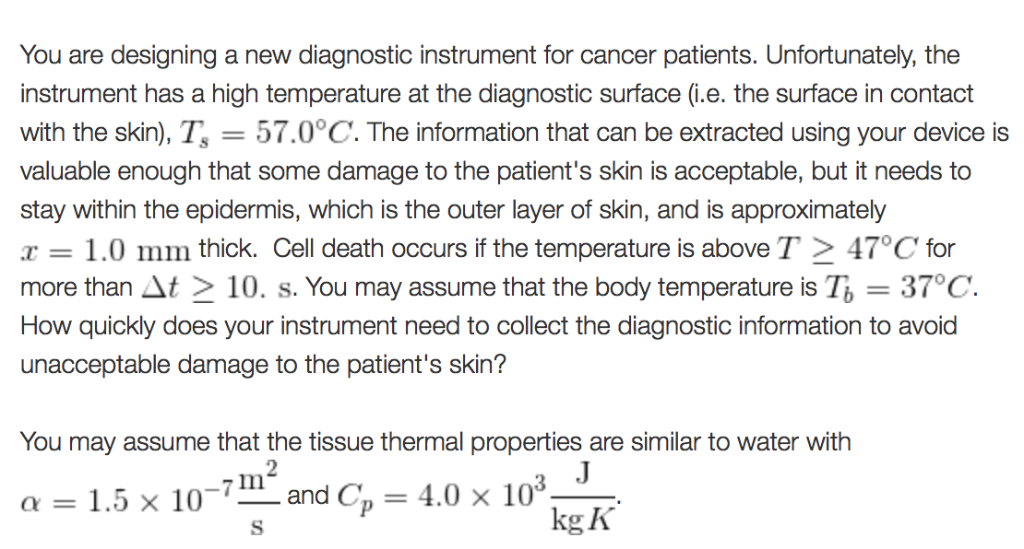 You are designing a new diagnostic instrument for cancer patients. Unfortunately, the
instrument has a high temperature at the diagnostic surface (i.e. the surface in contact
with the skin), 7 = 57.0°C". The information that can be extracted using your device is
valuable enough that some damage to the patient's skin is acceptable, but it needs to
stay within the epidermis, which is the outer layer of skin, and is approximately
x = 1.0 mm thick. Cell death occurs if the temperature is above T" > 47°C" for
more than A¢ > 10. s. You may assume that the body temperature is Tj, = 37°C".
How quickly does your instrument need to collect the diagnostic information to avoid
unacceptable damage to the patient's skin?
You may assume that the tissue thermal properties are similar to water with
a=15x 10-7 ang Cp =4.0x 10°.
s kg K