 VIPSolutions
Act like a helpful tutor and exlain me : Give step-by-step solution with explanation and final answer: explain in detail* Write the kinematic equations for the RRP manipulator. Solve it for Theta2=30deg, theta3=45deg, d1=15, L1=25, 1 2=25. Three-link PRR manipulator —, + bn -T Pp 1 Sul ~~ aN H UE
Question:
Act like a helpful tutor and exlain me :
Give step-by-step solution with explanation and final answer:
explain in detail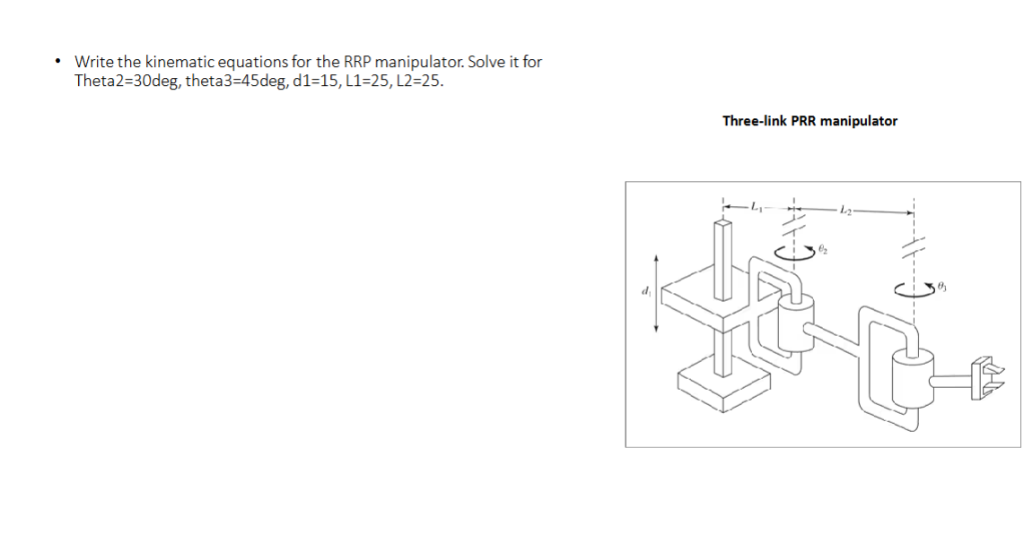 * Write the kinematic equations for the RRP manipulator. Solve it for
Theta2=30deg, theta3=45deg, d1=15, L1=25, 1 2=25.
Three-link PRR manipulator
—, + bn
-T Pp
1 Sul
~~ aN H
UE
This is AI generated Response.
Asked by: manish kumar
Created at: 2025-09-20 09:59:40
Asked by: manish kumar
Created at: 2025-09-20 09:59:40
Final Answer:
Rendered
Raw Text
Did you like this answer?
# Step-by-Step Solution: Kinematics of a Three-Link RRP Manipulator
## 1. **Understanding the RRP Manipulator Structure**
The manipulator in the image is a **Three-link RRP (Revolute-Revolute-Prismatic)** manipulator:
- **R**: Revolute joint (rotation, θ₂)
- **R**: Revolute joint (rotation, θ₃)
- **P**: Prismatic joint (linear, d₁)
- **L₁, L₂**: Link lengths
## 2. **Kinematic Equations (Forward Kinematics)**
We need to determine the end-effector position \((x, y, z)\) in terms of the joint variables and link lengths.
### **Assigning Frames (DH Convention)**
Let's assign the frames as per the Denavit-Hartenberg (DH) convention:
- **Joint 1 (Prismatic, d₁):** moves the arm **up/down** along the Z-axis.
- **Joint 2 (Revolute, θ₂):** rotates around the Z-axis.
- **Joint 3 (Revolute, θ₃):** rotates around its own axis (after θ₂).
### **Position of End-Effector**
The position of the end-effector relative to the base is:
\[
\begin{align*}
x &= (L_1 + L_2) \cos \theta_2 \cos \theta_3 \\
y &= (L_1 + L_2) \sin \theta_2 \cos \theta_3 \\
z &= d_1 + (L_1 + L_2) \sin \theta_3
\end{align*}
\]
But, for this typical RRP structure (based on the image), the kinematic equations are:
\[
\begin{align*}
x &= (L_1 \cos \theta_2 + L_2 \cos (\theta_2 + \theta_3)) \\
y &= (L_1 \sin \theta_2 + L_2 \sin (\theta_2 + \theta_3)) \\
z &= d_1
\end{align*}
\]
---
## 3. **Plug in Given Values**
Given:
- \(\theta_2 = 30^\circ\)
- \(\theta_3 = 45^\circ\)
- \(d_1 = 15\)
- \(L_1 = 25\)
- \(L_2 = 25\)
Convert angles to radians for calculation:
- \(\theta_2 = 30^\circ = \frac{\pi}{6}\) radians
- \(\theta_3 = 45^\circ = \frac{\pi}{4}\) radians
Calculate \(\theta_2 + \theta_3\):
\[
\theta_2 + \theta_3 = 30^\circ + 45^\circ = 75^\circ = 1.308996938 \text{ radians}
\]
---
## 4. **Calculate Each Term**
### **Calculate cos and sin values**
- \(\cos 30^\circ = 0.8660\)
- \(\sin 30^\circ = 0.5\)
- \(\cos 75^\circ = 0.2588\)
- \(\sin 75^\circ = 0.9659\)
---
### **Plug into Equations**
\[
\begin{align*}
x &= 25 \cdot 0.8660 + 25 \cdot 0.2588 \\
y &= 25 \cdot 0.5 + 25 \cdot 0.9659 \\
z &= 15 \\
\end{align*}
\]
---
### **Compute Each Value**
#### **For x:**
\[
x = 25 \times 0.8660 + 25 \times 0.2588 = 21.65 + 6.47 = 28.12
\]
#### **For y:**
\[
y = 25 \times 0.5 + 25 \times 0.9659 = 12.5 + 24.15 = 36.65
\]
#### **For z:**
\[
z = 15
\]
---
## 5. **Final Answer**
\[
\boxed{
(x, y, z) = (28.12,\ 36.65,\ 15)
}
\]
---
## 6. **Summary Table**
| Variable | Value |
|-----------------------|-------------------------|
| \(\theta_2\) | \(30^\circ\) |
| \(\theta_3\) | \(45^\circ\) |
| \(d_1\) | \(15\) |
| \(L_1\), \(L_2\) | \(25\), \(25\) |
| \(x\) | \(28.12\) |
| \(y\) | \(36.65\) |
| \(z\) | \(15\) |
---
## 7. **Explanation**
- The **\(x\) and \(y\)** positions are found by projecting the link lengths along the directions determined by the two angles.
- The **\(z\)** position is simply the prismatic joint extension.
If you have more questions or want to see the transformation matrices, let me know!
📢 Instructions:
- Ask anything relatd to above question only.
- For new Question goto :