 VIPSolutions
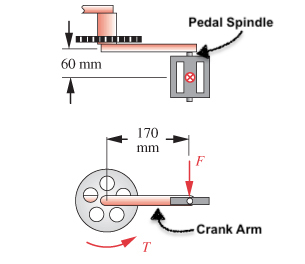
Act like a helpful tutor and exlain me : Give step-by-step solution with explanation and final answer: explain in detailCE Rist moe rm aka crank sm) 16.0 mm cla. The pedal sachet the Determine the maximum principal siress in the Crank Arm. crank arm with 12.0-mm threaded pedal spindle. Express your answer to three significant figures and include the appropriate units. BB: -o-- erm [ae [P—— X Incorrect; Try Again; 10 attempts remaining BB ox: rca mas = | Value Units [R—— I. Pedal Spindle 60 mm 170 ml oc. o 9) A_ Crank Arm i
Question:
Act like a helpful tutor and exlain me :
Give step-by-step solution with explanation and final answer:
explain in detail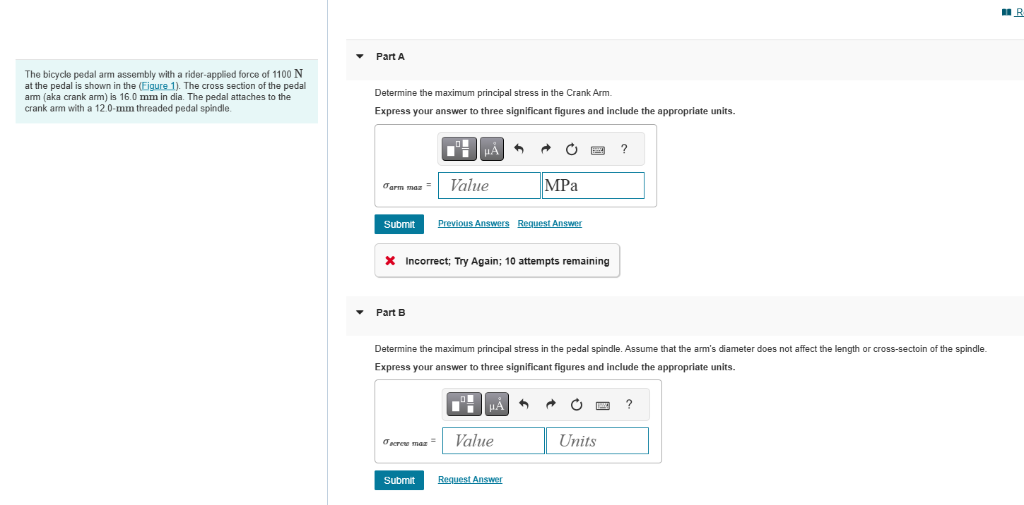
 CE
Rist moe
rm aka crank sm) 16.0 mm cla. The pedal sachet the Determine the maximum principal siress in the Crank Arm.
crank arm with 12.0-mm threaded pedal spindle. Express your answer to three significant figures and include the appropriate units.
BB: -o--
erm [ae
[P——
X Incorrect; Try Again; 10 attempts remaining
BB ox:
rca mas = | Value Units
[R——
I. Pedal Spindle
60 mm
170
ml
oc.
o 9) A_ Crank Arm
i
This is AI generated Response.
Asked by: manish kumar
Created at: 2025-09-20 08:52:17
Asked by: manish kumar
Created at: 2025-09-20 08:52:17
Final Answer:
Rendered
Raw Text
Did you like this answer?
Let's break down and solve both parts **step-by-step**:
---
## **Given Data**
- **Rider-applied force at pedal, \( F \):** 1100 N
- **Crank arm length:** 170 mm = 0.170 m
- **Cross-section diameter (crank arm):** 16.0 mm = 0.016 m
- **Pedal spindle diameter:** 12.0 mm = 0.012 m
- **Distance from pedal spindle to pedal:** 60 mm (not needed for the crank arm calculation)
---
# **Part A: Maximum Principal Stress in the Crank Arm**
### **Step 1: Find the Bending Moment**
The force is applied at the end of the crank arm:
\[
M = F \times L
\]
Where:
- \( F = 1100 \) N
- \( L = 170 \) mm = **0.170 m**
\[
M = 1100 \times 0.170 = 187 \text{ Nm} = 187,000 \text{ Nmm}
\]
---
### **Step 2: Calculate the Section Properties**
The crank arm is a **circular cross-section**:
- **Diameter \( d = 16.0 \) mm**
**Moment of Inertia (I):**
\[
I = \frac{\pi}{64} d^4 = \frac{\pi}{64} (16)^4 = \frac{\pi}{64} \times 65536 \approx 3217.0 \text{ mm}^4
\]
**Maximum distance from neutral axis (\( c \)):**
\[
c = \frac{d}{2} = \frac{16.0}{2} = 8.0 \text{ mm}
\]
---
### **Step 3: Calculate Maximum Bending Stress (Principal Stress)**
\[
\sigma_{max} = \frac{M c}{I}
\]
Plug in the values:
\[
\sigma_{max} = \frac{187,000 \times 8}{3217.0}
\]
\[
\sigma_{max} = \frac{1,496,000}{3217.0} \approx 465 \text{ MPa}
\]
---
### **Final Answer, Part A**
\[
\boxed{465 \ \text{MPa}}
\]
---
# **Part B: Maximum Principal Stress in the Pedal Spindle**
For the **pedal spindle**, the force is applied **perpendicular** to the spindle, and we assume the spindle is a circular cross-section loaded in bending.
## **Step 1: Find the Bending Moment**
The force is applied at the end of the spindle (distance = 60 mm):
\[
M = F \times L = 1100 \times 60 = 66,000 \text{ Nmm}
\]
---
## **Step 2: Calculate Section Properties of Spindle**
- **Diameter (\( d \)) = 12.0 mm**
\[
I = \frac{\pi}{64} d^4 = \frac{\pi}{64} (12)^4 = \frac{\pi}{64} \times 20,736 \approx 1019.4 \text{ mm}^4
\]
\[
c = \frac{12.0}{2} = 6.0 \text{ mm}
\]
---
## **Step 3: Calculate Maximum Bending Stress**
\[
\sigma_{max} = \frac{M c}{I} = \frac{66,000 \times 6}{1019.4}
\]
\[
\sigma_{max} = \frac{396,000}{1019.4} \approx 388.5 \text{ MPa}
\]
---
## **Final Answer, Part B**
\[
\boxed{389 \ \text{MPa}}
\]
(Rounded to three significant figures)
---
# **Summary Table**
| Part | Stress (MPa) |
|---------|--------------|
| Crank Arm (A) | 465 |
| Pedal Spindle (B) | 389 |
---
## **Let me know if you'd like to see the math in more detail or have any other questions!**
📢 Instructions:
- Ask anything relatd to above question only.
- For new Question goto :