 VIPSolutions
Act like a helpful tutor and exlain me : Give step-by-step solution with explanation and final answer:JR — o i xXx a tity te biaion of xch siogen som ceed. 2 pin) v2 MBS XX Ee I points) FS — points)
Question:
Act like a helpful tutor and exlain me :
Give step-by-step solution with explanation and final answer: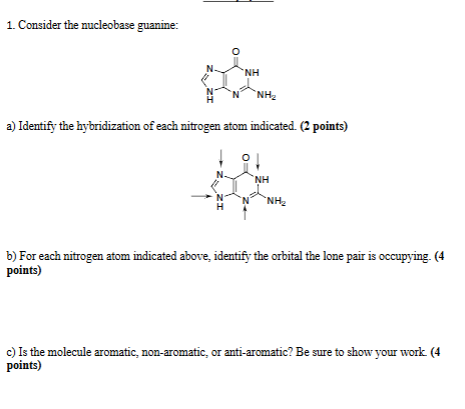 JR —
o
i
xXx
a
tity te biaion of xch siogen som ceed. 2 pin)
v2
MBS
XX
Ee
I
points)
FS —
points)
This is AI generated Response.
Asked by: Sagar
Created at: 2025-09-20 04:32:17
Asked by: Sagar
Created at: 2025-09-20 04:32:17
Final Answer:
Rendered
Raw Text
Did you like this answer?
Let's go through each part step by step for guanine:
---
## **a) Identify the hybridization of each nitrogen atom indicated.**
We will label the indicated nitrogen atoms as \( N_1, N_2, N_3, N_4 \) (clockwise from the top left, as shown by the arrows).
### **Step-by-step hybridization:**
#### **1. $N_1$ (Top, double-bonded to C, attached to H)**
- Attached to 2 atoms (C, H), 1 lone pair, and involved in aromatic ring.
- **Hybridization:** $sp^2$
#### **2. $N_2$ (Right, in amine group, attached to 2 H)**
- Attached to 1 C, 2 H, 1 lone pair.
- **Hybridization:** $sp^3$
#### **3. $N_3$ (Bottom, in ring, double-bonded to C)**
- Attached to 2 atoms (C, C), 1 lone pair, involved in aromatic ring.
- **Hybridization:** $sp^2$
#### **4. $N_4$ (Left, single-bonded in ring)**
- Attached to 2 atoms (C, C), 1 lone pair, involved in aromatic ring.
- **Hybridization:** $sp^2$
---
## **b) For each nitrogen atom, identify the orbital the lone pair is occupying.**
### **Step-by-step:**
#### **1. $N_1$ ($sp^2$)**
- Lone pair is in an **sp² orbital** (perpendicular to the p orbital involved in the aromatic π system).
#### **2. $N_2$ ($sp^3$)**
- Lone pair is in an **sp³ orbital** (not involved in aromaticity).
#### **3. $N_3$ ($sp^2$)**
- Lone pair is in an **sp² orbital** (same as above).
#### **4. $N_4$ ($sp^2$)**
- Lone pair is in a **p orbital**, contributing to the aromatic π system.
---
## **c) Is the molecule aromatic, non-aromatic, or anti-aromatic?**
### **Step-by-step:**
#### **Aromaticity criteria:**
1. **Planarity**: The molecule must be planar.
2. **Cyclic**: The molecule must be cyclic.
3. **Conjugation**: There must be a continuous ring of p orbitals (conjugation).
4. **Hückel's Rule**: Must have \(4n+2\) π electrons.
#### **Count π electrons in ring:**
- **C=C double bonds:** 2 (each contributes 2 π electrons) = 4 electrons
- **N_4** (left): lone pair in p orbital = 2 electrons
Total π electrons in the ring: **6 π electrons**
#### **Apply Hückel's Rule:**
- \(4n+2 = 6 \implies n=1\)
- Satisfies Hückel's rule
#### **Conclusion:**
- The molecule is **aromatic**.
---
## **Final Answers**
### **a) Hybridization:**
- $N_1$: $sp^2$
- $N_2$: $sp^3$
- $N_3$: $sp^2$
- $N_4$: $sp^2$
### **b) Lone Pair Orbital:**
- $N_1$: $sp^2$
- $N_2$: $sp^3$
- $N_3$: $sp^2$
- $N_4$: p orbital (participates in aromaticity)
### **c) Aromaticity:**
- **Guanine is aromatic** (planar, cyclic, conjugated, 6 π electrons; satisfies Hückel’s rule).
---
**Let me know if you'd like a diagram or further clarification!**
📢 Instructions:
- Ask anything relatd to above question only.
- For new Question goto :