Act like a helpful tutor and exlain me :
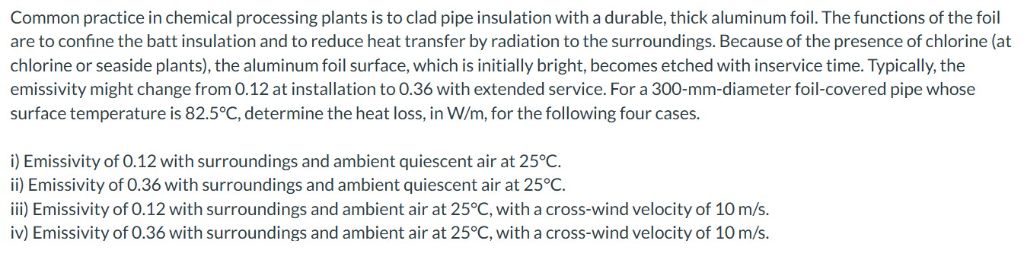
Give step-by-step solution with explanation and final answer:Common practice in chemical processing plants is to clad pipe insulation with a durable, thick aluminum foil. The functions of the foil
are to confine the batt insulation and to reduce heat transfer by radiation to the surroundings. Because of the presence of chlorine (at
chlorine or seaside plants), the aluminum foil surface, which is initially bright, becomes etched with inservice time. Typically, the
emissivity might change from 0.12 at installation to 0.36 with extended service. For a 300-mm-diameter foil-covered pipe whose
surface temperature is 82.5°C, determine the heat loss, in W/m, for the following four cases.
i) Emissivity of 0.12 with surroundings and ambient quiescent air at 25°C.
ii) Emissivity of 0.36 with surroundings and ambient quiescent air at 25°C.
iii) Emissivity of 0.12 with surroundings and ambient air at 25°C, with a cross-wind velocity of 10 m/s.
iv) Emissivity of 0.36 with surroundings and ambient air at 25°C, with a cross-wind velocity of 10 m/s.
Question:
Act like a helpful tutor and exlain me :
Give step-by-step solution with explanation and final answer:Common practice in chemical processing plants is to clad pipe insulation with a durable, thick aluminum foil. The functions of the foil
are to confine the batt insulation and to reduce heat transfer by radiation to the surroundings. Because of the presence of chlorine (at
chlorine or seaside plants), the aluminum foil surface, which is initially bright, becomes etched with inservice time. Typically, the
emissivity might change from 0.12 at installation to 0.36 with extended service. For a 300-mm-diameter foil-covered pipe whose
surface temperature is 82.5°C, determine the heat loss, in W/m, for the following four cases.
i) Emissivity of 0.12 with surroundings and ambient quiescent air at 25°C.
ii) Emissivity of 0.36 with surroundings and ambient quiescent air at 25°C.
iii) Emissivity of 0.12 with surroundings and ambient air at 25°C, with a cross-wind velocity of 10 m/s.
iv) Emissivity of 0.36 with surroundings and ambient air at 25°C, with a cross-wind velocity of 10 m/s.
This is AI generated Response.
Asked by: manish kumar
Created at: 2025-09-19 20:54:24
Final Answer:
RenderedRaw Text
Did you like this answer?
Let's break down the problem step by step:
---
## **Given Data**
- **Pipe diameter, \( D \) = 300 mm = 0.3 m**
- **Surface temperature, \( T_s \) = 82.5°C = 355.65 K (since \( T(K) = T(°C) + 273.15 \))**
- **Ambient temperature, \( T_\infty \) = 25°C = 298.15 K**
- **Emissivity, \( \epsilon \):** 0.12 or 0.36
- **Cross-wind velocity, \( V \):** 0 or 10 m/s
- **Stefan-Boltzmann constant, \( \sigma = 5.67 \times 10^{-8} \) W/m²·K⁴**
---
## **Step 1: Calculate Heat Loss by Radiation**
The radiative heat loss per unit area:
\[
q_{rad} = \epsilon \sigma (T_s^4 - T_\infty^4)
\]
---
## **Step 2: Calculate Heat Loss by Convection**
**For a horizontal cylinder:**
\[
q_{conv} = h (T_s - T_\infty)
\]
Where \( h \) is the convective heat transfer coefficient.
### **a) For Quiescent Air (Natural Convection):**
For a horizontal cylinder, the empirical correlation is:
\[
Nu = C \cdot (Gr \cdot Pr)^n
\]
where \( Nu = \frac{hD}{k} \).
We'll use the Churchill and Chu correlation for natural convection:
\[
Nu = 0.60 + \frac{0.387 Ra^{1/6}}{\left[1 + (0.559/Pr)^{9/16}\right]^{8/27}}
\]
where \( Ra = Gr \cdot Pr \).
We'll need properties at the film temperature:
\[
T_f = \frac{T_s + T_\infty}{2} = \frac{355.65 + 298.15}{2} = 326.9 \text{ K} \approx 53.75^\circ\text{C}
\]
**From typical air property tables at 54°C:**
- \( \nu = 20.0 \times 10^{-6} \) m²/s
- \( k = 0.027 \) W/m·K
- \( Pr = 0.71 \)
- \( \beta = 1/T_f = 1/326.9 = 0.00306 \) 1/K
\[
Gr = \frac{g \beta (T_s - T_\infty) D^3}{\nu^2}
\]
\[
g = 9.81 \text{ m/s}^2
\]
\[
Gr = \frac{9.81 \times 0.00306 \times (355.65 - 298.15) \times (0.3)^3}{(20.0 \times 10^{-6})^2}
\]
\[
Gr = \frac{9.81 \times 0.00306 \times 57.5 \times 0.027}{4 \times 10^{-10}}
\]
\[
= \frac{0.0519}{4 \times 10^{-10}}
\]
\[
0.00306 \times 57.5 = 0.17595
\]
\[
0.17595 \times 0.027 = 0.00475065
\]
\[
9.81 \times 0.00475065 = 0.0466
\]
\[
0.0466 / (4 \times 10^{-10}) = 1.165 \times 10^8
\]
\[
Pr = 0.71
\]
\[
Ra = Gr \cdot Pr = 1.165 \times 10^8 \times 0.71 = 8.27 \times 10^7
\]
Now, apply the Churchill & Chu correlation:
\[
Nu = 0.60 + \frac{0.387 (8.27 \times 10^7)^{1/6}}{[1 + (0.559/0.71)^{9/16}]^{8/27}}
\]
First, \( (8.27 \times 10^7)^{1/6} \approx 13.5 \)
Denominator:
\[
1 + (0.559/0.71)^{9/16} = 1 + (0.787)^{0.5625} \approx 1 + 0.870 = 1.87
\]
\[
[1.87]^{8/27} \approx 1.225
\]
So,
\[
Nu = 0.60 + \frac{0.387 \times 13.5}{1.225} = 0.60 + \frac{5.225}{1.225} = 0.60 + 4.27 = 4.87
\]
Now,
\[
h = \frac{Nu \cdot k}{D} = \frac{4.87 \times 0.027}{0.3} = 0.439 \text{ W/m}^2\text{K}
\]
### **b) For Forced Convection (Cross-wind 10 m/s):**
Empirical correlation for cylinder in cross-flow:
\[
Nu = 0.193 Re^{0.618} Pr^{1/3}
\]
\[
Re = \frac{V D}{\nu} = \frac{10 \times 0.3}{20 \times 10^{-6}} = 150,000
\]
\[
Nu = 0.193 \times (1.5 \times 10^5)^{0.618} \times (0.71)^{1/3}
\]
First, \( (1.5 \times 10^5)^{0.618} \approx 1526 \)
\[
(0.71)^{1/3} = 0.893
\]
\[
Nu = 0.193 \times 1526 \times 0.893 \approx 263
\]
\[
h = \frac{Nu \cdot k}{D} = \frac{263 \times 0.027}{0.3} = 23.7 \text{ W/m}^2\text{K}
\]
---
## **Step 3: **Total Heat Loss Calculation**
\[
q_{total} = q_{rad} + q_{conv}
\]
**Calculate \( q_{rad} \):**
\[
q_{rad} = \epsilon \sigma (T_s^4 - T_\infty^4)
\]
\[
T_s^4 = (355.65)^4 = 1.6 \times 10^{10}
\]
\[
T_\infty^4 = (298.15)^4 = 7.89 \times 10^{9}
\]
\[
T_s^4 - T_\infty^4 = 8.11 \times 10^9
\]
\[
q_{rad} = \epsilon \cdot 5.67 \times 10^{-8} \cdot 8.11 \times 10^9 = \epsilon \cdot 459.5 \text{ W/m}^2
\]
---
**Calculate \( q_{conv} \):**
\[
q_{conv} = h (T_s - T_\infty) = h \cdot (355.65 - 298.15) = h \cdot 57.5
\]
---
## **Step 4: Plug Values for All Cases**
### **i) \( \epsilon = 0.12 \), Quiescent Air (\( h = 0.439 \))**
\[
q_{rad} = 0.12 \times 459.5 = 55.1 \text{ W/m}^2
\]
\[
q_{conv} = 0.439 \times 57.5 = 25.25 \text{ W/m}^2
\]
\[
q_{total} = 55.1 + 25.25 = 80.35 \text{ W/m}^2
\]
---
### **ii) \( \epsilon = 0.36 \), Quiescent Air (\( h = 0.439 \))**
\[
q_{rad} = 0.36 \times 459.5 = 165.4 \text{ W/m}^2
\]
\[
q_{conv} = 25.25 \text{ W/m}^2
\]
\[
q_{total} = 165.4 + 25.25 = 190.65 \text{ W/m}^2
\]
---
### **iii) \( \epsilon = 0.12 \), Cross-wind 10 m/s (\( h = 23.7 \))**
\[
q_{rad} = 55.1 \text{ W/m}^2
\]
\[
q_{conv} = 23.7 \times 57.5 = 1,363 \text{ W/m}^2
\]
\[
q_{total} = 55.1 + 1,363 = 1,418.1 \text{ W/m}^2
\]
---
### **iv) \( \epsilon = 0.36 \), Cross-wind 10 m/s (\( h = 23.7 \))**
\[
q_{rad} = 165.4 \text{ W/m}^2
\]
\[
q_{conv} = 1,363 \text{ W/m}^2
\]
\[
q_{total} = 165.4 + 1,363 = 1,528.4 \text{ W/m}^2
\]
---
## **Summary Table**
| Case | Emissivity | \( h \) (W/m²·K) | \( q_{rad} \) (W/m²) | \( q_{conv} \) (W/m²) | \( q_{total} \) (W/m²) |
|------|------------|------------------|----------------------|----------------------|------------------------|
| i | 0.12 | 0.439 | 55.1 | 25.25 | 80.35 |
| ii | 0.36 | 0.439 | 165.4 | 25.25 | 190.65 |
| iii | 0.12 | 23.7 | 55.1 | 1,363 | 1,418.1 |
| iv | 0.36 | 23.7 | 165.4 | 1,363 | 1,528.4 |
---
## **Final Answers**
### **i. \( \epsilon = 0.12 \), Quiescent Air:**
**Heat loss = 80.4 W/m²**
### **ii. \( \epsilon = 0.36 \), Quiescent Air:**
**Heat loss = 190.7 W/m²**
### **iii. \( \epsilon = 0.12 \), Cross-wind 10 m/s:**
**Heat loss = 1,418 W/m²**
### **iv. \( \epsilon = 0.36 \), Cross-wind 10 m/s:**
**Heat loss = 1,528 W/m²**
---
**If you need step-by-step details for any specific step (for example, the property lookup or a particular equation), just ask!**
VIPSolutions focuses on clear, step‑by‑step explanations so you can learn quickly. Whether you need an AI‑generated walkthrough or a short hint to get unstuck, each solution is organized for fast reading and easy review later.
Search similar questions, compare approaches, and bookmark the best answers for revision. Our goal is simple: quick, reliable study help that feels natural—not noisy.
 VIPSolutions
 Common practice in chemical processing plants is to clad pipe insulation with a durable, thick aluminum foil. The functions of the foil
are to confine the batt insulation and to reduce heat transfer by radiation to the surroundings. Because of the presence of chlorine (at
chlorine or seaside plants), the aluminum foil surface, which is initially bright, becomes etched with inservice time. Typically, the
emissivity might change from 0.12 at installation to 0.36 with extended service. For a 300-mm-diameter foil-covered pipe whose
surface temperature is 82.5°C, determine the heat loss, in W/m, for the following four cases.
i) Emissivity of 0.12 with surroundings and ambient quiescent air at 25°C.
ii) Emissivity of 0.36 with surroundings and ambient quiescent air at 25°C.
iii) Emissivity of 0.12 with surroundings and ambient air at 25°C, with a cross-wind velocity of 10 m/s.
iv) Emissivity of 0.36 with surroundings and ambient air at 25°C, with a cross-wind velocity of 10 m/s.