 VIPSolutions
Act like a helpful tutor and exlain me : Give step-by-step solution with explanation and final answer: Solve only 3rd1. Consider the following QM system. A particle in a QM system has wavefunction 't' that is not an cigenfunction of the Energy Operator, H . The wave function '¥, however, can be expanded as a superposition of Eigenfunctions of the Energy operator represented by Wi, v2 and ys, and these Eigenfunctions have Eigenvalues Ey, Ey, and E; respectively of the Energy operator. [This means H yi = Ejyi. and Hy: = Eaya, H ys = Eas] Specifically, W can be written as ¥ = ciy) + cows + cays, where the Eigenfunctions yi, wy and y; are Orthonormal (means?), and c;, ¢; and c; arc the Expansion Coefficients. To reduce the complexity of the problem, assume ¥ is Normalized. Providing a brief rationale for your answer, what is the probability of getting E1 as the energy value for this QM state W? [Hint: A similar example was looked at in class. While this should be a very straight forward question, do not just guess an answer!]. Section #5. Some Details Required in providing a rationale. 2. For the particle in the system defined in Question 1, determine the average Energy. Details Required. [Hint: Review “Expectation value” section]. Section #5. +o PY Note: Reminder, (Ey= [W*H -¥ dt wo 3. Determine the standard deviation in the measurement of Encrgy for the system defined in Question 1 with wavefunction ¥. Please show all work. (Hint: This too was looked at in class]. Sections #4, #5. Details Required. Note: We have seen the approach used to find uncertainties or standard deviations in Quantum Mechanics. For this Question, it is given by of =+0% = EH (2? nN _*P 52 hr py Note: (£%)= TW*A W.dr= [W*H-(H-¥) dr. Hopefully you will see that Q3 is an extension of what you should have done in getting your answer to Q2. Do not be concerned that your answer for Q3 is a rather an “ungainly” looking one.
Question:
Act like a helpful tutor and exlain me :
Give step-by-step solution with explanation and final answer:
Solve only 3rd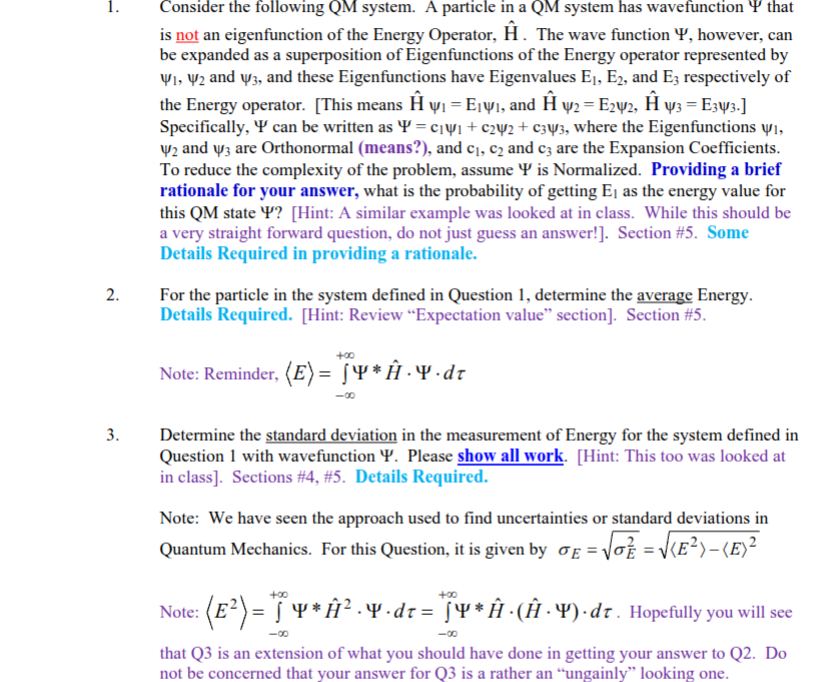 1. Consider the following QM system. A particle in a QM system has wavefunction 't' that
is not an cigenfunction of the Energy Operator, H . The wave function '¥, however, can
be expanded as a superposition of Eigenfunctions of the Energy operator represented by
Wi, v2 and ys, and these Eigenfunctions have Eigenvalues Ey, Ey, and E; respectively of
the Energy operator. [This means H yi = Ejyi. and Hy: = Eaya, H ys = Eas]
Specifically, W can be written as ¥ = ciy) + cows + cays, where the Eigenfunctions yi,
wy and y; are Orthonormal (means?), and c;, ¢; and c; arc the Expansion Coefficients.
To reduce the complexity of the problem, assume ¥ is Normalized. Providing a brief
rationale for your answer, what is the probability of getting E1 as the energy value for
this QM state W? [Hint: A similar example was looked at in class. While this should be
a very straight forward question, do not just guess an answer!]. Section #5. Some
Details Required in providing a rationale.
2. For the particle in the system defined in Question 1, determine the average Energy.
Details Required. [Hint: Review “Expectation value” section]. Section #5.
+o PY
Note: Reminder, (Ey= [W*H -¥ dt
wo
3. Determine the standard deviation in the measurement of Encrgy for the system defined in
Question 1 with wavefunction ¥. Please show all work. (Hint: This too was looked at
in class]. Sections #4, #5. Details Required.
Note: We have seen the approach used to find uncertainties or standard deviations in
Quantum Mechanics. For this Question, it is given by of =+0% = EH (2?
nN _*P 52 hr py
Note: (£%)= TW*A W.dr= [W*H-(H-¥) dr. Hopefully you will see
that Q3 is an extension of what you should have done in getting your answer to Q2. Do
not be concerned that your answer for Q3 is a rather an “ungainly” looking one.
Asked by: Sagar
Created at: 2025-09-19 19:18:11
Final Answer:
📢 Instructions:
- Ask anything relatd to above question only.
- For new Question goto :