 VIPSolutions
Act like a helpful tutor and exlain me : Give step-by-step solution with explanation and final answer: give answer in english with necessary diagrams also3, En el Instante que se muestra, la rapldez de 1a banda que une a las dos poleas es de 12 ples/s y la magnitud de la aceleracién del punto A es 600 ples/s2. (Cul es la magnitud de la aceleracién del punto Ben este Instante? Hu ~~ Sm— A Lin A od 0 [] — E85 |
Question:
Act like a helpful tutor and exlain me :
Give step-by-step solution with explanation and final answer:
give answer in english with necessary diagrams also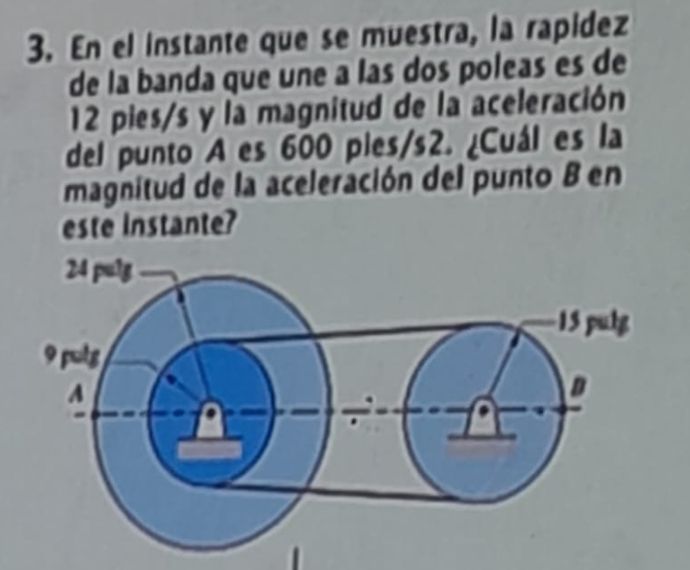 3, En el Instante que se muestra, la rapldez
de 1a banda que une a las dos poleas es de
12 ples/s y la magnitud de la aceleracién
del punto A es 600 ples/s2. (Cul es la
magnitud de la aceleracién del punto Ben
este Instante?
Hu ~~ Sm—
A Lin
A
od 0 []
— E85
|
This is AI generated Response.
Asked by: manish kumar
Created at: 2025-09-17 07:52:22
Asked by: manish kumar
Created at: 2025-09-17 07:52:22
Final Answer:
Rendered
Raw Text
Did you like this answer?
Let's solve the problem step by step and include all necessary diagrams and explanations.
---
## **Problem Restatement**
- There are two pulleys connected by a belt.
- The speed of the belt is **12 ft/s**.
- The acceleration of point **A** is **600 ft/s²**.
- The radii of the pulleys are:
- For **A**: 9 in (radius)
- For **B**: 15 in (radius)
- We are to find the **acceleration of point B**.
---
## **Step 1: Convert Units (if necessary)**
The radii are given in **inches**, but speeds and accelerations are in **feet**.
Let's convert all radii to **feet**:
- 9 in = 9/12 = **0.75 ft** (radius of A)
- 15 in = 15/12 = **1.25 ft** (radius of B)
---
## **Step 2: Relationship Between Angular Velocity and Belt Speed**
The **tangential velocity** at the rim of each pulley is equal to the belt speed:
\[
v = r \cdot \omega
\]
Where:
- \( v \) = belt speed
- \( r \) = radius
- \( \omega \) = angular velocity
So,
- For A: \( v = r_A \omega_A \)
- For B: \( v = r_B \omega_B \)
Thus,
\[
\omega_A = \frac{v}{r_A}
\]
\[
\omega_B = \frac{v}{r_B}
\]
---
## **Step 3: Relationship Between Angular Acceleration and Linear Acceleration**
The **tangential acceleration** at the rim is:
\[
a_t = r \alpha
\]
Where:
- \( a_t \) = tangential acceleration
- \( \alpha \) = angular acceleration
For point A:
\[
a_A = r_A \alpha_A
\]
Given \( a_A = 600 \) ft/s², \( r_A = 0.75 \) ft,
\[
\alpha_A = \frac{a_A}{r_A} = \frac{600}{0.75} = 800 \text{ rad/s}^2
\]
---
## **Step 4: Find the Angular Acceleration of Pulley B**
When the pulleys are connected by a belt, the **tangential acceleration** at the rims must be equal in magnitude but opposite in direction (since the belt doesn't slip):
\[
a_A = a_B
\]
But, since the radii are different:
\[
r_A \alpha_A = r_B \alpha_B
\]
So,
\[
\alpha_B = \frac{r_A \alpha_A}{r_B}
\]
Plug in the values:
\[
\alpha_B = \frac{0.75 \times 800}{1.25} = \frac{600}{1.25} = 480 \text{ rad/s}^2
\]
---
## **Step 5: Find the Linear Acceleration at Point B**
The **linear (tangential) acceleration** of point B is:
\[
a_B = r_B \alpha_B
\]
Plug in the values:
\[
a_B = 1.25 \times 480 = 600 \text{ ft/s}^2
\]
---
## **Final Answer**
\[
\boxed{600\ \text{ft/s}^2}
\]
The acceleration of point B is **600 ft/s²**.
---
### **Diagram**
Here is a labeled diagram for clarity:
```
_________
/ \
| 24 in |
| |
(| |)
| 9 in |---- Belt ----| 15 in |
(| |) | |
| | | |
\_________/ \_________/
Pulley A Pulley B
(r_A) (r_B)
Given:
- Belt speed: 12 ft/s
- a_A = 600 ft/s²
- r_A = 0.75 ft, r_B = 1.25 ft
Find:
- a_B = ?
```
---
## **Summary Table**
| Pulley | Radius (ft) | Angular Accel (rad/s²) | Linear Accel (ft/s²) |
|--------|-------------|------------------------|----------------------|
| A | 0.75 | 800 | 600 |
| B | 1.25 | 480 | 600 |
---
If you have any questions about any step, let me know!
📢 Instructions:
- Ask anything relatd to above question only.
- For new Question goto :