 VIPSolutions
Act like a helpful tutor and exlain me : Give step-by-step solution with explanation and final answer:Known values: 7 (constant) 6 z 170 | 025trad | 13sin(8)n Problem Statement: carousel horse folows 2 3D pa described in cylindrical coordinates i he able. Determine th veloc and acceleraion vectors and magnus whe 115 seconds. Numerical Answers: (nude unis) (158) = it gt k (158) = dirt gt k lIz(1s8)ll = la(ass)| =
Question:
Act like a helpful tutor and exlain me :
Give step-by-step solution with explanation and final answer: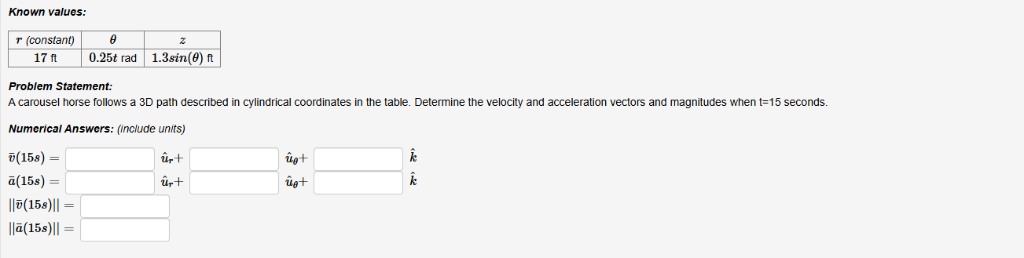 Known values:
7 (constant) 6 z
170 | 025trad | 13sin(8)n
Problem Statement:
carousel horse folows 2 3D pa described in cylindrical coordinates i he able. Determine th veloc and acceleraion vectors and magnus whe 115 seconds.
Numerical Answers: (nude unis)
(158) = it gt k
(158) = dirt gt k
lIz(1s8)ll =
la(ass)| =
This is AI generated Response.
Asked by: manish kumar
Created at: 2025-09-15 09:00:38
Asked by: manish kumar
Created at: 2025-09-15 09:00:38
Final Answer:
Rendered
Raw Text
Did you like this answer?
Let's break down the problem **step-by-step**:
---
## **Step 1: Extract Given Values**
- \( r = 17 \) ft (constant)
- \( \theta = 0.25t \) rad
- \( z = 1.8\sin(\theta) \) ft
- \( t = 15 \) s
---
## **Step 2: Cylindrical Coordinates to Velocity and Acceleration**
### **General Formulas in Cylindrical Coordinates**
For position: \( \vec{r} = r\hat{u}_r + z \hat{k} \)
With \( r, \theta, z \) all functions of time:
**Velocity:**
\[
\vec{v} = \dot{r}\hat{u}_r + r\dot{\theta}\hat{u}_\theta + \dot{z}\hat{k}
\]
**Acceleration:**
\[
\vec{a} = (\ddot{r} - r\dot{\theta}^2)\hat{u}_r + (r\ddot{\theta} + 2\dot{r}\dot{\theta})\hat{u}_\theta + \ddot{z}\hat{k}
\]
But since \( r \) is constant:
- \( \dot{r} = 0 \)
- \( \ddot{r} = 0 \)
So,
\[
\vec{v} = r\dot{\theta}\hat{u}_\theta + \dot{z}\hat{k}
\]
\[
\vec{a} = (-r\dot{\theta}^2)\hat{u}_r + (r\ddot{\theta})\hat{u}_\theta + \ddot{z}\hat{k}
\]
---
## **Step 3: Compute Needed Quantities at \( t = 15 \) s**
### **Calculate \( \theta \), \( \dot{\theta} \), \( \ddot{\theta} \):**
\[
\theta = 0.25t \implies \dot{\theta} = 0.25, \quad \ddot{\theta} = 0
\]
So:
- \( \theta(15) = 0.25 \times 15 = 3.75 \) rad
- \( \dot{\theta} = 0.25 \text{ rad/s} \)
- \( \ddot{\theta} = 0 \)
### **Calculate \( z \), \( \dot{z} \), \( \ddot{z} \):**
\[
z = 1.8\sin(\theta)
\]
\[
\dot{z} = 1.8\cos(\theta)\dot{\theta}
\]
\[
\ddot{z} = 1.8[-\sin(\theta)\dot{\theta}^2 + \cos(\theta)\ddot{\theta}]
\]
But \( \ddot{\theta}=0 \), so:
\[
\ddot{z} = -1.8\sin(\theta)\dot{\theta}^2
\]
Now substitute \( \theta = 3.75 \), \( \dot{\theta}=0.25 \):
- \( \sin(3.75) \approx -0.5716 \)
- \( \cos(3.75) \approx -0.8206 \)
\[
z = 1.8 \times (-0.5716) = -1.0289 \text{ ft}
\]
\[
\dot{z} = 1.8 \times (-0.8206) \times 0.25 = -0.3693 \text{ ft/s}
\]
\[
\ddot{z} = -1.8 \times (-0.5716) \times (0.25)^2 = 1.8 \times 0.5716 \times 0.0625 = 0.0643 \text{ ft/s}^2
\]
---
## **Step 4: Plug Into Velocity and Acceleration Formulas**
### **Velocity Vector**
\[
\vec{v} = r\dot{\theta} \hat{u}_\theta + \dot{z} \hat{k}
\]
\[
r\dot{\theta} = 17 \times 0.25 = 4.25 \text{ ft/s}
\]
So:
\[
\vec{v}(15s) = 0\,\hat{u}_r + 4.25\,\hat{u}_\theta + (-0.37)\,\hat{k} \approx 0\,\hat{u}_r + 4.25\,\hat{u}_\theta - 0.37\,\hat{k}
\]
### **Acceleration Vector**
\[
\vec{a} = (-r\dot{\theta}^2)\hat{u}_r + (r\ddot{\theta})\hat{u}_\theta + \ddot{z}\hat{k}
\]
\[
r\dot{\theta}^2 = 17 \times (0.25)^2 = 17 \times 0.0625 = 1.0625
\]
So:
\[
\vec{a}(15s) = -1.06\,\hat{u}_r + 0\,\hat{u}_\theta + 0.064\,\hat{k}
\]
---
## **Step 5: Magnitudes**
### **Velocity Magnitude**
\[
|\vec{v}| = \sqrt{(4.25)^2 + (-0.37)^2} = \sqrt{18.0625 + 0.1369} = \sqrt{18.1994} \approx 4.27\, \text{ft/s}
\]
### **Acceleration Magnitude**
\[
|\vec{a}| = \sqrt{(-1.06)^2 + (0)^2 + (0.064)^2} = \sqrt{1.1236 + 0.0041} = \sqrt{1.1277} \approx 1.06\, \text{ft/s}^2
\]
---
## **Step 6: Final Answers (with units!)**
### **Vectors**
\[
\boxed{
\vec{v}(15s) = 0\,\hat{u}_r + 4.25\,\hat{u}_\theta - 0.37\,\hat{k} \,\,\, \text{(ft/s)}
}
\]
\[
\boxed{
\vec{a}(15s) = -1.06\,\hat{u}_r + 0\,\hat{u}_\theta + 0.064\,\hat{k} \,\,\, \text{(ft/s}^2\text{)}
}
\]
### **Magnitudes**
\[
\boxed{
|\vec{v}(15s)| = 4.27\, \text{ft/s}
}
\]
\[
\boxed{
|\vec{a}(15s)| = 1.06\, \text{ft/s}^2
}
\]
---
### **Summary Table**
| Quantity | Value |
|-------------------------|------------------------------------|
| \(\vec{v}(15s)\) | \(0\,\hat{u}_r + 4.25\,\hat{u}_\theta - 0.37\,\hat{k}\) ft/s |
| \(\vec{a}(15s)\) | \(-1.06\,\hat{u}_r + 0\,\hat{u}_\theta + 0.064\,\hat{k}\) ft/s² |
| \(|\vec{v}(15s)|\) | \(4.27\) ft/s |
| \(|\vec{a}(15s)|\) | \(1.06\) ft/s² |
Let me know if you need *any step* explained in more detail!
📢 Instructions:
- Ask anything relatd to above question only.
- For new Question goto :