 VIPSolutions
Act like a helpful tutor and exlain me : Give step-by-step solution with explanation and final answer:1. During thermal bonding of nonwoven, the following parameters were considered- Applied Pressure- 1.2MPa, E= 24 Mpa, R,=200 mm, R,= 300 mm, L= 2000 mm, Web-speed- 200 m/min, T_=200 mm, T_ =60 mm SES suRSET Find the contact time and gap between rollers. If the fabric materia i * TK eS 3 Polypropylene and it has 50% porosity, then will the fabric be uniformly \\ heated, when both the rollers are subjected to similar quantity of heat, \ not the heat flux, and PP and air have thermal diffusivities of 0.1x10* and N 2x10 m/s, respectively. (24343)
Question:
Act like a helpful tutor and exlain me :
Give step-by-step solution with explanation and final answer: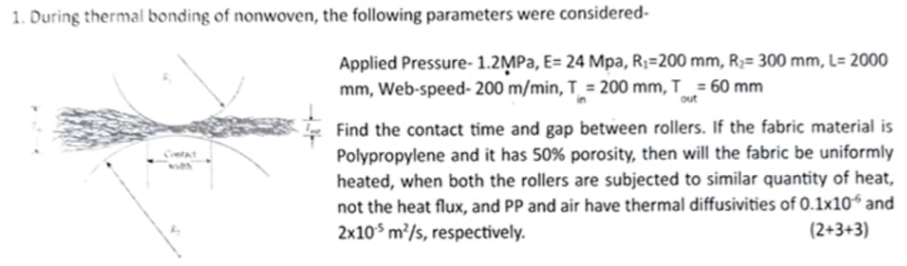 1. During thermal bonding of nonwoven, the following parameters were considered-
Applied Pressure- 1.2MPa, E= 24 Mpa, R,=200 mm, R,= 300 mm, L= 2000
mm, Web-speed- 200 m/min, T_=200 mm, T_ =60 mm
SES suRSET Find the contact time and gap between rollers. If the fabric materia i
* TK eS 3 Polypropylene and it has 50% porosity, then will the fabric be uniformly
\\ heated, when both the rollers are subjected to similar quantity of heat,
\ not the heat flux, and PP and air have thermal diffusivities of 0.1x10* and
N 2x10 m/s, respectively. (24343)
This is AI generated Response.
Asked by: manish kumar
Created at: 2025-09-14 17:16:24
Asked by: manish kumar
Created at: 2025-09-14 17:16:24
Final Answer:
Rendered
Raw Text
Did you like this answer?
Let's break down the problem step-by-step:
---
## **Given Data**
- **Applied Pressure, \(P\)** = 1.2 MPa
- **Young's Modulus, \(E\)** = 24 MPa
- **Roller Radii, \(R_1\)** = 200 mm, \(R_2\)** = 300 mm
- **Roller Length, \(L\)** = 2000 mm
- **Web speed, \(V\)** = 200 m/min = \( \frac{200}{60} = 3.33 \) m/s
- **Thickness in, \(T_{in}\)** = 200 mm
- **Thickness out, \(T_{out}\)** = 60 mm
- **Porosity** = 50%
- **Thermal Diffusivity**:
- Polypropylene (\(\alpha_{PP}\)) = \(0.1 \times 10^{-6}\) m\(^2\)/s
- Air (\(\alpha_{air}\)) = \(2 \times 10^{-5}\) m\(^2\)/s
---
## **1. Contact Time (\(t_c\))**
**Contact time** is the time for which a point on the web remains in contact with the roller.
\[
\text{Contact time, } t_c = \frac{\text{Contact width}}{\text{Web speed}}
\]
The **contact width (w)** can be estimated using the formula for the width of the flattened contact between two cylinders under pressure:
\[
w = \sqrt{\frac{4 P R_{eq} L}{\pi E}}
\]
Where,
- \(P\) = Applied Pressure
- \(E\) = Young's Modulus (of web)
- \(R_{eq}\) = Equivalent radius of rollers
For two cylinders:
\[
\frac{1}{R_{eq}} = \frac{1}{R_1} + \frac{1}{R_2}
\]
### **Step 1: Calculate \(R_{eq}\)**
\[
\frac{1}{R_{eq}} = \frac{1}{200} + \frac{1}{300} = \frac{3 + 2}{600} = \frac{5}{600}
\]
\[
R_{eq} = \frac{600}{5} = 120 \text{ mm} = 0.12 \text{ m}
\]
### **Step 2: Convert Units**
- \(P = 1.2 \) MPa = \(1.2 \times 10^6\) Pa
- \(E = 24 \) MPa = \(24 \times 10^6\) Pa
- \(L = 2000 \) mm = 2 m
- \(R_{eq} = 0.12\) m
### **Step 3: Calculate Contact Width (w)**
\[
w = \sqrt{ \frac{4 \times 1.2 \times 10^6 \times 0.12 \times 2 }{ \pi \times 24 \times 10^6 }}
\]
\[
= \sqrt{ \frac{4 \times 1.2 \times 0.12 \times 2 \times 10^6}{\pi \times 24 \times 10^6}}
\]
\[
= \sqrt{ \frac{1.152 \times 10^6}{75.398 \times 10^6} }
\]
\[
= \sqrt{ \frac{1.152}{75.398} }
\]
\[
= \sqrt{0.01528}
\]
\[
= 0.1236 \text{ m} = 123.6 \text{ mm}
\]
### **Step 4: Calculate Contact Time (\(t_c\))**
\[
t_c = \frac{w}{\text{Web speed}} = \frac{0.1236}{3.33} = 0.037 \text{ s} = 37 \text{ ms}
\]
---
## **2. Gap Between Rollers (\(g\))**
The gap is the thickness of the web after compression:
\[
g = T_{out}
\]
Given:
- \(T_{out} = 60 \) mm
---
## **3. Will the Fabric Be Uniformly Heated?**
Polypropylene web (50% porosity) is a composite of PP and air. To be uniformly heated, heat must penetrate the web during the contact time.
### **Thermal Diffusivity of the Web:**
\[
\alpha_{web} = (\text{fraction of PP}) \times \alpha_{PP} + (\text{fraction of air}) \times \alpha_{air}
\]
\[
= 0.5 \times 0.1 \times 10^{-6} + 0.5 \times 2 \times 10^{-5}
\]
\[
= 0.05 \times 10^{-6} + 1 \times 10^{-5}
\]
\[
= 0.05 \times 10^{-6} + 10 \times 10^{-6}
\]
\[
= 10.05 \times 10^{-6} \text{ m}^2/\text{s}
\]
### **Thermal Penetration Depth (\(\delta\)):**
\[
\delta = \sqrt{\alpha_{web} \cdot t_c}
\]
\[
\delta = \sqrt{10.05 \times 10^{-6} \times 0.037}
\]
\[
= \sqrt{0.37185 \times 10^{-6}}
\]
\[
= \sqrt{3.72 \times 10^{-7}}
\]
\[
= 6.1 \times 10^{-4} \text{ m} = 0.61 \text{ mm}
\]
**Compressed thickness = 60 mm**
**Penetration depth = 0.61 mm**
So, **the fabric will NOT be uniformly heated** during the contact time, as the penetration depth is much smaller than the compressed thickness.
---
## **### Final Answers**
**1. Contact time:**
\[
\boxed{0.037\, \text{s} \text{ or } 37\, \text{ms}}
\]
**2. Gap between rollers:**
\[
\boxed{60\, \text{mm}}
\]
**3. Will the fabric be uniformly heated?**
\[
\boxed{\text{No, because the thermal penetration depth (0.61 mm) is much less than the compressed web thickness (60 mm).}}
\]
📢 Instructions:
- Ask anything relatd to above question only.
- For new Question goto :