 VIPSolutions
Act like a helpful tutor and exlain me : Give step-by-step solution with explanation and final answer:MECHANICAL ENGINEERING Q1. A hollow shaft is required to transmit 600 kW at 200 rpm, the maximum shear stress limited to 60 N/mm?. 1. The external and internal diameters of the shaft. (10 marks) 2. The angle of twist over a length of 2 m if the shear modulus G = 80 GPa.). (10 marks) 3. Comment on the advantage of a hollow shaft over a solid shaft for the same torque transmission. (5 marks) Total = 25 marks
Question:
Act like a helpful tutor and exlain me :
Give step-by-step solution with explanation and final answer: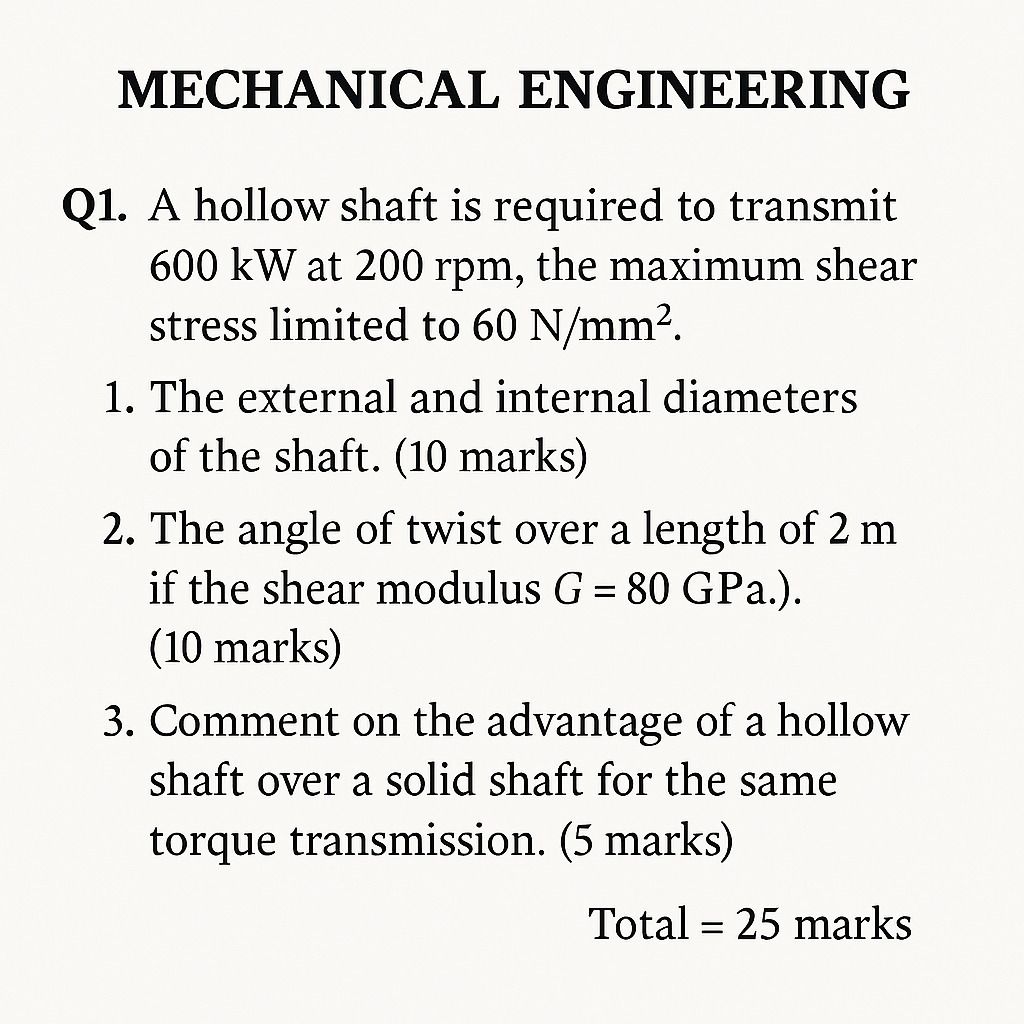 MECHANICAL ENGINEERING
Q1. A hollow shaft is required to transmit
600 kW at 200 rpm, the maximum shear
stress limited to 60 N/mm?.
1. The external and internal diameters
of the shaft. (10 marks)
2. The angle of twist over a length of 2 m
if the shear modulus G = 80 GPa.).
(10 marks)
3. Comment on the advantage of a hollow
shaft over a solid shaft for the same
torque transmission. (5 marks)
Total = 25 marks
This is AI generated Response.
Asked by: manish kumar
Created at: 2025-09-14 14:36:27
Asked by: manish kumar
Created at: 2025-09-14 14:36:27
Final Answer:
Rendered
Raw Text
Did you like this answer?
Let's solve the problem step by step.
---
# Q1. Hollow Shaft Design
## **Given Data**
- Power, \( P = 600 \) kW \( = 600 \times 10^3 \) W
- Speed, \( N = 200 \) rpm
- Max shear stress, \( \tau_{max} = 60 \) N/mm² \( = 60 \times 10^6 \) N/m²
- Shear modulus, \( G = 80 \) GPa \( = 80 \times 10^9 \) N/m²
- Shaft length, \( L = 2 \) m
Let:
- Outer diameter = \( D_o \)
- Inner diameter = \( D_i \)
- Let \( D_i = k D_o \) (commonly, \( k = 0.6 \) for hollow shafts, unless otherwise specified)
---
## **1. Finding External and Internal Diameters**
### **Step 1: Calculate Torque (\( T \))**
Power transmitted by a shaft:
\[
P = 2\pi N T / 60
\]
\[
T = \frac{P \times 60}{2\pi N}
\]
Plug in values:
\[
T = \frac{600,000 \times 60}{2\pi \times 200}
\]
\[
T = \frac{36,000,000}{1,256.64}
\]
\[
T \approx 28,651 \text{ Nm}
\]
---
### **Step 2: Torsion Formula for a Hollow Shaft**
\[
\tau_{max} = \frac{T \cdot R_o}{J}
\]
Where
- \( R_o = D_o/2 \)
- \( J = \frac{\pi}{32} (D_o^4 - D_i^4) \) (polar moment of inertia)
So,
\[
\tau_{max} = \frac{T \cdot (D_o/2)}{\frac{\pi}{32} (D_o^4 - D_i^4)}
\]
\[
\tau_{max} = \frac{16T D_o}{\pi (D_o^4 - D_i^4)}
\]
Given \( D_i = k D_o \):
\[
D_o^4 - D_i^4 = D_o^4 (1 - k^4)
\]
Rewriting,
\[
\tau_{max} = \frac{16T}{\pi D_o^3 (1 - k^4)}
\]
\[
D_o^3 = \frac{16T}{\pi \tau_{max} (1 - k^4)}
\]
Let \( k = 0.6 \):
- \( 1 - k^4 = 1 - (0.6)^4 = 1 - 0.1296 = 0.8704 \)
Plug in the values:
- \( T = 28,651 \) Nm \( = 28,651 \times 10^3 \) Nmm
- \( \tau_{max} = 60 \) N/mm²
\[
D_o^3 = \frac{16 \times 28,651 \times 10^3}{\pi \times 60 \times 0.8704}
\]
Calculate the denominator:
- \( \pi \times 60 \times 0.8704 \approx 3.1416 \times 60 \times 0.8704 \approx 164.213 \)
Now:
\[
D_o^3 = \frac{458,416,000}{164.213}
\]
\[
D_o^3 \approx 2,791,424 \text{ mm}^3
\]
\[
D_o = \sqrt[3]{2,791,424} \approx 140.3 \text{ mm}
\]
Now,
\[
D_i = k D_o = 0.6 \times 140.3 \approx 84.2 \text{ mm}
\]
---
### **Final Answers for 1:**
- **External diameter \( D_o \):** **140.3 mm**
- **Internal diameter \( D_i \):** **84.2 mm**
---
## **2. Angle of Twist Over 2 m**
Angle of twist,
\[
\theta = \frac{T L}{G J}
\]
- \( L = 2 \) m \( = 2000 \) mm
- \( G = 80 \) GPa \( = 80 \times 10^3 \) N/mm²
- \( T = 28,651 \times 10^3 \) Nmm
- \( J = \frac{\pi}{32} (D_o^4 - D_i^4) \)
Calculate \( D_o^4 \) and \( D_i^4 \):
\[
D_o = 140.3 \text{ mm},\ D_i = 84.2 \text{ mm}
\]
\[
D_o^4 = (140.3)^4 \approx 388,175,000
\]
\[
D_i^4 = (84.2)^4 \approx 50,252,000
\]
\[
D_o^4 - D_i^4 = 388,175,000 - 50,252,000 = 337,923,000
\]
So,
\[
J = \frac{\pi}{32} \times 337,923,000 \approx 0.09817 \times 337,923,000 \approx 33,186,000 \text{ mm}^4
\]
Now,
\[
\theta = \frac{T L}{G J} = \frac{28,651,000 \times 2000}{80,000 \times 33,186,000}
\]
Calculate denominator:
- \( 80,000 \times 33,186,000 = 2,654,880,000,000 \)
Numerator:
- \( 28,651,000 \times 2000 = 57,302,000,000 \)
So,
\[
\theta = \frac{57,302,000,000}{2,654,880,000,000}
\]
\[
\theta \approx 0.0216 \text{ radians}
\]
Convert to degrees:
- \( 0.0216 \times \frac{180}{\pi} \approx 1.24^\circ \)
---
### **Final Answer for 2:**
- **Angle of twist over 2 m = \( 0.0216 \) radians (or \( 1.24^\circ \))**
---
## **3. Advantage of a Hollow Shaft Over a Solid Shaft**
- **Weight Reduction:** Hollow shafts are lighter than solid shafts for the same torque capacity because material is distributed away from the center, where it is less effective.
- **Material Efficiency:** For the same weight, a hollow shaft can transmit more torque than a solid shaft.
- **Less Stress Concentration:** Hollow shafts can better withstand stress concentrations, especially in applications with bending and torsional loads.
- **Cost Savings:** Less material usage can lower cost, especially in high-strength materials.
- **Torsional Stiffness:** By optimizing the outer and inner diameters, hollow shafts can be designed for high torsional rigidity.
---
## **Summary Table**
| Part | Answer |
|----------|------------------------------------------------------|
| 1 | \( D_o = 140.3 \) mm, \( D_i = 84.2 \) mm |
| 2 | Angle of twist = \( 0.0216 \) radians \( (1.24^\circ) \) |
| 3 | Hollow shafts are lighter, more material-efficient, and can handle the same torque as solid shafts with less weight and material. |
If you need further clarifications or derivations, let me know!
📢 Instructions:
- Ask anything relatd to above question only.
- For new Question goto :