Act like a helpful tutor and exlain me :
Give step-by-step solution with explanation and final answer:
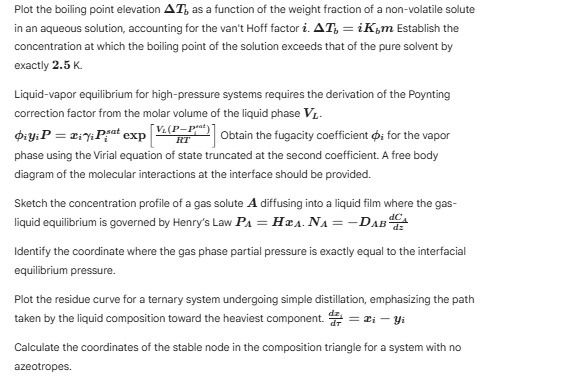
(answer in humanised style without using bullet points)Plot the boiling point elevation AT, as a function of the weight fraction of a non-volatile solute
na ios slr Scum thant lfc 1) 4 en Exh
ona SEH 5 li PO 5 SET Bo lo
cacy 25K,
PC ————
‘correction factor from the molar volume of the liquid phase Vz.
uP = mi2uPio exp =E)] pin acy confit Foc thor
hee sing the Vial cquaton of sae nate ath second cosficnt A ros bry
hag I SE HS OT i
Sotohthe concematon profi of go sale A isin to fim wher th gs
id cubis governed by Heys Low Po = He Na = Dias
Kiokly sc irs os hospi pose wang to pets
DA
Proto resce crv for tary systom undergoing simple dilation, amphasizg th pth
taken by the uid composition toward the heaviest component. £2: = 2; — yi
Calcite he coordinates of th sible node th compostion rangle for system with no
Question:
Act like a helpful tutor and exlain me :
Give step-by-step solution with explanation and final answer:
(answer in humanised style without using bullet points)Plot the boiling point elevation AT, as a function of the weight fraction of a non-volatile solute
na ios slr Scum thant lfc 1) 4 en Exh
ona SEH 5 li PO 5 SET Bo lo
cacy 25K,
PC ————
‘correction factor from the molar volume of the liquid phase Vz.
uP = mi2uPio exp =E)] pin acy confit Foc thor
hee sing the Vial cquaton of sae nate ath second cosficnt A ros bry
hag I SE HS OT i
Sotohthe concematon profi of go sale A isin to fim wher th gs
id cubis governed by Heys Low Po = He Na = Dias
Kiokly sc irs os hospi pose wang to pets
DA
Proto resce crv for tary systom undergoing simple dilation, amphasizg th pth
taken by the uid composition toward the heaviest component. £2: = 2; — yi
Calcite he coordinates of th sible node th compostion rangle for system with no
This is AI generated Response.
Asked by: Francis
Created at: 2026-01-14 09:06:29
Final Answer:
RenderedRaw Text
Did you like this answer?
Absolutely! Let's through each part step by step with explanations.
---
### 1. **Boiling Point Elevation as a Function of Weight Fraction**
The boiling point elevation (\(\Delta T_b\)) for a non-volatile solute in water is given by:
\[\Delta T_b = i K_b m\]
Here,
- \(i\) = van't Hoff factor (accounts for the number of particles the solute splits into)
- \(K_b\) = ebullioscopic constant of the solvent (for water, \(K_b \approx .512 \, \mathrm{K\,kg\,mol^{-1}}\))
- \(m\) = molality of the solution (moles of solute per kg of solvent)
The molality \(m\) can be related to the weight fraction \(w\) of solute (let’s call the solute B and solvent A):
\[
w_B = \frac{\text{mass of B}}{\text{total mass}} = \frac{n_B M_B}{n_B M_B + n_A M_A}
\]
But for dilute solutions, \(m \approx \frac{w_B}{M_B(1-w_B)} \approx \frac{w_B}{M_B}\) (since \(w_B\) is small).
**To find the concentration at which the boiling point increases by 2.5 K:**
Set \(\Delta T_b = 2.5\,\text{K}\):
\[
2.5 = i K_b m
\]
\[
m = \frac{2.5}{i K_b}
\]
So, the required molality is \(\frac{2.5}{i K_b}\).
**In words:** As you increase the weight fraction of solute, the boiling point elevation increases linearly with molality, which can be related back to weight fraction for dilute solutions.
---
### 2. **Poynting Correction Factor for High-Pressure Liquid-Vapor Equilibrium**
The Poynting correction accounts for the effect of pressure on the fugacity (effective pressure) of the liquid phase. The correction factor is:
\[
\exp \left[ \frac{V_L (P - P^{sat})}{RT} \right]
\]
where
- \(V_L\) = molar volume of liquid
- \(P\) = system pressure
- \(P^{sat}\) = saturation pressure
- \(R\) = gas constant
- \(T\) = temperature
The fugacity of component \(i\) in the liquid is:
\[
\phi_i y_i P = x_i \gamma_i P_i^{sat} \exp \left[ \frac{V_L (P - P^{sat})}{RT} \right]
\]
where \(\gamma_i\) is the activity coefficient, \(x_i\) is mole fraction in liquid, \(y_i\) in vapor.
**Fugacity for vapor phase:**
Use the truncated Virial equation (second coefficient):
\[
\ln \phi_i = \frac{P}{RT} \left( B_i + y_j B_{ij} - y_i B_{ii} \right)
\]
A free body diagram at the interface would show molecules in both phases, with arrows indicating evaporation and condensation events, and the net flux depending on differences in chemical potential.
---
### 3. **Concentration Profile of Gas Diffusing into Liquid**
For gas \(A\) dissolving into a liquid film, the steady-state diffusion (Fick's Law) with Henry's Law at the interface:
\[
P_A = H x_A
\]
\[
N_A = - D_{AB} \frac{dC_A}{dx}
\]
At steady-state and for a flat film of thickness \(\delta\), the concentration profile is linear:
\[
C_A(x) = C_{A,\text{interface}} + \left( \frac{C_{A,\text{bulk}} - C_{A,\text{interface}}}{\delta} \right) x
\]
where \(C_{A,\text{interface}}\) is related to \(P_A\) by Henry's Law.
---
### 4. **Coordinate Where Gas Partial Pressure Equals Interfacial Equilibrium Pressure**
This occurs exactly at the liquid-gas interface. At this point, the partial pressure of \(A\) in the gas phase equals \(H x_A\) (Henry's Law), which is the equilibrium pressure.
---
### 5. **Ternary System Residue Curve and Distillation Path**
A residue curve tracks the composition of the remaining liquid during distillation. For simple distillation, the path moves towards the heaviest-boiling component in the composition triangle. The differential equation for the residue curve is:
\[
\frac{dz_i}{dt} = z_i - y_i
\]
where \(z_i\) is the liquid composition and \(y_i\) is the vapor composition in equilibrium with the liquid. The path will move towards the corner representing the heaviest component (highest boiling point), because that is what remains as the more volatile components are removed.
---
### 6. **Stable Node in Composition Triangle (No Azeotropes)**
For a ternary system with no azeotropes, the stable node (final composition) is at the vertex of the triangle that represents the pure component with the highest boiling point. This is where the residue curve will end up after all the more volatile components are distilled off.
---
#### **Summary**
Each step connects physical chemistry concepts with mathematical expressions to solve phase equilibrium and distillation problems. For boiling point elevation, you use the van’t Hoff law and relate molality to weight fraction, setting the elevation to 2.5 K to find the needed concentration. For vapor-liquid equilibrium, you derive the correction factor, show how fugacity is calculated using equations of state, and illustrate molecular interactions at interfaces. For diffusion and distillation, you describe the profiles, equilibrium points, and how residue curves behave in ternary systems, especially when no azeotropes are present—the final stable composition is the pure, least volatile component.
VIPSolutions focuses on clear, step‑by‑step explanations so you can learn quickly. Whether you need an AI‑generated walkthrough or a short hint to get unstuck, each solution is organized for fast reading and easy review later.
Search similar questions, compare approaches, and bookmark the best answers for revision. Our goal is simple: quick, reliable study help that feels natural—not noisy.
 VIPSolutions
 Plot the boiling point elevation AT, as a function of the weight fraction of a non-volatile solute
na ios slr Scum thant lfc 1) 4 en Exh
ona SEH 5 li PO 5 SET Bo lo
cacy 25K,
PC ————
‘correction factor from the molar volume of the liquid phase Vz.
uP = mi2uPio exp =E)] pin acy confit Foc thor
hee sing the Vial cquaton of sae nate ath second cosficnt A ros bry
hag I SE HS OT i
Sotohthe concematon profi of go sale A isin to fim wher th gs
id cubis governed by Heys Low Po = He Na = Dias
Kiokly sc irs os hospi pose wang to pets
DA
Proto resce crv for tary systom undergoing simple dilation, amphasizg th pth
taken by the uid composition toward the heaviest component. £2: = 2; — yi
Calcite he coordinates of th sible node th compostion rangle for system with no