 VIPSolutions
Act like a helpful tutor and exlain me : Give step-by-step solution with explanation and final answer:An experimental thermodynamic system evaluates the compressibility factor Z for a real gas at various reduced pressures P, and reduced temperatures T;. The deviation from ideal gas behavior is quantified using the following data array for a fixed isothermal condition. Reduced Pressure , [ 0.5 1 1.0 T 2.0 [4.0 T 6.0 | 8.0 [10.0] Compressibility Z 0.07 0.84 | 0.72 [0.88 | 1.05 | 1.22 [ 1.40 | Objective: Establish the fugacity coefficient ¢ at P, = 1.0 by evaluating the integral In ¢ = Poza Jo FHP Sketch the Maxwell relations by establishing the exact differential identities for the four primary thermodynamic potentials: Internal Energy U7, Enthalpy HI, Helmholtz Free Energy A, and Gibbs Free Energy G.. Formulate the relationship (8%), =(2) y by applying Euler's reciprocity criterion to the fundamental equation dA = —SdT — PdV . Establish the partial derivative of entropy with respect to pressure at constant temperature. The steady-flow energy equation SFEE governs the operation of a high-pressure steam turbine where the kinetic and potential energy changes are neglected. The power output W is a direct function of the mass flow rate 7i2 and the enthalpy drop across the blades. 5 mn Q ~ W = ri(hout — hin) + 2 (Vous -V2) Calculate the specific work output uw in kJ/kg if the inlet steam is at P; and T} and the exit conditions correspond to a saturated vapor state. Formulate the chemical potential p; for a multi-component system in a state of phase equilibrium where the Gibbs-Duhem equation 3" n; dj; = —SdT + VAP must be satisfied. Synthesize the criteria for spontaneous processes in terms of the total entropy change of the universe A Sn, > 0. Establish the relationship between the equilibrium constant K, and the standard Gibbs free energy change AG® using the van't Hoff reaction isotherm
Question:
Act like a helpful tutor and exlain me :
Give step-by-step solution with explanation and final answer: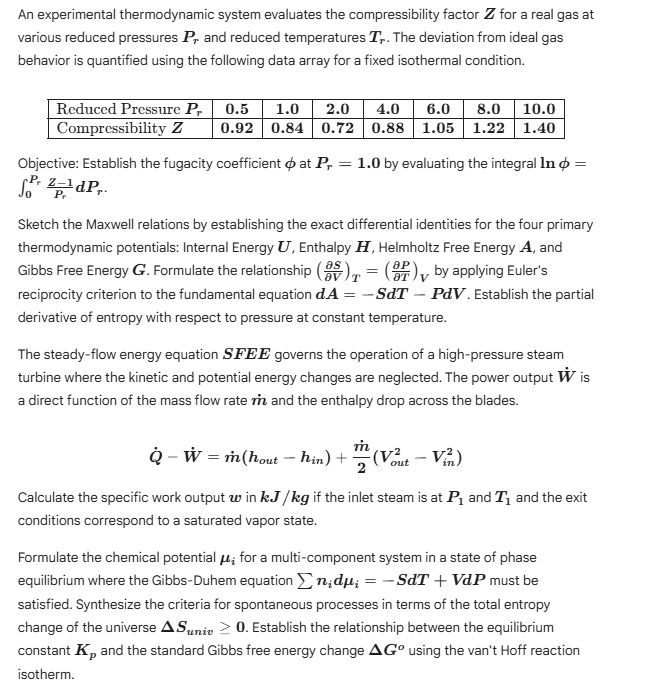 An experimental thermodynamic system evaluates the compressibility factor Z for a real gas at
various reduced pressures P, and reduced temperatures T;. The deviation from ideal gas
behavior is quantified using the following data array for a fixed isothermal condition.
Reduced Pressure , [ 0.5 1 1.0 T 2.0 [4.0 T 6.0 | 8.0 [10.0]
Compressibility Z 0.07 0.84 | 0.72 [0.88 | 1.05 | 1.22 [ 1.40 |
Objective: Establish the fugacity coefficient ¢ at P, = 1.0 by evaluating the integral In ¢ =
Poza
Jo FHP
Sketch the Maxwell relations by establishing the exact differential identities for the four primary
thermodynamic potentials: Internal Energy U7, Enthalpy HI, Helmholtz Free Energy A, and
Gibbs Free Energy G.. Formulate the relationship (8%), =(2) y by applying Euler's
reciprocity criterion to the fundamental equation dA = —SdT — PdV . Establish the partial
derivative of entropy with respect to pressure at constant temperature.
The steady-flow energy equation SFEE governs the operation of a high-pressure steam
turbine where the kinetic and potential energy changes are neglected. The power output W is
a direct function of the mass flow rate 7i2 and the enthalpy drop across the blades.
5 mn
Q ~ W = ri(hout — hin) + 2 (Vous -V2)
Calculate the specific work output uw in kJ/kg if the inlet steam is at P; and T} and the exit
conditions correspond to a saturated vapor state.
Formulate the chemical potential p; for a multi-component system in a state of phase
equilibrium where the Gibbs-Duhem equation 3" n; dj; = —SdT + VAP must be
satisfied. Synthesize the criteria for spontaneous processes in terms of the total entropy
change of the universe A Sn, > 0. Establish the relationship between the equilibrium
constant K, and the standard Gibbs free energy change AG® using the van't Hoff reaction
isotherm
Asked by: francis
Created at: 2026-01-09 11:42:03
Final Answer:
📢 Instructions:
- Ask anything relatd to above question only.
- For new Question goto :