 VIPSolutions
Act like a helpful tutor and exlain me : (give me answer without using bullet-points)F; en in, Cao Ca exit concentration of A (mol/L) Chao inlet concentration of A (mol/L) k 7 space time (s) A B k first-order rate constant (s7*) i Fout, Ca Xa conversion of A Consider a liquid-phase, irreversible, first-order reaction A — B taking place in a Continuous Stirred Tank Reactor (CSTR) operating at steady state and constant temperature. The reaction rate is given by 7A = —kCa. (a) Sketch the exit concentration of reactant A, Cy, as a function of the space time, 7, by deriving the design equation for the CSTR. On your plot, clearly indicate the inlet concentration Cao and the asymptotic behavior of Cy as 7 approaches infinity. (b) Plot the fractional conversion of reactant A, X, against the dimensionless Damkghler number, Da = kr, by developing the relationship between conversion and the Damkéhler number from the CSTR design equation. Illustrate how the conversion changes from a low value at low Da to a high value at high Da. (c) Mlustrate the relationship between the reaction rate, —r4, and the exit concentration, Ca, by plotting the rate law on a graph with Cy on the x-axis and —r4 on the y-axis. Explain how the rate constant, k, corresponds to the slope of this linear plot.
Question:
Act like a helpful tutor and exlain me :
(give me answer without using bullet-points)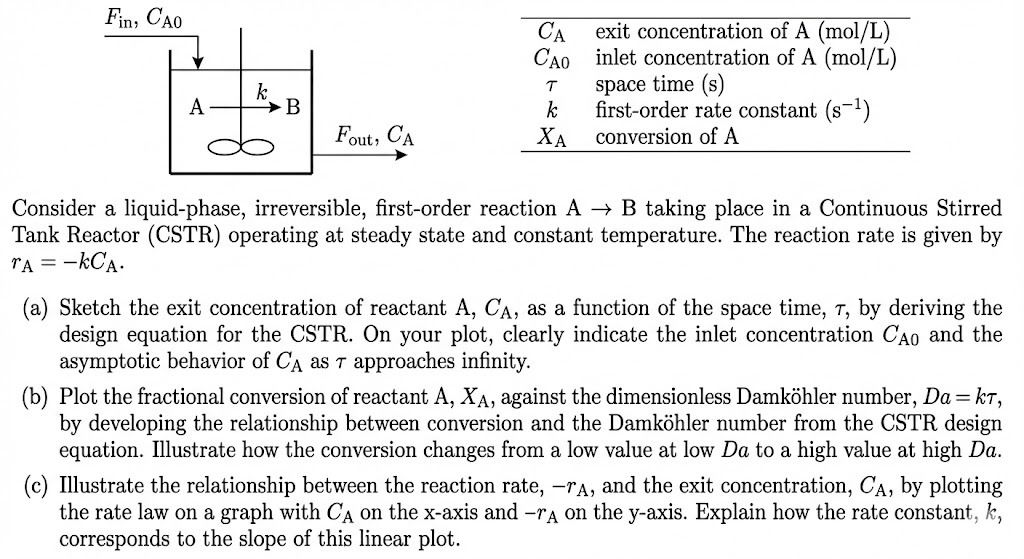 F; en
in, Cao Ca exit concentration of A (mol/L)
Chao inlet concentration of A (mol/L)
k 7 space time (s)
A B k first-order rate constant (s7*)
i Fout, Ca Xa conversion of A
Consider a liquid-phase, irreversible, first-order reaction A — B taking place in a Continuous Stirred
Tank Reactor (CSTR) operating at steady state and constant temperature. The reaction rate is given by
7A = —kCa.
(a) Sketch the exit concentration of reactant A, Cy, as a function of the space time, 7, by deriving the
design equation for the CSTR. On your plot, clearly indicate the inlet concentration Cao and the
asymptotic behavior of Cy as 7 approaches infinity.
(b) Plot the fractional conversion of reactant A, X, against the dimensionless Damkghler number, Da = kr,
by developing the relationship between conversion and the Damkéhler number from the CSTR design
equation. Illustrate how the conversion changes from a low value at low Da to a high value at high Da.
(c) Mlustrate the relationship between the reaction rate, —r4, and the exit concentration, Ca, by plotting
the rate law on a graph with Cy on the x-axis and —r4 on the y-axis. Explain how the rate constant, k,
corresponds to the slope of this linear plot.
Asked by: Francis
Created at: 2026-01-29 08:34:00
Final Answer:
📢 Instructions:
- Ask anything relatd to above question only.
- For new Question goto :