 VIPSolutions
Act like a helpful tutor and exlain me : (Give me answer in humanised style without using bullet points)2. (10%) Using oH 2) ld —| =Cou;r=|| =| +P |= i —b)= (5), ply I F772 es 2) +V and the equation of state for a gas P(V —b)=RT b show that 4, =—— Cs Where wer, H, U, BT, ¥, Cp, and b are Joule-Thomson coefficient, enthalpy, internal energy, pressure, temperature, volume, heat capacity at constant pressure, parameters of the finite size of molecules, respectively.
Question:
Act like a helpful tutor and exlain me :
(Give me answer in humanised style without using bullet points)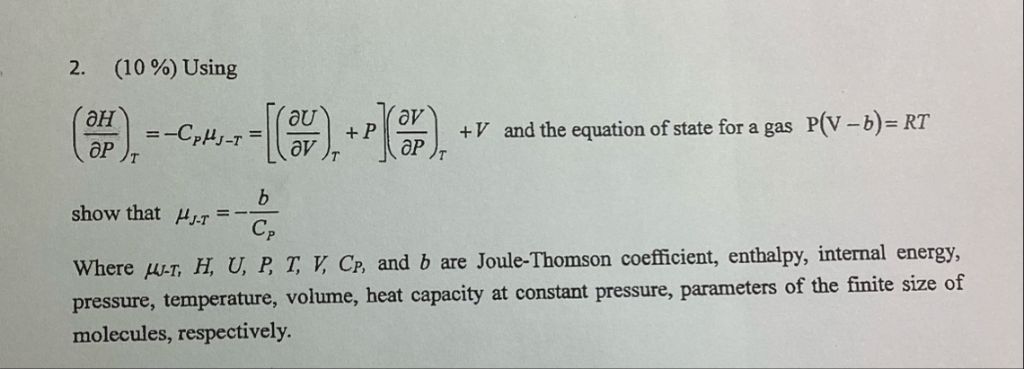 2. (10%) Using
oH 2) ld
—| =Cou;r=|| =| +P |= i —b)=
(5), ply I F772 es 2) +V and the equation of state for a gas P(V —b)=RT
b
show that 4, =——
Cs
Where wer, H, U, BT, ¥, Cp, and b are Joule-Thomson coefficient, enthalpy, internal energy,
pressure, temperature, volume, heat capacity at constant pressure, parameters of the finite size of
molecules, respectively.
This is AI generated Response.
Asked by: Francis
Created at: 2026-01-13 20:06:57
Asked by: Francis
Created at: 2026-01-13 20:06:57
Final Answer:
Rendered
Raw Text
Did you like this answer?
Absolutely, let’s walk through the problem step by step in a way that makes sense!
We start with two things:
1. The thermodynamic relation:
\[
\left(\frac{\partial H}{\partial P}\right)_T = -C_P \mu_{J-T} = \left[\left(\frac{\partial U}{\partial V}\right)_T + P\right]\left(\frac{\partial V}{\partial P}\right)_T + V
\]
2. The equation of state for the gas:
\[
P(V - b) = RT
\]
Our goal is to show that:
\[
\mu_{J-T} = -\frac{b}{C_P}
\]
Let’s break it down:
**Step 1: Manipulate the equation of state**
From \( P(V - b) = RT \), you can solve for \( V \):
\[
V = \frac{RT}{P} + b
\]
**Step 2: Find \( \left(\frac{\partial V}{\partial P}\right)_T \)**
Differentiate \( V \) with respect to \( P \) at constant \( T \):
\[
\left(\frac{\partial V}{\partial P}\right)_T = \frac{\partial}{\partial P} \left(\frac{RT}{P} + b\right) = -\frac{RT}{P^2}
\]
**Step 3: Find \( \left(\frac{\partial U}{\partial V}\right)_T \)**
For a van der Waals-like gas (with only the finite size correction \( b \)), internal energy \( U \) depends only on temperature, not volume (because there's no \( a \) term for intermolecular attraction). So,
\[
\left(\frac{\partial U}{\partial V}\right)_T =
\]
**Step 4: Substitute into the big equation**
Plug everything into the main equation:
\[
\left(\frac{\partial H}{\partial P}\right)_T = \left[ + P \right]\left(-\frac{RT}{P^2}\right) + V
\]
\[
= -\frac{RT}{P} + V
\]
But recall \( V = \frac{RT}{P} + b \). So:
\[
-\frac{RT}{P} + V = -\frac{RT}{P} + \left(\frac{RT}{P} + b\right) = b
\]
So,
\[
\left(\frac{\partial H}{\partial P}\right)_T = b
\]
**Step 5: Relating to Joule-Thomson coefficient**
From the original equation,
\[
- C_P \mu_{J-T} = b
\]
\[
\mu_{J-T} = -\frac{b}{C_P}
\]
And that’s what we wanted to prove! So, by plugging the equation of state and considering the properties of the gas, you can show the Joule-Thomson coefficient for this equation of state is \(-\frac{b}{C_P}\).
Let me know if you want to see any step in more detail or have questions about why we made any particular assumption!
📢 Instructions:
- Ask anything relatd to above question only.
- For new Question goto :