This is AI generated Response.
Asked by: Francis
Created at: 2026-01-13 08:29:31
Final Answer:
RenderedRaw Text
Did you like this answer?
Absolutely, let's walk through each part of the question together in a more conversational style, so you understand both the concepts and how to approach the problems.
---
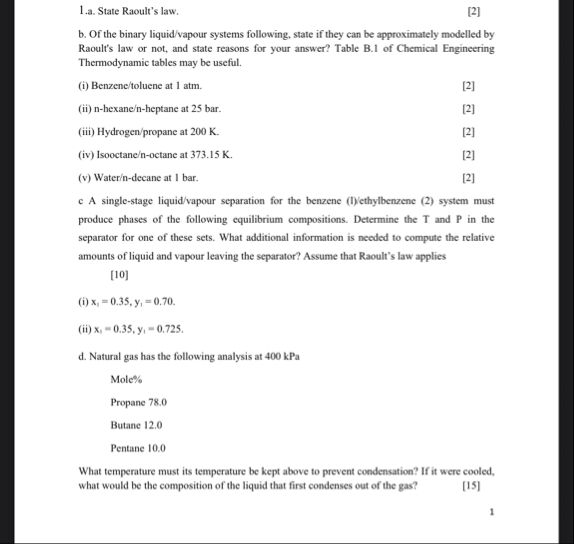
### a. State Raoult’s Law
Raoult’s law is a principle used in thermodynamics to describe the vapor pressure of an ideal mixture of liquids. It basically says that the partial vapor pressure of each component in a liquid mixture is equal to the vapor pressure of the pure component multiplied by its mole fraction in the mixture. In mathematical terms, for component **i**, it’s given as \( P_i = x_i P_i^* \), where \( x_i \) is the mole fraction of component **i** in the liquid phase, and \( P_i^* \) is the vapor pressure of the pure component **i**.
---
### b. Evaluate Binary Systems for Raoult’s Law Applicability
Let’s look at each binary system and decide if Raoult’s law is a good approximation:
**(i) Benzene/toluene at 1 atm**
Both benzene and toluene are quite similar chemically (both are aromatic hydrocarbons), and they mix nearly ideally. So, Raoult’s law should work well for this system at low pressures like 1 atm.
**(ii) n-Hexane/n-heptane at 25 bar**
n-Hexane and n-heptane are also chemically similar (both are straight-chain alkanes), which means they tend to form ideal solutions. However, the high pressure (25 bar) might introduce some non-ideal behavior due to deviation from ideal gas behavior and possible interactions. Still, Raoult’s law could be a decent approximation, but not perfect.
**(iii) Hydrogen/propane at 200 K**
Hydrogen and propane are very different molecules—hydrogen is a tiny, nonpolar diatomic gas, while propane is a much larger hydrocarbon. They don’t mix ideally, and at low temperatures (200 K), you’re likely to see strong deviations from Raoult’s law. So, no, Raoult’s law wouldn’t be suitable here.
**(iv) Isooctane/n-octane at 373.15 K**
Isooctane and n-octane are isomers, meaning they have the same molecular formula but different structures. Their properties are very close, so their mixtures are close to ideal, and Raoult’s law is a good approximation at this moderate temperature.
**(v) Water/n-decane at 1 bar**
Water and n-decane are extremely different: water is highly polar, n-decane is nonpolar, and they don’t mix well (they’re practically immiscible). Therefore, Raoult’s law is not appropriate for this system.
---
### c. Single-Stage Liquid/Vapour Separation (Benzene/Ethylbenzene)
You have to find the temperature and pressure for a separator where the liquid and vapor phases have the given compositions. You’ll use Raoult’s law and the equilibrium condition that the partial pressures of the components must equal the vapor phase mole fraction times the total pressure.
For example, for set (i):
\( x_1 = .35, x_2 = .65 \) in the liquid,
\( y_1 = .70, y_2 = .30 \) in the vapor.
You would set up the equations:
\( y_1 = \frac{x_1 P_1^*}{P} \)
\( y_2 = \frac{x_2 P_2^*}{P} \)
and \( y_1 + y_2 = 1 \).
You’d need vapor pressure data (from a table) for benzene and ethylbenzene at different temperatures to solve for both \( T \) (from the vapor pressure equations) and \( P \).
**Additional information needed:**
To compute the relative amounts of liquid and vapor leaving the separator, you need to know the total number of moles entering or a mass/energy balance, or the overall composition of the feed. This allows you to use a lever rule or material balance.
---
### d. Natural Gas Dew Point, and Composition of First Condensed Liquid
You’re told the composition of a natural gas mixture at 400 kPa. The question asks what temperature you must keep it at to prevent condensation (so, the dew point), and what the composition of the first drop of condensed liquid would be if you cooled it.
To solve this, you would use the concept that at the dew point, the sum of the partial pressures (each mole fraction times its vapor pressure at the dew point temperature) equals the total pressure. You’d set up the equation:
\( P = \sum_i y_i P_i^* \),
where \( y_i \) is the mole fraction in the gas and \( P_i^* \) is the vapor pressure of each component at the dew point temperature.
You’d solve for \( T \) such that this equation is satisfied.
Afterwards, the composition of the first liquid to form (the condensate) can be found using the fact that, at equilibrium, the ratio of mole fractions in the two phases is given by the ratio of the vapor pressures, so:
\( x_i = \frac{y_i P}{P_i^*} \)
for each component.
---
If you get stuck, let me know which step you want to see worked out numerically or explained in more detail!
VIPSolutions focuses on clear, step‑by‑step explanations so you can learn quickly. Whether you need an AI‑generated walkthrough or a short hint to get unstuck, each solution is organized for fast reading and easy review later.
Search similar questions, compare approaches, and bookmark the best answers for revision. Our goal is simple: quick, reliable study help that feels natural—not noisy.
 VIPSolutions
 La. State Raoul’s law @
b.OF the binary liquid vapour systems following, sat if they can be spproximately modelled by
Raculfs Ia or not and state reasons for your answer? Table B.1 of Chemica Engineering
hemodynamic tables may be usfol.
0) Benzencholune a 1 am [E]
(i) nehexanein hepa at 25 bar [5]
(i Hydrogen propanc 1 200 K. [2]
(iv sooctancinoctane 1373.15 K [E]
0) Watri-decane at 1 br. [E)
© A single-stage liquidivapour separtion for the benzene (Ythylbenzene (2) system must
produce phases of the following equilibrium compositions. Determine the T and P in the
separator for one of thes sets. What additional information is ceded to compe the relative
amounts oFTiquid and vapour leaving the separator? Assume that Raoult's lv apples
10)
()%,=035.y, 070.
Natural ga has the following analysis t 400 Pa
Malet
Propane 780
Bune 120
pentane 100
What temperature must is temperature be kept above o prevent condensation? I i were cooled
‘what would be the composition of the liquid tht first condenses out of the gas? fie