Act like a helpful tutor and exlain me :
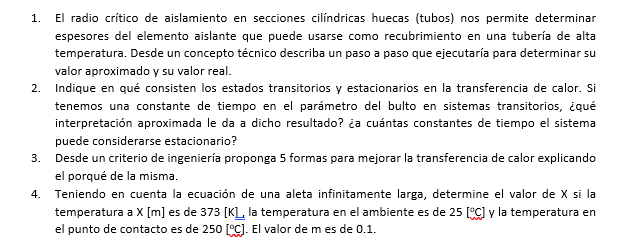
Give answer in english1 El radio critico de aislamiento en secciones cilindricas huecas (tubo) nos permite determina
espesores del elemento aislante que puede usarse como recubrimiento en una tuberia de alta
temperatura. Desde un concepto técnico describa un paso a paso que cjecutaria para determinar su
valor aproximado y su valor real.
2. Indique en qué consisten los estados transitorios v estacionarios en la transferencia de calor. Si
tenemos una constante de tiempo en el pardmetro del bulto en sistemas transitorios, {aué
interpretacién aproximada le da a dicho resultado? a cudntas constantes de tiempo el sistema
puede considerarse estacionario?
5. Desde un citerio de ingenieria proponga 5 formas para mejorar la transferencia de calor explicando
el poraué de la misma
4. Teniendo en cuenta la ecuacién de una aleta infinitamente larga, determine el valor de X si la
temperatura a X [m] es de 373 [KL la temperatura en el ambiente es de 25 [°C] y la temperatura en
el punto de contacto es de 250 [°C]. € valor de m es de 0.1
Question:
Act like a helpful tutor and exlain me :
Give answer in english1 El radio critico de aislamiento en secciones cilindricas huecas (tubo) nos permite determina
espesores del elemento aislante que puede usarse como recubrimiento en una tuberia de alta
temperatura. Desde un concepto técnico describa un paso a paso que cjecutaria para determinar su
valor aproximado y su valor real.
2. Indique en qué consisten los estados transitorios v estacionarios en la transferencia de calor. Si
tenemos una constante de tiempo en el pardmetro del bulto en sistemas transitorios, {aué
interpretacién aproximada le da a dicho resultado? a cudntas constantes de tiempo el sistema
puede considerarse estacionario?
5. Desde un citerio de ingenieria proponga 5 formas para mejorar la transferencia de calor explicando
el poraué de la misma
4. Teniendo en cuenta la ecuacién de una aleta infinitamente larga, determine el valor de X si la
temperatura a X [m] es de 373 [KL la temperatura en el ambiente es de 25 [°C] y la temperatura en
el punto de contacto es de 250 [°C]. € valor de m es de 0.1
This is AI generated Response.
Asked by: manish kumar
Created at: 2025-09-12 09:34:18
Final Answer:
RenderedRaw Text
Did you like this answer?
Sure! Here are clear English explanations and answers for each question:
---
## 1. **Critical Radius of Insulation in Cylindrical Tubes**
**Explanation:**
The critical radius of insulation helps us determine the optimal thickness of insulation for cylindrical pipes to minimize heat loss. If the insulation is too thin or too thick, it may not be effective.
**Step-by-Step (Approximate and Actual Value):**
1. **Identify parameters:**
- Pipe outer radius \( r_0 \)
- Insulation thermal conductivity \( k \)
- Heat transfer coefficient \( h \) (outside the insulation)
2. **Formula for Critical Radius:**
\[
r_{cr} = \frac{k}{h}
\]
Where:
- \( r_{cr} \) = critical radius
- \( k \) = thermal conductivity of insulation
- \( h \) = external convective heat transfer coefficient
3. **Approximate Value:**
- Use average values for \( k \) and \( h \).
- Calculate \( r_{cr} \) directly.
4. **Actual Value:**
- Use precise, measured values for \( k \) and \( h \).
- Calculate \( r_{cr} \) for the specific situation.
---
## 2. **Transient and Steady-State Heat Transfer**
**Explanation:**
- **Transient State:** Temperature changes with time.
- **Steady-State:** Temperature does **not** change with time (system reaches equilibrium).
**If you have a time constant in the lumped system parameter:**
- The time constant (\( \tau \)) tells you how fast the system responds to temperature changes.
- **Approximate Interpretation:** After about **5 time constants**, the system is considered to be at steady-state (temperature changes are negligible).
**Summary:**
- After \( 5\tau \), the system is approximately steady-state.
---
## 3. **5 Ways to Improve Heat Transfer (Engineering Perspective)**
1. **Increase Surface Area:** Fins, extended surfaces.
- *Why:* More area for heat to escape/enter.
2. **Use Materials with Higher Thermal Conductivity:** Copper, aluminum.
- *Why:* Heat moves faster through better conductors.
3. **Increase Temperature Difference:** Raise source/lower sink temperature.
- *Why:* Greater driving force for heat transfer.
4. **Enhance Convection:** Use fans, increase fluid velocity.
- *Why:* Moves heat away from surfaces faster.
5. **Reduce Thermal Resistance:** Improve contact between surfaces, use thermal paste.
- *Why:* Less resistance means easier heat flow.
---
## 4. **Fin Equation (Infinitely Long Fin)**
Given:
- \( T(x) = 373\,K \) at position \( x \)
- Ambient temperature \( T_\infty = 25^\circ C = 298\,K \)
- Base temperature \( T_b = 250^\circ C = 523\,K \)
- \( m = 0.1 \)
**Fin temperature equation (for an infinitely long fin):**
\[
\frac{T(x) - T_\infty}{T_b - T_\infty} = e^{-mx}
\]
**Plug in the values:**
\[
\frac{373 - 298}{523 - 298} = e^{-0.1x}
\]
\[
\frac{75}{225} = e^{-0.1x}
\]
\[
0.333 = e^{-0.1x}
\]
Take the natural logarithm of both sides:
\[
\ln(0.333) = -0.1x
\]
\[
-1.099 = -0.1x
\]
\[
x = \frac{1.099}{0.1} = 10.99
\]
**Final Answer:**
\[
\boxed{x = 11}
\]
---
If you need further clarification or details on any question, let me know!
VIPSolutions focuses on clear, step‑by‑step explanations so you can learn quickly. Whether you need an AI‑generated walkthrough or a short hint to get unstuck, each solution is organized for fast reading and easy review later.
Search similar questions, compare approaches, and bookmark the best answers for revision. Our goal is simple: quick, reliable study help that feels natural—not noisy.
 VIPSolutions
 1 El radio critico de aislamiento en secciones cilindricas huecas (tubo) nos permite determina
espesores del elemento aislante que puede usarse como recubrimiento en una tuberia de alta
temperatura. Desde un concepto técnico describa un paso a paso que cjecutaria para determinar su
valor aproximado y su valor real.
2. Indique en qué consisten los estados transitorios v estacionarios en la transferencia de calor. Si
tenemos una constante de tiempo en el pardmetro del bulto en sistemas transitorios, {aué
interpretacién aproximada le da a dicho resultado? a cudntas constantes de tiempo el sistema
puede considerarse estacionario?
5. Desde un citerio de ingenieria proponga 5 formas para mejorar la transferencia de calor explicando
el poraué de la misma
4. Teniendo en cuenta la ecuacién de una aleta infinitamente larga, determine el valor de X si la
temperatura a X [m] es de 373 [KL la temperatura en el ambiente es de 25 [°C] y la temperatura en
el punto de contacto es de 250 [°C]. € valor de m es de 0.1