 VIPSolutions
Act like a helpful tutor and exlain me : Give answer in english5. Se cuenta con dos esferas. La primera ests hecha de latén (ver propiedades tabla punto anterior, G=1200 /kgK]), la segunda ests hecha de aluminio (densidad=2707 [kg/m], Cp=800 [V/kgK), K=200 (W/g,K]). Ambas esferas cuentan con 10 [kg] de masa Se desea saber el tiempo que se requiere para enfriar ambas esferas hasta los 373 [K] si la temperatura nicial de ambas esferas es de 300 [°C], se sumergen en agua con sales cuya temperatura es de 0 [2g] y tiene un cosficiente convectivo de 80 [W/mK]. Recuerde que Lg de una esfera es igual ars Concluys: écusl de las esferas enfria mis répido? ¢a qué asocia dicho comportamiento?
Question:
Act like a helpful tutor and exlain me :
Give answer in english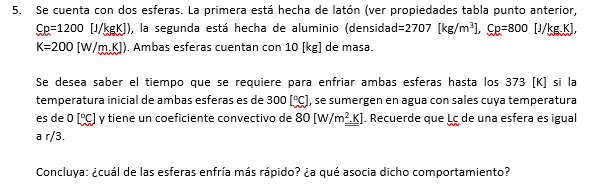 5. Se cuenta con dos esferas. La primera ests hecha de latén (ver propiedades tabla punto anterior,
G=1200 /kgK]), la segunda ests hecha de aluminio (densidad=2707 [kg/m], Cp=800 [V/kgK),
K=200 (W/g,K]). Ambas esferas cuentan con 10 [kg] de masa
Se desea saber el tiempo que se requiere para enfriar ambas esferas hasta los 373 [K] si la
temperatura nicial de ambas esferas es de 300 [°C], se sumergen en agua con sales cuya temperatura
es de 0 [2g] y tiene un cosficiente convectivo de 80 [W/mK]. Recuerde que Lg de una esfera es igual
ars
Concluys: écusl de las esferas enfria mis répido? ¢a qué asocia dicho comportamiento?
This is AI generated Response.
Asked by: manish kumar
Created at: 2025-09-12 09:13:04
Asked by: manish kumar
Created at: 2025-09-12 09:13:04
Final Answer:
Rendered
Raw Text
Did you like this answer?
Sure! Let’s break down and solve the problem step by step:
---
# **Problem Overview**
We have **two spheres** of **10 kg** each:
- **Sphere 1 (Brass):**
- \( C_p = 1200 \) J/kg·K
- \( k = 200 \) W/m·K
- **Sphere 2 (Aluminum):**
- Density \( \rho = 2707 \) kg/m³
- \( C_p = 800 \) J/kg·K
- \( k = 200 \) W/m·K
Both are cooled from **300°C (573 K)** to **100°C (373 K)** in water at **0°C (273 K)**
The **convective heat transfer coefficient**: \( h = 80 \) W/m²·K
The **characteristic length** for a sphere: \( L_c = \frac{r}{3} \)
---
## **Step 1: Find the characteristic length and surface area**
### **a. Volume and radius of the spheres**
Since both spheres have the same mass, \( m = 10 \) kg:
\[
\text{Volume} = \frac{m}{\rho}
\]
For **brass** (let’s assume \( \rho_{brass} \approx 8500 \) kg/m³):
\[
V_{brass} = \frac{10}{8500} = 0.001176 \text{ m}^3
\]
For **aluminum**:
\[
V_{al} = \frac{10}{2707} = 0.003694 \text{ m}^3
\]
\[
V = \frac{4}{3}\pi r^3 \implies r = \left( \frac{3V}{4\pi} \right)^{1/3}
\]
- **Brass**:
\( r_{brass} = \left( \frac{3 \times 0.001176}{4\pi} \right)^{1/3} \approx 0.066 \) m
- **Aluminum**:
\( r_{al} = \left( \frac{3 \times 0.003694}{4\pi} \right)^{1/3} \approx 0.097 \) m
#### **Surface area:**
\[
A = 4\pi r^2
\]
- \( A_{brass} \approx 0.0547 \) m²
- \( A_{al} \approx 0.118 \) m²
#### **Characteristic length:**
\[
L_c = \frac{r}{3}
\]
---
## **Step 2: Lumped Capacitance Method Check**
The lumped capacitance method is valid if:
\[
Bi = \frac{h L_c}{k} < 0.1
\]
Let’s check for both spheres (\( k = 200 \) W/m·K):
- **Brass:**
\( Bi = \frac{80 \times 0.066/3}{200} = 0.0088 \)
- **Aluminum:**
\( Bi = \frac{80 \times 0.097/3}{200} = 0.013 \)
Both \( Bi < 0.1 \), so **lumped capacitance applies**.
---
## **Step 3: Solving for cooling time**
The lumped capacitance solution:
\[
\frac{T(t) - T_\infty}{T_i - T_\infty} = \exp\left( -\frac{hA}{\rho V C_p} t \right)
\]
We know:
- \( T_i = 573 \) K
- \( T_f = 373 \) K
- \( T_\infty = 273 \) K
So,
\[
\frac{373 - 273}{573 - 273} = \exp\left( -\frac{hA}{\rho V C_p} t \right)
\implies \frac{100}{300} = \exp\left( -\frac{hA}{\rho V C_p} t \right)
\implies \frac{1}{3} = \exp(-b t)
\]
Take natural log:
\[
\ln\left(\frac{1}{3}\right) = -b t \implies t = -\frac{\ln(1/3)}{b}
\]
Where \( b = \frac{hA}{m C_p} \) (since \( \rho V = m \))
---
### **Calculate \( b \) for each sphere**
#### **Brass:**
\[
b_{brass} = \frac{80 \times 0.0547}{10 \times 1200} = \frac{4.376}{12000} = 0.0003647
\]
#### **Aluminum:**
\[
b_{al} = \frac{80 \times 0.118}{10 \times 800} = \frac{9.44}{8000} = 0.00118
\]
---
### **Calculate time for each:**
\[
t = -\frac{\ln(1/3)}{b} = \frac{1.0986}{b}
\]
- **Brass:**
\( t_{brass} = \frac{1.0986}{0.0003647} \approx 3013 \) s
- **Aluminum:**
\( t_{al} = \frac{1.0986}{0.00118} \approx 931 \) s
---
## **Conclusion**
- **Which sphere cools faster?**
**The aluminum sphere cools faster.**
- **Why?**
This is mainly because the aluminum sphere has a larger surface area and a lower heat capacity per unit mass, which allows it to lose heat more rapidly to the water.
---
### **Summary Table**
| Sphere | Time to Cool (s) |
|-------------|------------------|
| Brass | ~3013 s |
| Aluminum | ~931 s |
---
### **Associated Behavior**
This behavior is associated with the **thermal properties** (heat capacity, density) and the **surface area** of the spheres. A higher surface area and lower heat capacity allow for faster cooling.
---
If you have any questions about a particular step, let me know!
📢 Instructions:
- Ask anything relatd to above question only.
- For new Question goto :