 VIPSolutions
Act like a helpful tutor and exlain me :Four people are attempting to move a stage platform across the floor. If they exert the horizontal forces shown, determine (a) the equivalent force-couple system at O and (b) the points on the x- and y-axes through which the line of action of the single resultant force Rpasses. Assume Fy =701b,F,=681b,F3=471Ib,F4=71lb,a=75in.,b=63in,and§ = 41° i fi | [) IA B, F, b F, CA o a Fy Answers: (a) The force-couple system at O: =~ (H HN : | Pb vo- H Klb-in. (b) The line of action of the single resultant R: Onthe x-axis x= [: | in. Onthey-axis y= [: | in.
Question:
Act like a helpful tutor and exlain me :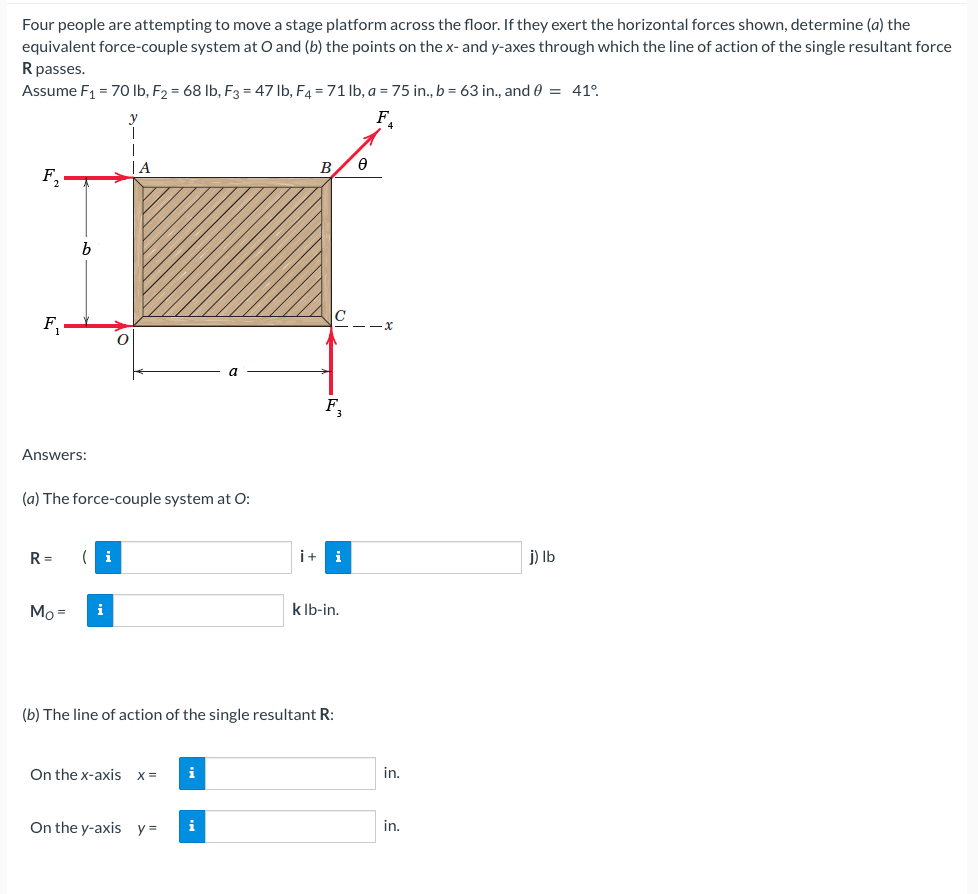 Four people are attempting to move a stage platform across the floor. If they exert the horizontal forces shown, determine (a) the
equivalent force-couple system at O and (b) the points on the x- and y-axes through which the line of action of the single resultant force
Rpasses.
Assume Fy =701b,F,=681b,F3=471Ib,F4=71lb,a=75in.,b=63in,and§ = 41°
i fi
| [)
IA B,
F,
b
F, CA
o
a
Fy
Answers:
(a) The force-couple system at O:
=~ (H HN : | Pb
vo- H Klb-in.
(b) The line of action of the single resultant R:
Onthe x-axis x= [: | in.
Onthey-axis y= [: | in.
This is AI generated Response.
Asked by: manish kumar
Created at: 2025-09-07 22:37:19
Asked by: manish kumar
Created at: 2025-09-07 22:37:19
Final Answer:
Rendered
Raw Text
Did you like this answer?
Absolutely! Let's break down the problem step by step.
---
## **Step 1: Understanding the Problem**
You have four forces acting horizontally on a stage platform. You need to:
### **(a) Find the equivalent force-couple system at O (the origin):**
- **Resultant Force \( \vec{R} \)**
- **Resultant Moment at O (\( M_O \))**
### **(b) Find the points on the x- and y-axes through which the line of action of the resultant force passes.**
---
## **Step 2: Calculating the Resultant Force \( \vec{R} \)**
Let's resolve each force into its x and y components:
- \( F_1 = 70\, \text{lb} \) (to the right, along +x)
- \( F_2 = 68\, \text{lb} \) (up, along +y)
- \( F_3 = 47\, \text{lb} \) (to the left, along -x)
- \( F_4 = 71\, \text{lb} \) at an angle \( \theta = 41^\circ \) from the x-axis (top right corner)
**Components for \( F_4 \):**
- \( F_{4x} = F_4 \cos(41^\circ) \)
- \( F_{4y} = F_4 \sin(41^\circ) \)
### **Sum the Forces:**
\[
\vec{R}_x = F_1 - F_3 + F_{4x}
\]
\[
\vec{R}_y = F_2 + F_{4y}
\]
Plug in the values:
- \( F_{4x} = 71 \cos(41^\circ) \approx 53.53 \) lb
- \( F_{4y} = 71 \sin(41^\circ) \approx 46.65 \) lb
So,
\[
\vec{R}_x = 70 - 47 + 53.53 = 76.53\, \text{lb}
\]
\[
\vec{R}_y = 68 + 46.65 = 114.65\, \text{lb}
\]
So, the resultant force:
\[
\boxed{\vec{R} = 76.53\,\mathbf{i} + 114.65\,\mathbf{j} \ \text{lb}}
\]
---
## **Step 3: Calculating the Moment About O**
Use \( M_O = \sum (\vec{r} \times \vec{F}) \):
- \( F_1 \) acts at O: \( r = 0 \) → moment = 0.
- \( F_2 \) acts at A (\( (0, b) \)):
- \( M_{O2} = (0 \mathbf{i} + b \mathbf{j}) \times (68 \mathbf{j}) = 0 \) (since both are in y-direction).
- \( F_3 \) acts at C (\( (a, 0) \)):
- \( M_{O3} = (a \mathbf{i}) \times (-47 \mathbf{i}) = 0 \) (since both are in x-direction).
- \( F_4 \) acts at B (\( (a, b) \)), at \( \theta = 41^\circ \):
The position vector for \( F_4 \) is \( \vec{r}_4 = a \mathbf{i} + b \mathbf{j} \).
The force vector for \( F_4 \) is \( F_4 \cos\theta \mathbf{i} + F_4 \sin\theta \mathbf{j} \).
The cross product is:
\[
M_{O4} = |a\mathbf{i} + b\mathbf{j}| \times |F_4 \cos\theta \mathbf{i} + F_4 \sin\theta \mathbf{j}|
\]
\[
= (a \mathbf{i} + b \mathbf{j}) \times (F_4 \cos\theta \mathbf{i} + F_4 \sin\theta \mathbf{j})
\]
\[
= a F_4 \sin\theta (\mathbf{i} \times \mathbf{j}) + b F_4 \cos\theta (\mathbf{j} \times \mathbf{i})
\]
\[
= a F_4 \sin\theta (\mathbf{k}) - b F_4 \cos\theta (\mathbf{k})
\]
\[
= [a F_4 \sin\theta - b F_4 \cos\theta] \mathbf{k}
\]
**Plug in the numbers:**
- \( a = 75 \) in, \( b = 63 \) in
- \( F_4 = 71 \) lb, \( \sin(41^\circ) = 0.6561 \), \( \cos(41^\circ) = 0.7547 \)
\[
M_{O4} = [75 \times 71 \times 0.6561 - 63 \times 71 \times 0.7547]
\]
\[
= [75 \times 46.59 - 63 \times 53.59]
\]
\[
= [3494.25 - 3376.17]
\]
\[
= 118.08 \ \text{lb-in}
\]
Now let's check for any other moments:
- \( F_2 \)'s moment arm is \( a \) (since it acts at (0, b) and is a force in y at a distance a from O along x):
- \( M_{O2} = a \times F_2 \) (clockwise, so negative)
- \( M_{O2} = 75 \times 68 = 5100 \) lb-in (CW, so negative)
- \( F_3 \) acts at (a, 0), force is -x, arm is -b (since force is down, but arm is from O to a):
- \( M_{O3} = -b \times F_3 \) (CCW)
- \( M_{O3} = -63 \times 47 = -2961 \) lb-in
Summing all the moments (counterclockwise positive):
\[
M_O = -5100 + (-2961) + 118.08 = -7942.92 \ \text{lb-in}
\]
---
## **Step 4: Line of Action of Resultant Force**
The resultant force \( \vec{R} \) can be represented as a single force passing at a certain distance from O, producing the same moment.
\[
M_O = R \cdot d
\]
where \( d \) is the perpendicular distance from O to the line of action of \( \vec{R} \).
But, to find the intercepts on the axes:
- **x-intercept:** Set \( y = 0 \) and solve for \( x \).
- **y-intercept:** Set \( x = 0 \) and solve for \( y \).
From the moment equation:
\[
M_O = x R_y - y R_x
\]
**On the x-axis (\( y=0 \)):**
\[
M_O = x R_y
\implies x = \frac{M_O}{R_y}
\]
**On the y-axis (\( x=0 \)):**
\[
M_O = -y R_x
\implies y = -\frac{M_O}{R_x}
\]
---
## **Step 5: Plug in the Numbers**
- \( R_x = 76.53 \) lb
- \( R_y = 114.65 \) lb
- \( M_O = -7942.92 \) lb-in
**x-intercept:**
\[
x = \frac{-7942.92}{114.65} \approx -69.3 \ \text{in}
\]
**y-intercept:**
\[
y = -\frac{-7942.92}{76.53} \approx 103.8 \ \text{in}
\]
---
# **Summary Table**
| Quantity | Value |
|--------------------------|-------------------------------|
| \( R \) | \( 76.53\,\mathbf{i} + 114.65\,\mathbf{j} \) lb |
| \( M_O \) | \( -7942.92 \) lb-in |
| x-intercept | \( -69.3 \) in |
| y-intercept | \( 103.8 \) in |
---
## **Filling the Answers:**
(a) The force-couple system at O:
- R = (76.53) i + (114.65) j lb
- \( M_O = -7942.92 \) lb-in
(b) The line of action of the single resultant R:
- On the x-axis: \( x = -69.3 \) in
- On the y-axis: \( y = 103.8 \) in
---
**Let me know if you want to see the detailed calculations for any particular step!**
📢 Instructions:
- Ask anything relatd to above question only.
- For new Question goto :