 VIPSolutions
Act like a helpful tutor and exlain me :EXTREMELY DIFFICULT ECONOMICS QUESTION Given an economy described by production function Y; = F(K,, L,), with oe >0, = > 0, and regular concave technology. Wage W, is set by W,= MPL, = 5. The nominal interest rate i, determined by i, =r, + i, + @iij, where ¢ > 1 1 is the real rate gi — by; 7» @ + Pt, 0, sn, to't u, fion expectations 1, = —- ty = . inflation expectations 7; are determined adaptively as & . i Government operates a balanced-budget rule T; =T, (Y,- G,), where T,> 0, and T, = 7 + AT, with At,> 0, Technology evolves as A, = A + G/(1 -A), where G > 0,0
Question:
Act like a helpful tutor and exlain me :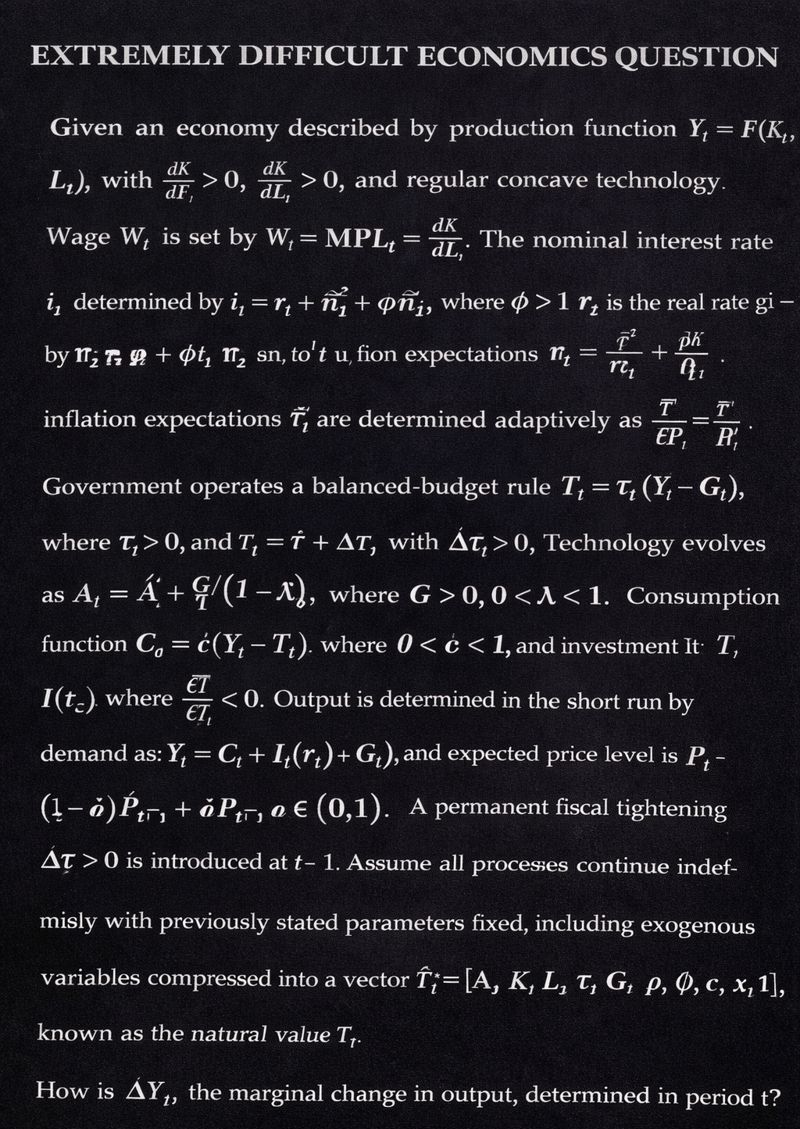 EXTREMELY DIFFICULT ECONOMICS QUESTION
Given an economy described by production function Y; = F(K,,
L,), with oe >0, = > 0, and regular concave technology.
Wage W, is set by W,= MPL, = 5. The nominal interest rate
i, determined by i, =r, + i, + @iij, where ¢ > 1 1 is the real rate gi —
by; 7» @ + Pt, 0, sn, to't u, fion expectations 1, = —- ty = .
inflation expectations 7; are determined adaptively as & . i
Government operates a balanced-budget rule T; =T, (Y,- G,),
where T,> 0, and T, = 7 + AT, with At,> 0, Technology evolves
as A, = A + G/(1 -A), where G > 0,0
This is AI generated Response.
Asked by: Alok Kumar
Created at: 2026-02-01 06:09:09
Asked by: Alok Kumar
Created at: 2026-02-01 06:09:09
Final Answer:
Rendered
Raw Text
Did you like this answer?
# Explanation of the "Extremely Difficult Economics Question"
Let's break down the problem step-by-step to help you understand each part before tackling the core question.
---
## 1. **Production Function**
- **Output:** \( Y_t = F(K_t, L_t) \)
- **K:** Capital
- **L:** Labor
- The function is **concave** (diminishing returns), and output increases with both inputs.
- **Marginal Product of Labor:** Wage \( W_t = MPL_t = \frac{dK}{dL_t} \)
---
## 2. **Interest Rate Setup**
- **Nominal interest rate:** \( i_t = r_t + \tilde{\pi}_t + \phi \tilde{n}_t \)
- \( r_t \): Real interest rate
- \( \tilde{\pi}_t \): Expected inflation
- \( \phi > 1 \): Sensitivity parameter
- \( \tilde{n}_t \): Some expectation, formula not entirely clear but involves inflation and another variable
---
## 3. **Government Rule**
- **Balanced Budget:** \( T_t = \tau_t (Y_t - G_t) \)
- \( \tau_t \): Tax rate, with a permanent increase at \( t-1 \): \( \tau_t = \bar{\tau} + \Delta \tau_t \)
- \( G_t \): Government spending
---
## 4. **Technology Growth**
- \( A_t = \dot{A_t} + \frac{G}{(1-\lambda)} \)
- Technology improves over time, spurred by government spending.
---
## 5. **Consumption and Investment**
- **Consumption:** \( C_t = c(Y_t - T_t) \), where \( < c < 1 \)
- **Investment:** \( I_t \), which depends negatively on the interest rate.
---
## 6. **Output Determination (Short Run)**
- \( Y_t = C_t + I_t(r_t) + G_t \)
- Output is the sum of consumption, investment, and government spending.
---
## 7. **Expected Price Level**
- \( P_t = (1 - \sigma) \dot{P}_{t,1} + \sigma \dot{P}_{t,1} \), \( \sigma \in (, 1) \)
- Expected price level is a weighted average.
---
## 8. **The Shock: Fiscal Tightening**
- **At \( t-1 \):** Permanent increase in tax rate \( \Delta \tau > \)
- **All other parameters are fixed.**
---
## 9. **Question**
> **How is \( \Delta Y_t \), the marginal change in output, determined in period \( t \)?**
---
# **How to Approach the Solution**
### **Step 1: Immediate Effect of Fiscal Tightening**
- **Higher taxes (\( \Delta \tau > \))** reduce disposable income: \( Y_t - T_t \) falls.
- **Consumption falls:** \( C_t = c(Y_t - T_t) \) → Lower \( C_t \).
- **Investment:** Higher taxes may indirectly affect \( I_t \), but the direct effect is via interest rate and output.
### **Step 2: Output Adjustment**
Plug into the output equation:
\[
Y_t = C_t + I_t(r_t) + G_t
\]
Since \( C_t \) falls (due to higher \( T_t \)), **output falls** unless offset by changes in \( I_t \) or \( G_t \).
### **Step 3: Multiplier Effect**
Because \( Y_t \) determines \( C_t \), there is a feedback loop:
- \( Y_t \downarrow \) → \( C_t \downarrow \) → \( Y_t \downarrow \) more, etc.
This is the **Keynesian multiplier**:
\[
\Delta Y_t = \frac{-c}{1 - c} \Delta T_t
\]
But here, \( T_t \) is a function of \( Y_t \) itself, so it's more complex.
### **Step 4: Investment and Interest Rate**
- If output falls, investment may fall (if it's positively related to output or negatively to interest rates).
- **Interest rate:** If government borrowing falls (via higher taxes), interest rates may fall, boosting investment.
### **Step 5: New Equilibrium**
Solve for the new \( Y_t \) using the equations, treating \( \Delta \tau \) as a shock and all else fixed.
---
# **Summary Formula (Simplified)**
Assuming \( G_t \) and other exogenous variables fixed, the change in output is primarily via the consumption channel:
\[
\Delta Y_t = \frac{-c}{1 - c(1 - \tau_t)} \Delta T_t
\]
But since \( T_t = \tau_t (Y_t - G_t) \), you would set up the equations and solve for \( \Delta Y_t \) in terms of \( \Delta \tau_t \) and the parameters.
---
## **Key Takeaway**
**The marginal change in output, \( \Delta Y_t \), is found by:**
1. Determining how higher taxes reduce disposable income and thus consumption.
2. Plugging this into the output equation, accounting for the feedback loop (multiplier).
3. Considering possible offsetting effects via interest rates and investment.
4. Solving the resulting system for \( \Delta Y_t \) in terms of \( \Delta \tau \) and fixed parameters.
---
## **If you want the math worked out step-by-step, let me know!**
I can show the algebra for the multiplier in this specific setup.
📢 Instructions:
- Ask anything relatd to above question only.
- For new Question goto :