 VIPSolutions
Act like a helpful tutor and exlain me :< @evovos +: EAEEE WOH > — (X A
Question:
Act like a helpful tutor and exlain me :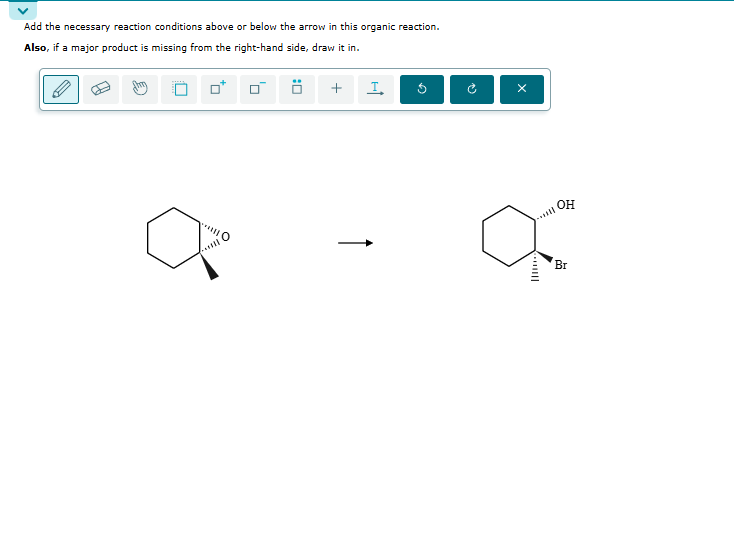 <
@evovos +: EAEEE
WOH
> — (X
A
This is AI generated Response.
Asked by: Alok Kumar
Created at: 2026-03-02 02:50:03
Asked by: Alok Kumar
Created at: 2026-03-02 02:50:03
Final Answer:
Rendered
Raw Text
Did you like this answer?
Absolutely! Let’s break down what’s happening in this reaction step by step.
---
## **Step 1: Analyzing the Reactants and Products**
### **Reactant**
- The starting molecule is **cyclohexanone** (a six-membered ring with a ketone group).
- The ketone oxygen is shown as a wedge, meaning it is coming out of the plane of the ring (stereochemistry is important here).
### **Product**
- The product is a cyclohexane ring with:
- An **OH** group (alcohol) on one carbon (wedge, up)
- A **Br** (bromine) atom on the adjacent carbon (dash, down)
- Both are on adjacent carbons and **anti** to each other (opposite faces of the ring).
---
## **Step 2: Deducing the Reaction**
### **Transformation**
- You go from a ketone (C=O) to a di-functionalized cyclohexane (with OH and Br on adjacent carbons).
- The stereochemistry is anti, meaning the two groups are added to opposite sides of the ring.
### **Possible Reaction**
This transformation is characteristic of:
- **Alpha-bromination of a ketone** (forming an α-bromo ketone)
- **Followed by nucleophilic substitution (e.g., with water or hydroxide) to give a halohydrin**
But here, the **OH** and **Br** are on adjacent carbons, with opposite stereochemistry, suggesting a **halohydrin formation** from an alkene, but we started from a ketone.
#### Actually, this is a classic **alpha-halogenation followed by nucleophilic addition**:
1. **Alpha-bromination**:
Use **Br₂** in **acidic** or **basic** conditions to brominate the α-position of the ketone.
2. **Nucleophilic attack**:
Water (or hydroxide) attacks the carbonyl, giving a **bromohydrin**.
However, the product looks like the result of a **stereoselective reduction** (to alcohol) and **bromination**.
#### This is best explained as:
1. **Bromination at the alpha-position** (*enolizable position*) to give **α-bromo cyclohexanone**.
2. **Stereoselective reduction** (e.g., with NaBH₄ or LiAlH₄) to an alcohol.
---
## **Step 3: Reaction Conditions**
### **Stepwise Mechanism**
1. **Bromination (α-bromination):**
- **Br₂, AcOH (acetic acid)** or **Br₂, H₂O**
This converts the ketone to an α-bromo ketone.
2. **Reduction:**
- **NaBH₄, EtOH** or **LiAlH₄**
- This reduces the carbonyl group to an alcohol.
### **Stereochemistry**
- The reduction step is generally **stereoselective**, leading to anti addition due to the ring's geometry.
---
## **Summary Table**
| Step | Reagents/Conditions | Transformation |
|--------------|-----------------------------------|------------------------------------------------|
| 1. α-bromination | Br₂, AcOH (or Br₂, H₂O) | Adds Br to the α-carbon next to the ketone |
| 2. Reduction | NaBH₄ (or LiAlH₄), EtOH | Reduces C=O to OH (alcohol) |
---
## **Final Reaction Scheme**
```markdown
Cyclohexanone (with stereochemistry)
|
| 1. Br₂, AcOH
| 2. NaBH₄, EtOH
V
Trans-2-bromo-cyclohexanol (anti: OH and Br)
```
---
## **Answer to Your Question**
- **Add the reaction conditions:**
Above the arrow, write:
**1. Br₂, AcOH**
**2. NaBH₄, EtOH**
- **Major Product:**
The major product shown is correct (trans isomer).
If you want the other possible (cis) stereoisomer, you could also draw it, but usually the trans is major.
---
### **In Summary:**
- The reaction is **α-bromination of cyclohexanone followed by reduction**.
- **Conditions:** Br₂/AcOH, then NaBH₄/EtOH.
- **Product:** Trans-2-bromo-cyclohexanol.
If you have more questions or want the mechanism, just ask!
📢 Instructions:
- Ask anything relatd to above question only.
- For new Question goto :