 VIPSolutions
Act like a helpful tutor and exlain me :Equilibrium solutions and phase lines. Find the equilibrium solutions for each of the differential equations in Exercise Group 1.3.8.8-13. Draw the phase line for each equation and classify each equilibrium solution as a sink, a source, or a node. —9y— dz 8.y=2-5 9. 2 _ (2 +2) dt dz di 10. Zz =F 0-2 11. 2 —sin2y 12. 2' = (2 + 1)(z — 1) 13.2 =z fz +1
Question:
Act like a helpful tutor and exlain me :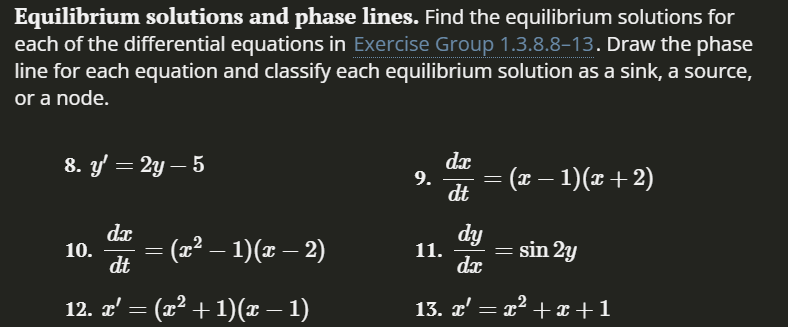 Equilibrium solutions and phase lines. Find the equilibrium solutions for
each of the differential equations in Exercise Group 1.3.8.8-13. Draw the phase
line for each equation and classify each equilibrium solution as a sink, a source,
or a node.
—9y— dz
8.y=2-5 9. 2 _ (2 +2)
dt
dz di
10. Zz =F 0-2 11. 2 —sin2y
12. 2' = (2 + 1)(z — 1) 13.2 =z fz +1
This is AI generated Response.
Asked by: Alok Kumar
Created at: 2026-01-28 04:58:23
Asked by: Alok Kumar
Created at: 2026-01-28 04:58:23
Final Answer:
Rendered
Raw Text
Did you like this answer?
Sure! Let's break down the steps for each equation:
## **Step-by-Step Guide**
### 1. **Find Equilibrium Solutions**
Equilibrium solutions (also called critical points) are values where the derivative is zero.
Set the right side of the equation to zero and solve for the variable.
### 2. **Phase Line Analysis**
- Draw a number line.
- Mark equilibrium points.
- For each interval, check the sign of the derivative to determine the direction (increasing/decreasing).
- Classify each equilibrium point:
- **Sink**: Arrows point towards the equilibrium (stable).
- **Source**: Arrows point away (unstable).
- **Node**: Special cases, but for 1D, usually just sinks or sources.
---
## **Examples**
### **8. \( y' = 2y - 5 \)**
#### **Equilibrium:**
Set \( 2y - 5 = \implies y = 2.5 \)
#### **Phase Line:**
- For \( y < 2.5 \), \( y' < \) (decreasing)
- For \( y > 2.5 \), \( y' > \) (increasing)
#### **Classification:**
- **Source** (arrows point away from \( y = 2.5 \))
---
### **9. \( \frac{dx}{dt} = (x-1)(x+2) \)**
#### **Equilibrium:**
Set \( (x-1)(x+2) = \implies x = 1 \) or \( x = -2 \)
#### **Phase Line:**
- For \( x < -2 \): Both terms negative, product positive (\( x' > \)), arrow →
- For \( -2 < x < 1 \): One term negative, product negative (\( x' < \)), arrow ←
- For \( x > 1 \): Both terms positive, product positive (\( x' > \)), arrow →
#### **Classification:**
- At \( x = -2 \): **Source** (arrows away)
- At \( x = 1 \): **Sink** (arrows toward)
---
### **10. \( \frac{dx}{dt} = (x^2-1)(x-2) \)**
Factor: \( (x-1)(x+1)(x-2) \)
#### **Equilibrium:**
\( x = -1, 1, 2 \)
#### **Phase Line:**
- Check sign in each interval:
- \( x < -1 \): \( -, -, - \) ⇒ \( - \) (\( x' < \)), ←
- \( -1 < x < 1 \): \( +, -, - \) ⇒ \( + \) (\( x' > \)), →
- \( 1 < x < 2 \): \( +, +, - \) ⇒ \( - \) (\( x' < \)), ←
- \( x > 2 \): \( +, +, + \) ⇒ \( + \) (\( x' > \)), →
#### **Classification:**
- \( x = -1 \): **Source** (arrows away)
- \( x = 1 \): **Sink** (arrows toward)
- \( x = 2 \): **Source** (arrows away)
---
### **11. \( \frac{dy}{dx} = \sin(2y) \)**
#### **Equilibrium:**
\( \sin(2y) = \implies 2y = n\pi \implies y = n\pi/2 \), for any integer \( n \).
#### **Phase Line:**
- Between each equilibrium, use sign of \( \sin(2y) \) (periodic: +, -, +, ...)
- For example, between \( y= \) and \( y=\pi/2 \), \( \sin(2y) > \) (increasing), next interval \( \sin(2y) < \) (decreasing).
#### **Classification:**
- Alternate between **sources** and **sinks** at each \( y = n\pi/2 \).
---
### **12. \( x' = (x^2+1)(x-1) \)**
#### **Equilibrium:**
- \( x^2 + 1 \) is always positive, so only \( x-1 = \implies x = 1 \)
#### **Phase Line:**
- For \( x < 1 \), \( x' < \) (decreasing)
- For \( x > 1 \), \( x' > \) (increasing)
#### **Classification:**
- \( x = 1 \): **Source** (arrows away)
---
### **13. \( x' = x^2 + x + 1 \)**
#### **Equilibrium:**
- \( x^2 + x + 1 = \) has no real roots (discriminant < )
- **No equilibrium solutions**
#### **Phase Line:**
- \( x^2 + x + 1 > \) always, so \( x' > \) everywhere (always increasing)
---
## **Summary Table**
| Equation | Equilibrium(s) | Classification |
|----------|----------------|---------------|
| 8 | \( y = 2.5 \) | Source |
| 9 | \( x = -2, 1 \)| Source at -2, Sink at 1 |
| 10 | \( x = -1, 1, 2 \) | Source at -1 & 2, Sink at 1 |
| 11 | \( y = n\pi/2 \) | Alternate Source/Sink |
| 12 | \( x = 1 \) | Source |
| 13 | None | No equilibrium |
If you want a diagram for any specific phase line, let me know!
📢 Instructions:
- Ask anything relatd to above question only.
- For new Question goto :