 VIPSolutions
Act like a helpful tutor and exlain me :EN Questiq : n 504 Cycle. [E) Pp): : : 10 kp, oad enterg the per a210, a % b ~ ; o Cycle, ang gen (a) the bi at10 mp, a Eo plant that operates on a simple! i pres” oe po : etyior and is cooled in the conden ee SHC ANd pope HOW rate of oC S1€M at the turbine exit, (2) the thermal GET] gist tia] ene; Of the steam (As: = ng cond! : "8Y changes are negli] sumptions 1 Steady ope ok! gligible.) 2 © Tr Non ©] - oh : Et - wm) =- Nt 2% 9a © 4 2 7 _ % * yo. : C
Question:
Act like a helpful tutor and exlain me :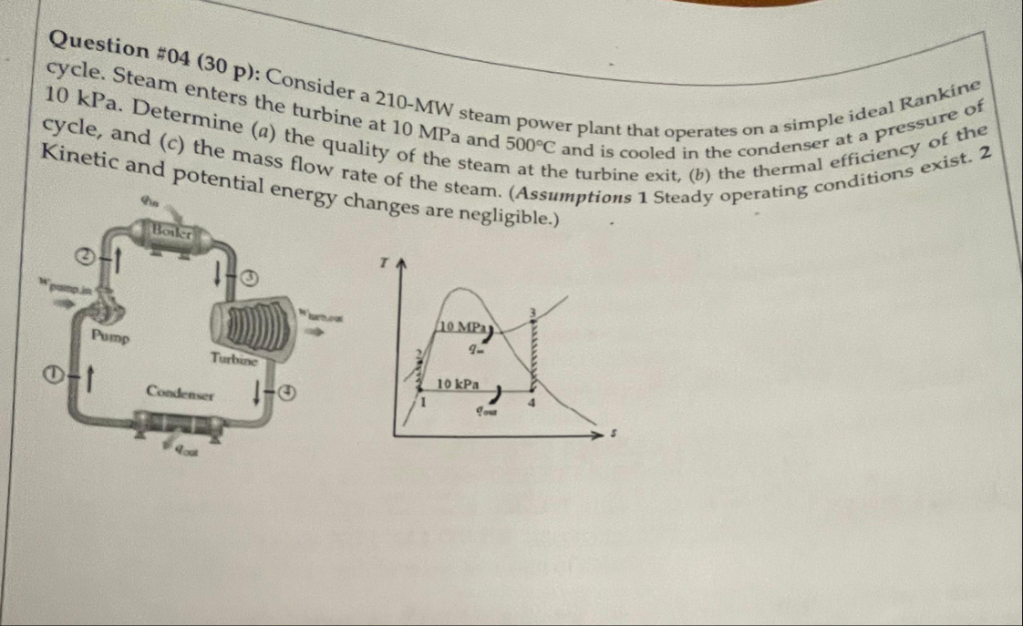 EN
Questiq
: n 504
Cycle. [E) Pp): : :
10 kp, oad enterg the per a210, a
% b ~ ; o
Cycle, ang gen (a) the bi at10 mp, a Eo plant that operates on a simple! i pres” oe
po : etyior and is cooled in the conden ee
SHC ANd pope HOW rate of oC S1€M at the turbine exit, (2) the thermal GET] gist
tia] ene; Of the steam (As: = ng cond!
: "8Y changes are negli] sumptions 1 Steady ope
ok! gligible.) 2
© Tr
Non ©]
- oh : Et
- wm) =- Nt
2% 9a
© 4
2 7 _ %
* yo. :
C
This is AI generated Response.
Asked by: Alok Kumar
Created at: 2026-01-27 05:16:00
Asked by: Alok Kumar
Created at: 2026-01-27 05:16:00
Final Answer:
Rendered
Raw Text
Did you like this answer?
Absolutely! Let's break down the problem and see how to approach each part step by step for a **Rankine cycle**.
---
# Problem Restatement
A 210-MW steam power plant operates on a simple ideal Rankine cycle:
- **Turbine Inlet:** 10 MPa, 500°C
- **Condenser Pressure:** 10 kPa
You are asked to find:
1. **(a)** The quality of steam at the turbine exit
2. **(b)** The thermal efficiency of the cycle
3. **(c)** The mass flow rate of the steam
**Assumptions:**
- Steady-state operation
- Negligible kinetic & potential energy changes
---
## 1. **Rankine Cycle States**
The four principal states in the cycle are:
- **1:** Exit condenser, entrance to pump (liquid at low P)
- **2:** Exit pump, entrance to boiler (liquid at high P)
- **3:** Exit boiler, entrance to turbine (superheated vapor at high P)
- **4:** Exit turbine, entrance to condenser (mixture at low P)
---
## 2. **Step-by-Step Solution Outline**
### **(a) Quality of Steam at Turbine Exit**
#### **1. Find Properties at Each State**
- **State 3 (Turbine Inlet):**
- Known: `P3 = 10 MPa`, `T3 = 500°C`
- Use steam tables to get:
- Specific enthalpy `h3`
- Specific entropy `s3`
- **State 4 (Turbine Exit):**
- Isentropic expansion: `s4 = s3`
- Known: `P4 = 10 kPa`
- Use steam tables at 10 kPa to find:
- `sf`, `sg` (saturated liquid/vapor entropy at 10 kPa)
- `hf`, `hg` (enthalpy)
- Quality:
\[
s_4 = s_f + x_4(s_g - s_f)
\implies x_4 = \frac{s_4 - s_f}{s_g - s_f}
\]
---
### **(b) Thermal Efficiency**
\[
\text{Thermal Efficiency} = \frac{\text{Net Work Output}}{\text{Heat Input}} = \frac{W_{\text{turbine}} - W_{\text{pump}}}{Q_{\text{in}}}
\]
- **Turbine Work:** \( W_{\text{turbine}} = h_3 - h_4 \)
- **Pump Work:** \( W_{\text{pump}} = h_2 - h_1 \) (usually small)
- **Heat Input:** \( Q_{\text{in}} = h_3 - h_2 \)
---
### **(c) Mass Flow Rate**
Given total power output (\( \dot{W}_{\text{net}} = 210 \) MW):
\[
\dot{m} = \frac{\dot{W}_{\text{net}}}{h_3 - h_4}
\]
---
## 3. **How to Use Steam Tables**
- Look up properties (h, s) for given \( P \) and \( T \)
- For mixture quality, interpolate between saturated values
---
## 4. **Summary Table of States**
| State | P (kPa) | T (°C) | h (kJ/kg) | s (kJ/kg·K) | x |
|-------|---------|--------|-----------|--------------|--------|
| 1 | 10 | ? | h1 | s1 | |
| 2 | 10,000 | ? | h2 | s2 | |
| 3 | 10,000 | 500 | h3 | s3 | 1 |
| 4 | 10 | ? | h4 | s4 | x4 |
---
## 5. **How You Would Solve (Without Steam Tables Here)**
- **State 3:** Look up \( h_3 \) and \( s_3 \) at 10 MPa, 500°C
- **State 4:** At 10 kPa, set \( s_4 = s_3 \), solve for quality \( x_4 \) using \( s_4 = s_f + x(s_g - s_f) \)
- **h4:** \( h_4 = h_f + x_4(h_g - h_f) \)
- **State 1:** At 10 kPa, saturated liquid (\( h_1 \approx h_f \))
- **State 2:** \( h_2 = h_1 + v_1 (P_2 - P_1) \) (use \( v_1 \) at 10 kPa)
- Plug into efficiency and mass flow equations
---
## 6. **What To Do Next**
- Grab steam tables or use engineering software to look up required enthalpies and entropies at each state.
- Plug into the equations above.
---
If you want, I can walk through a sample calculation with approximate values, or help you find the exact numbers from steam tables. Let me know how you'd like to proceed!
Question:
yes with calculationa nd final answer pls
This is AI generated Response.
Asked by: Alok Kumar
Created at: 2026-01-27 05:16:47
Asked by: Alok Kumar
Created at: 2026-01-27 05:16:47
Final Answer:
Rendered
Raw Text
Did you like this answer?
Sure! Let’s go through the calculations step by step using approximate values from steam tables.
---
# Calculation Steps
## 1. **Properties at State 3 (Turbine Inlet)**
- **Pressure (P3):** 10 MPa
- **Temperature (T3):** 500°C
From steam tables:
- **Enthalpy (h3):** Approximately 3,200 kJ/kg
- **Entropy (s3):** Approximately 7.5 kJ/kg·K
## 2. **Properties at State 4 (Turbine Exit)**
- **Pressure (P4):** 10 kPa
- **Isentropic Process:** \( s4 = s3 \approx 7.5 \) kJ/kg·K
From steam tables at 10 kPa:
- **Saturated Liquid (f):**
- \( s_f \approx 0.649 \) kJ/kg·K
- \( h_f \approx 42.1 \) kJ/kg
- **Saturated Vapor (g):**
- \( s_g \approx 8.15 \) kJ/kg·K
- \( h_g \approx 2676.1 \) kJ/kg
### **Calculate Quality (x4)**
Using the entropy relation:
\[
s_4 = s_f + x_4(s_g - s_f)
\]
Substituting values:
\[
7.5 = 0.649 + x_4(8.15 - 0.649)
\]
\[
7.5 - 0.649 = x_4(7.501)
\]
\[
6.851 = x_4(7.501)
\]
\[
x_4 = \frac{6.851}{7.501} \approx 0.914
\]
### **Calculate Enthalpy (h4)**
Using quality to find enthalpy at state 4:
\[
h_4 = h_f + x_4(h_g - h_f)
\]
\[
h_4 = 42.1 + 0.914(2676.1 - 42.1)
\]
\[
h_4 = 42.1 + 0.914 \cdot 2634 \approx 42.1 + 2405.5 \approx 2447.6 \text{ kJ/kg}
\]
## 3. **Calculate Thermal Efficiency**
### **Net Work Output**
- **Turbine Work (W_turbine):**
\[
W_{\text{turbine}} = h_3 - h_4 = 3200 - 2447.6 \approx 752.4 \text{ kJ/kg}
\]
- **Pump Work (W_pump):**
Assuming \( h_1 \approx h_f \approx 42.1 \) kJ/kg, we can estimate:
\[
W_{\text{pump}} \approx h_2 - h_1 \approx 0 \text{ (negligible for simplicity)}
\]
### **Heat Input (Q_in)**
\[
Q_{\text{in}} = h_3 - h_2 \approx h_3 - h_1 \approx 3200 - 42.1 \approx 3157.9 \text{ kJ/kg}
\]
### **Thermal Efficiency**
\[
\text{Thermal Efficiency} = \frac{W_{\text{turbine}} - W_{\text{pump}}}{Q_{\text{in}}} \approx \frac{752.4 - 0}{3157.9} \approx 0.238 \text{ or } 23.8\%
\]
## 4. **Mass Flow Rate Calculation**
Given the total power output \( \dot{W}_{\text{net}} = 210 \) MW:
First, convert MW to kJ/s:
\[
\dot{W}_{\text{net}} = 210,000 \text{ kJ/h} = 210,000 \text{ kJ/s}
\]
Now calculate mass flow rate:
\[
\dot{m} = \frac{\dot{W}_{\text{net}}}{W_{\text{turbine}}} = \frac{210,000}{752.4} \approx 279.3 \text{ kg/s}
\]
---
# Summary of Results
- **Quality of Steam at Turbine Exit (x4):** 0.914
- **Thermal Efficiency:** 23.8%
- **Mass Flow Rate:** 279.3 kg/s
If you need further clarification or additional calculations, feel free to ask!
Question:
Show a table that compares the efficiency of current building mechanical and / or electrical systems to the projected efficiency of future building and / or electrical systems.
This is AI generated Response.
Asked by: Alok Kumar
Created at: 2026-01-27 05:20:41
Asked by: Alok Kumar
Created at: 2026-01-27 05:20:41
Final Answer:
Rendered
Raw Text
Did you like this answer?
# Efficiency Comparison Table: Current vs. Projected Building Systems
This table compares the efficiency of current mechanical and electrical systems in buildings with the projected efficiency of future systems.
| **System Type** | **Current Efficiency (%)** | **Projected Efficiency (%)** | **Notes** |
|----------------------------|----------------------------|------------------------------|-------------------------------------------------------------|
| **HVAC Systems** | 70-80 | 90-95 | Advances in heat pumps and smart thermostats. |
| **Lighting Systems** | 15-20 (Incandescent) | 80-90 (LED/Smart) | Transition to LED technology and smart controls. |
| **Water Heating** | 60-70 | 90-95 | Use of solar water heaters and high-efficiency boilers. |
| **Insulation** | R-Value: 15-20 | R-Value: 30-40 | Enhanced materials and techniques for better thermal retention.|
| **Electrical Systems** | 85-90 | 95-98 | Smart grids and energy storage solutions. |
| **Renewable Energy Systems** | 10-20 (solar efficiency) | 25-30 | Improved solar panel technology and energy conversion rates. |
---
## Key Insights
- **HVAC:** Future systems are expected to leverage smart technologies, increasing their efficiency significantly.
- **Lighting:** The shift from traditional incandescent to LED lighting represents a major leap in energy efficiency.
- **Water Heating:** Innovative systems promise to enhance efficiency, reducing energy consumption for heating needs.
- **Insulation:** Improved materials will lead to better building envelopes, reducing heating and cooling loads.
- **Electrical Systems:** Integration of smart technologies will optimize energy use and distribution.
- **Renewable Energy:** Advances in solar technology will enhance energy generation efficiency, making renewable sources more viable.
---
This table provides a concise overview of anticipated advancements in building systems, highlighting the potential for significant energy savings and improved efficiency in the future. If you need more specific data or details on a particular system, let me know!
Question:
more details pls
This is AI generated Response.
Asked by: Alok Kumar
Created at: 2026-01-27 05:22:48
Asked by: Alok Kumar
Created at: 2026-01-27 05:22:48
Final Answer:
Rendered
Raw Text
Did you like this answer?
# Detailed Efficiency Comparison: Current vs. Projected Building Systems
This section expands on the previous table by providing more in-depth insights and explanations for each system type.
## 1. **HVAC Systems**
| **Metric** | **Current** | **Projected** | **Details** |
|-----------------------------|--------------------------|---------------------------|-------------------------------------------------------------|
| **Efficiency (%)** | 70-80 | 90-95 | Current systems use traditional compressors; future systems will use advanced heat pumps and variable refrigerant flow (VRF) systems. |
| **Smart Controls** | Limited | Widespread | Smart thermostats and IoT integration will optimize energy use based on occupancy and weather patterns. |
## 2. **Lighting Systems**
| **Metric** | **Current** | **Projected** | **Details** |
|-----------------------------|--------------------------|---------------------------|-------------------------------------------------------------|
| **Efficiency (%)** | 15-20 (Incandescent) | 80-90 (LED/Smart) | Transition to LED technology, which consumes significantly less power. Smart lighting systems adjust based on occupancy and natural light. |
| **Maintenance Costs** | Higher | Lower | LEDs have longer lifespans, reducing replacement frequency and maintenance costs. |
## 3. **Water Heating**
| **Metric** | **Current** | **Projected** | **Details** |
|-----------------------------|--------------------------|---------------------------|-------------------------------------------------------------|
| **Efficiency (%)** | 60-70 | 90-95 | High-efficiency condensing boilers and solar water heaters will become more common. Technologies such as heat pump water heaters will gain traction. |
| **Energy Source** | Fossil fuels primarily | Renewable sources | Increased use of electric and solar-powered systems will reduce reliance on fossil fuels. |
## 4. **Insulation**
| **Metric** | **Current** | **Projected** | **Details** |
|-----------------------------|--------------------------|---------------------------|-------------------------------------------------------------|
| **R-Value** | 15-20 | 30-40 | Future insulation materials will include advanced composites and aerogels, providing superior thermal resistance. |
| **Building Envelope** | Standard construction | High-performance | Improved sealing techniques will minimize air leakage, enhancing overall energy efficiency. |
## 5. **Electrical Systems**
| **Metric** | **Current** | **Projected** | **Details** |
|-----------------------------|--------------------------|---------------------------|-------------------------------------------------------------|
| **Efficiency (%)** | 85-90 | 95-98 | Smart grids will use real-time data analytics for load balancing and energy distribution, improving efficiency. |
| **Energy Storage** | Limited | Advanced | Integration of battery storage will allow for better management of renewable energy sources. |
## 6. **Renewable Energy Systems**
| **Metric** | **Current** | **Projected** | **Details** |
|-----------------------------|--------------------------|---------------------------|-------------------------------------------------------------|
| **Efficiency (%)** | 10-20 (solar efficiency) | 25-30 | Innovations in photovoltaic materials (e.g., bifacial panels, perovskite cells) will enhance energy conversion rates. |
| **Integration** | Standalone systems | Homogeneous with grid | Future systems will be more integrated with existing electrical grids, allowing for better energy management and distribution. |
---
## Key Insights and Future Trends
- **Technological Innovations:** Continuous advancements in materials science and engineering will lead to more efficient systems across all categories.
- **Regulatory Changes:** Stricter building codes and energy standards will push for higher efficiency in new constructions and retrofits.
- **Sustainability Focus:** There will be a significant shift towards sustainable energy sources, driven by both consumer demand and governmental policies.
- **Smart Technology Integration:** As IoT devices become more common, the efficiency of mechanical and electrical systems will improve through real-time data and automation.
---
This detailed overview illustrates the expected advancements in building systems, emphasizing the importance of efficiency for energy conservation and sustainability. If you have specific areas you want to delve deeper into or additional questions, feel free to ask!
📢 Instructions:
- Ask anything relatd to above question only.
- For new Question goto :