 VIPSolutions
Act like a helpful tutor and exlain me :Ee STMT, i ~ kubbyitself) and pivoted at point P. = Roe je Be ( Sr BRI Ch 5 ie “ALY pe TE A
Question:
Act like a helpful tutor and exlain me :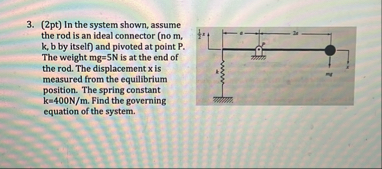 Ee
STMT, i
~ kubbyitself) and pivoted at point P. =
Roe je
Be (
Sr
BRI Ch 5
ie
“ALY pe
TE A
This is AI generated Response.
Asked by: Alok Kumar
Created at: 2026-01-27 05:54:45
Asked by: Alok Kumar
Created at: 2026-01-27 05:54:45
Final Answer:
Rendered
Raw Text
Did you like this answer?
Sure! Let's break down the problem and find the **governing equation** for the system.
---
## **Problem Recap**
- **Rod**: Ideal (no mass, no stiffness, no damping)
- **Pivot**: Point P
- **Weight**: \( mg = 5N \) at the end of the rod
- **Spring**: Spring constant \( k = 400 \, \text{N/m} \)
- **Displacement**: \( x \) (measured from equilibrium)
- **Goal**: Find the governing equation.
---
## **Step 1: System Diagram and Variables**
Let's label:
- **Rod length:** \( l \)
- **Displacement at end:** \( x \)
- **Spring attached at distance \( d \) from pivot**
When the weight moves down by \( x \), the spring also stretches by an amount **proportional to the arc length** at its attachment point.
---
## **Step 2: Kinematics**
Assume small angles (\( \theta \)), so that:
- Displacement at rod end: \( x = l \theta \) ⇒ \( \theta = \frac{x}{l} \)
- Displacement at spring point: \( x_s = d \theta = d \frac{x}{l} \)
---
## **Step 3: Forces and Torques**
### **Forces Acting**
1. **Spring Force:** \( F_{\text{spring}} = -k x_s = -k \frac{d}{l} x \) (restoring force)
2. **Weight:** \( mg \) (acts downward at rod end)
### **Torques about Pivot P**
- **Spring Torque:** \( \tau_{\text{spring}} = -k x_s \cdot d = -k \frac{d^2}{l} x \)
- **Weight Torque:** \( \tau_{\text{weight}} = -mg \cdot l \cdot \sin\theta \approx -mg \cdot l \cdot \theta = -mg \cdot x \)
- For small angles, \( \sin\theta \approx \theta \).
#### **Total Restoring Torque**
\[
\tau_{\text{total}} = -mg \cdot x - k \frac{d^2}{l} x
\]
---
## **Step 4: Equation of Motion**
Since the rod is massless and ideal, **no inertia term**. The sum of torques must be zero in static equilibrium, or if you assume small oscillations, you would write:
\[
(mg) \cdot x + k \frac{d^2}{l} x =
\]
Or, more generally (if considering dynamics and adding mass \( m_{\text{eff}} \) at the end):
\[
m_{\text{eff}} \ddot{x} + mg x + k \frac{d^2}{l} x =
\]
But since the rod is massless and only the weight at the end matters, if considering only static or quasi-static equilibrium:
\[
mg x + k \frac{d^2}{l} x =
\]
---
## **Step 5: Substitute Values**
Given:
- \( mg = 5 \) N
- \( k = 400 \) N/m
- \( d \), \( l \): Distances from diagram
The **governing equation** is:
\[
5x + 400 \frac{d^2}{l} x =
\]
Or, factoring \( x \):
\[
\boxed{
\left[5 + 400 \frac{d^2}{l} \right] x =
}
\]
This is the equation that governs the equilibrium (or motion for small perturbations) of the system.
---
### **Summary Table**
| Term | Physical Meaning |
|-----------|----------------------------------|
| \( 5x \) | Gravitational restoring force |
| \( 400 \frac{d^2}{l} x \) | Spring restoring force |
---
**If you have the values for \( d \) and \( l \), you can substitute them for a numerical answer.**
Let me know if you'd like to see the dynamic equation (with mass, if included), or if you want a step-by-step for a specific value!
📢 Instructions:
- Ask anything relatd to above question only.
- For new Question goto :