 VIPSolutions
Act like a helpful tutor and exlain me :e) An open-loop system is characterised through the transfer function G,,(s) = x O The closed-loop system is always stable for any K. O The closed-loop system is boundary stable. O The phase margin is always 90° for any K. O The gain margin is 3 dB for kK = 1.
Question:
Act like a helpful tutor and exlain me :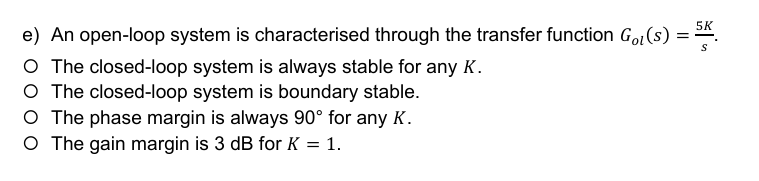 e) An open-loop system is characterised through the transfer function G,,(s) = x
O The closed-loop system is always stable for any K.
O The closed-loop system is boundary stable.
O The phase margin is always 90° for any K.
O The gain margin is 3 dB for kK = 1.
This is AI generated Response.
Asked by: Alok Kumar
Created at: 2026-01-26 03:44:29
Asked by: Alok Kumar
Created at: 2026-01-26 03:44:29
Final Answer:
Rendered
Raw Text
Did you like this answer?
Let's **analyze the given system** and each option:
### **Given Transfer Function**
\[
G_{ol}(s) = \frac{5K}{s}
\]
This is a **type-1 integrator** (a pole at the origin).
---
## **1. Stability of Closed-Loop System**
For a **unity feedback** system:
\[
G_{cl}(s) = \frac{G_{ol}(s)}{1 + G_{ol}(s)} = \frac{\frac{5K}{s}}{1 + \frac{5K}{s}} = \frac{5K}{s + 5K}
\]
- **Pole**: \( s = -5K \)
- For \( K > \), the pole is in the left half-plane (**stable**).
- For \( K = \), the system is at the origin (**marginally stable**).
- For \( K < \), the pole is in the right half-plane (**unstable**).
**Therefore:**
- "The closed-loop system is always stable for any \( K \)" is **incorrect**.
- "The closed-loop system is boundary stable" is **incorrect** for all \( K \), but **marginally stable** for \( K = \).
---
## **2. Phase Margin**
For the open-loop transfer function \( \frac{5K}{s} \):
- **At unity gain crossover (\(|G_{ol}(j\omega)| = 1\))**:
\[
\left| \frac{5K}{j\omega} \right| = 1 \implies \omega_{gc} = 5K
\]
- **Phase at this frequency**: Always \(-90^\circ\) (since \( \frac{1}{j\omega} \) gives phase \(-90^\circ\)).
- **Phase margin**: \(180^\circ - 90^\circ = 90^\circ\)
**So, "The phase margin is always 90° for any \( K \)" is TRUE.**
---
## **3. Gain Margin**
- **Phase crossover**: Where phase = \(-180^\circ\). But for an integrator, the phase is always \(-90^\circ\) (never reaches \(-180^\circ\)).
- **Gain margin**: Infinite (since the phase never reaches \(-180^\circ\)), so the statement about gain margin being 3 dB for \( K = 1 \) is **incorrect**.
---
## **Summary Table**
| Statement | True/False | Reason |
|-----------|:----------:|--------|
| The closed-loop system is always stable for any \( K \). | False | Only for \( K > \) |
| The closed-loop system is boundary stable. | False | Only for \( K = \) |
| **The phase margin is always 90° for any \( K \).** | **True** | Integrator always gives 90° PM |
| The gain margin is 3 dB for \( K = 1 \). | False | Gain margin is infinite |
---
## **Final Answer**
> **The correct statement is:**
>
> **The phase margin is always 90° for any \( K \).**
---
### **Let me know if you want to see the derivation or details for any specific option!**
Question:
Question 2 : Union ProbabilityDevice fails if component A ( P = 0 . 0 1 ) , B ( 0 . 0 3 ) , or C ( 0 . 0 4 ) fails independently. Probability device works?
This is AI generated Response.
Asked by: Alok Kumar
Created at: 2026-01-26 03:47:44
Asked by: Alok Kumar
Created at: 2026-01-26 03:47:44
Final Answer:
Rendered
Raw Text
Did you like this answer?
# Probability of Device Working
To determine the probability of a device working when components A, B, or C can fail independently, we first need to find the probability of each component failing and then calculate the probability of the device functioning.
### **1. Given Probabilities**
- **Probability of A failing**: \( P(A) = 0.01 \)
- **Probability of B failing**: \( P(B) = 0.03 \)
- **Probability of C failing**: \( P(C) = 0.04 \)
### **2. Probability of Each Component Working**
The probability of each component working is the complement of the failure probability:
- \( P(A \text{ works}) = 1 - P(A) = 1 - 0.01 = 0.99 \)
- \( P(B \text{ works}) = 1 - P(B) = 1 - 0.03 = 0.97 \)
- \( P(C \text{ works}) = 1 - P(C) = 1 - 0.04 = 0.96 \)
### **3. Total Probability of Device Working**
Since the components fail independently, the probability of the device working (i.e., none of the components A, B, or C fail) is calculated as:
\[
P(\text{Device works}) = P(A \text{ works}) \times P(B \text{ works}) \times P(C \text{ works})
\]
Substituting in the probabilities:
\[
P(\text{Device works}) = 0.99 \times 0.97 \times 0.96
\]
### **4. Calculation**
Calculating the above expression:
\[
P(\text{Device works}) = 0.99 \times 0.97 \times 0.96 \approx 0.941088
\]
### **5. Conclusion**
The probability that the device works is approximately:
\[
P(\text{Device works}) \approx 0.9411 \text{ or } 94.11\%
\]
### **Summary**
- **Probability of Device Working**: \( \approx 94.11\% \)
- **Probability of Device Failing**: \( 1 - P(\text{Device works}) \approx 5.89\% \)
Let me know if you need any further clarification or assistance!
📢 Instructions:
- Ask anything relatd to above question only.
- For new Question goto :