 VIPSolutions
Act like a helpful tutor and exlain me :Draw the product of the reaction shown below. Ignore inorganic | byproducts. | OH | { | | | OH pid [3 Na2Cr207 Acetone, H2S04 ee CE Ree teal te el g \ : ' ' \ 1 : 4 \ : ' 1 \ A Drawing A : ) 3 | / \ : ' ) \ / \ ] \ - - B. hod
Question:
Act like a helpful tutor and exlain me :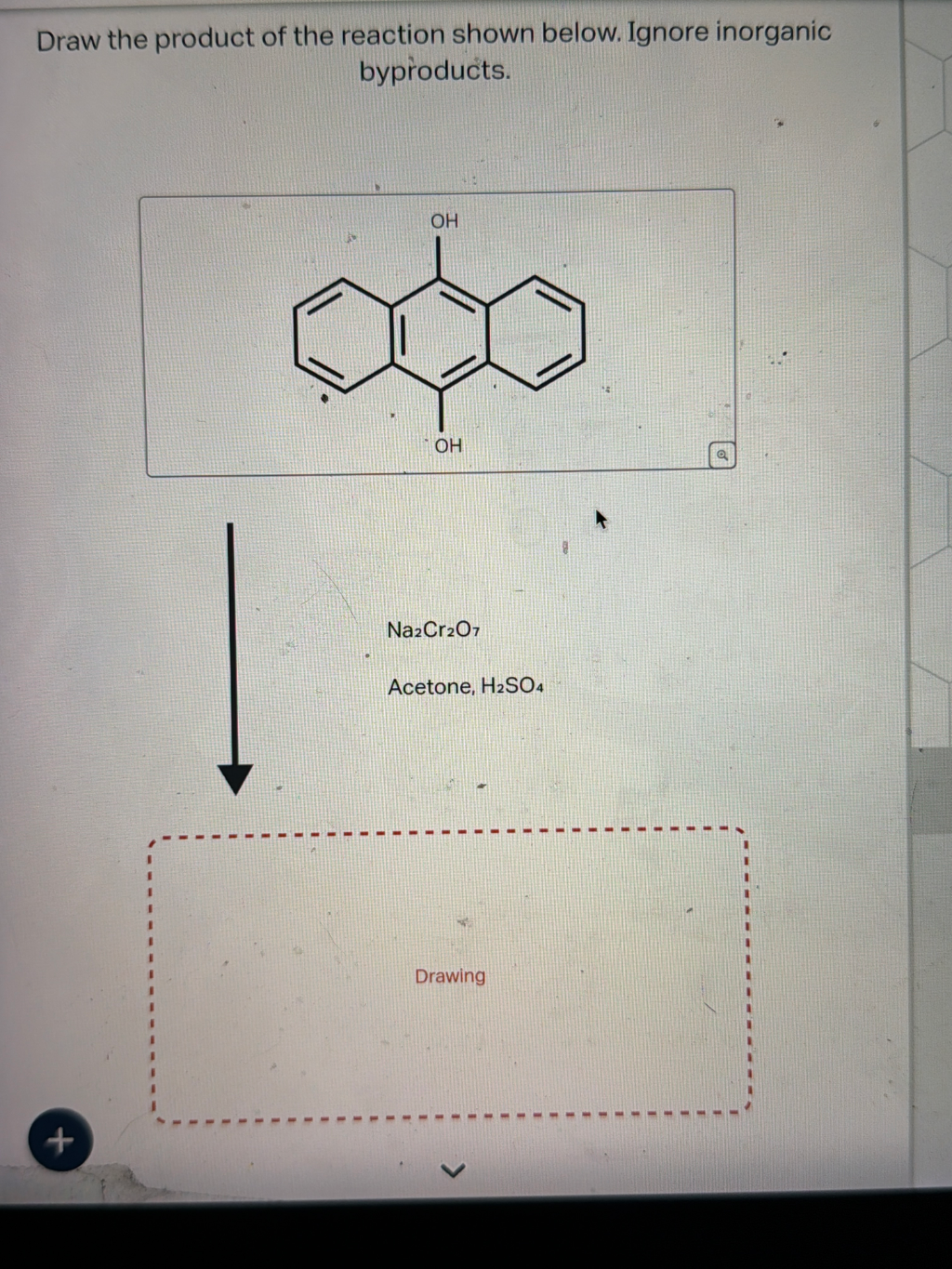 Draw the product of the reaction shown below. Ignore inorganic |
byproducts.
| OH
| {
|
| |
OH pid
[3
Na2Cr207
Acetone, H2S04
ee CE Ree teal te el
g \
: '
' \
1 :
4 \
: '
1 \
A Drawing A
: )
3 |
/ \
: '
) \
/ \
] \
- - B. hod
This is AI generated Response.
Asked by: Alok Kumar
Created at: 2026-02-01 07:25:19
Asked by: Alok Kumar
Created at: 2026-02-01 07:25:19
Final Answer:
Rendered
Raw Text
Did you like this answer?
Sure! Let's break down the reaction step by step:
---
## **Step 1: Understanding the Reactants**
The starting molecule is **1,2-dihydroxynaphthalene** (naphthalene ring with two adjacent OH groups).
---
## **Step 2: Understanding the Reagents**
- **Na₂Cr₂O₇** (sodium dichromate)
- **Acetone**
- **H₂SO₄** (sulfuric acid)
These reagents together are a **strong oxidizing system**. Sodium dichromate in acid is commonly used to oxidize alcohols.
---
## **Step 3: Predicting the Reaction**
### **What gets oxidized?**
- The starting compound has **two neighboring hydroxyl (OH) groups** on an aromatic ring (1,2-dihydroxy).
- With strong oxidizing agents, such as Na₂Cr₂O₇/H₂SO₄, **vicinal (neighboring) diols** on aromatic rings are oxidized to **quinones**.
### **What is the product?**
- The two OH groups are oxidized to **carbonyl groups (=O)**.
- This converts the molecule to **1,2-naphthoquinone**.
---
## **Step 4: Drawing the Product**
- The product is naphthalene with **two ketone groups at positions 1 and 2** (next to each other).
### **Product Structure: 1,2-Naphthoquinone**
```
O O
// \\
| |
| |
--- ---
```
Or, in words: The two OH groups are both replaced by C=O groups.
---
## **Summary Table**
| Step | Structure Change |
|----------------|--------------------------------|
| Start | 1,2-dihydroxy-naphthalene |
| Reagents | Na₂Cr₂O₇, H₂SO₄, acetone |
| Product | 1,2-naphthoquinone |
---
## **Final Product**
**1,2-naphthoquinone**
If you need a drawn structure, just let me know!
Question:
The density of ethanol, a colorless liquid that is commonly known as grain alcohol, is 0 . 7 8 9 g / mL . Calculate the mass of 2 6 . 2 mL of the liquid in grams.
This is AI generated Response.
Asked by: Alok Kumar
Created at: 2026-02-01 07:56:50
Asked by: Alok Kumar
Created at: 2026-02-01 07:56:50
Final Answer:
Rendered
Raw Text
Did you like this answer?
## **Calculating Mass of Ethanol**
To find the mass of ethanol given its volume and density, we can use the formula:
\[
\text{Mass} = \text{Density} \times \text{Volume}
\]
### **Given Data**
- **Density of Ethanol**: \(0.789 \, \text{g/mL}\)
- **Volume of Ethanol**: \(26.2 \, \text{mL}\)
### **Calculation**
Substituting the values into the formula:
\[
\text{Mass} = 0.789 \, \text{g/mL} \times 26.2 \, \text{mL}
\]
Calculating the mass:
\[
\text{Mass} = 20.7068 \, \text{g}
\]
### **Result**
The mass of \(26.2 \, \text{mL}\) of ethanol is approximately **20.71 grams** (rounded to two decimal places).
📢 Instructions:
- Ask anything relatd to above question only.
- For new Question goto :