 VIPSolutions
Act like a helpful tutor and exlain me :Draw the major product of this reaction. Ignore inorganic byproducts. OH PON (CHsCH2)sSiCl, EtsN pm EEEEE EE EE EEE EEE ! 1 ! 1 ! 1 1 Drawing 1 ! 1 ! 1 1 1
Question:
Act like a helpful tutor and exlain me :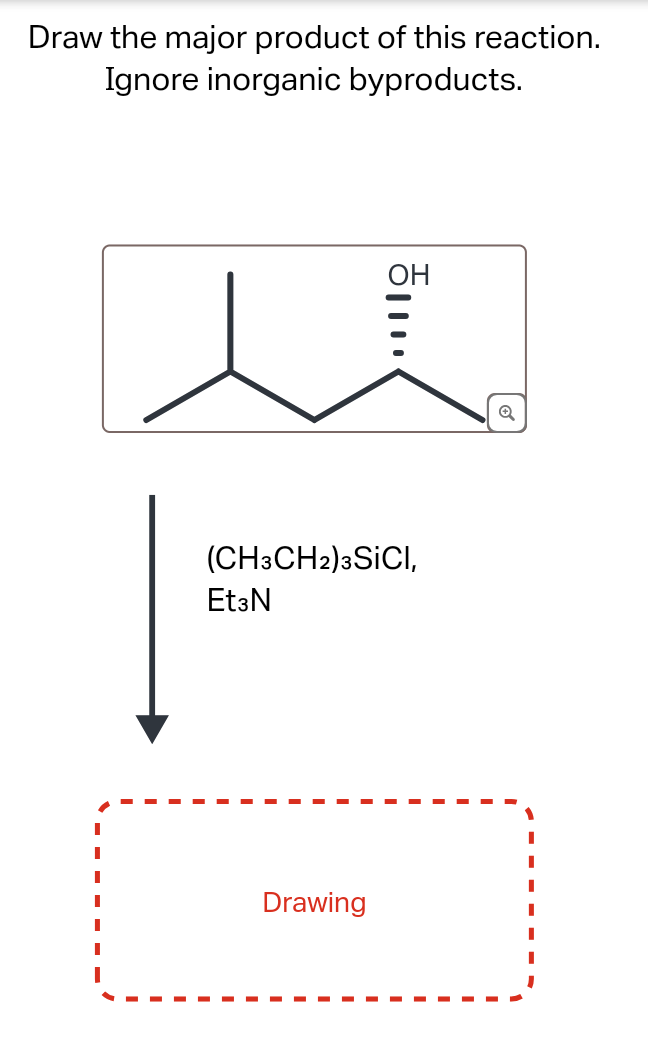 Draw the major product of this reaction.
Ignore inorganic byproducts.
OH
PON
(CHsCH2)sSiCl,
EtsN
pm EEEEE EE EE EEE EEE
! 1
! 1
! 1
1 Drawing 1
! 1
! 1
1 1
This is AI generated Response.
Asked by: Alok Kumar
Created at: 2026-02-01 04:39:52
Asked by: Alok Kumar
Created at: 2026-02-01 04:39:52
Final Answer:
Rendered
Raw Text
Did you like this answer?
Let's break down the reaction step by step:
## **Step 1: Analyzing the Starting Material**
The starting material is a chiral alcohol:
- It is a 2-pentanol derivative with the OH group **on a wedge** (meaning it's coming out of the plane).
## **Step 2: Reagents**
- **(CH₃CH₂)₃SiCl** is triethylsilyl chloride (TESCl), a common protecting group for alcohols.
- **Et₃N** is triethylamine, a base used to neutralize HCl formed during the reaction.
## **Step 3: The Reaction**
This is a **silylation reaction**, where the alcohol is converted into a silyl ether.
The **OH group** will be replaced with an **O–Si(CH₂CH₃)₃** group (TES ether).
**The stereochemistry at the carbon does NOT change** during this protection step: the O-TES group will be on the wedge, just like the original OH.
---
## **Major Product Structure**
Replace the OH with O–Si(CH₂CH₃)₃ (**TES group**) on the same wedge:
### **Product Drawing**
```
|
|
----C----CH2CH3
|
CH3–CH–CH2–O–Si(CH2CH3)3
|
(Wedge to OTES)
```
Or more simply, the product is:
- The same carbon skeleton,
- The wedge now shows **O–Si(CH₂CH₃)₃** instead of OH.
---
### **Summary Table**
| Reactant | Reagent | Product (Major) |
|-------------------------------|----------------------------------|----------------------------------------|
| Chiral alcohol (OH on wedge) | (CH₃CH₂)₃SiCl, Et₃N | O–Si(CH₂CH₃)₃ (TES) on wedge |
---
## **Key Points**
- This is a **protection** reaction for alcohols.
- The stereochemistry at the chiral center **does not change**.
- The OH group is replaced by O–Si(CH₂CH₃)₃ (TES).
If you want a drawing, let me know and I can describe it more visually!
📢 Instructions:
- Ask anything relatd to above question only.
- For new Question goto :