 VIPSolutions
Act like a helpful tutor and exlain me : Draw the detailed reaction mechanismQu. © og == 0
Question:
Act like a helpful tutor and exlain me :
Draw the detailed reaction mechanism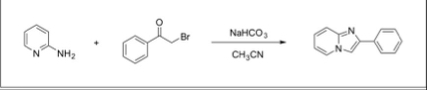 Qu. © og == 0
This is AI generated Response.
Asked by: Alok Kumar
Created at: 2026-02-02 05:42:12
Asked by: Alok Kumar
Created at: 2026-02-02 05:42:12
Final Answer:
Rendered
Raw Text
Did you like this answer?
Let's break down and explain **the detailed reaction mechanism** shown in your image:
### **Reaction Overview**
- **Reactants:** 2-aminopyridine + phenacyl bromide
- **Reagents:** NaHCO₃ (sodium bicarbonate), CH₃CN (acetonitrile)
- **Product:** 2-phenylimidazo[1,2-a]pyridine
This is a classic example of the **Groebke–Blackburn–Bienaymé (GBB) reaction** or an **imidazo[1,2-a]pyridine synthesis**.
---
## **Step-by-Step Mechanism**
### **Step 1: Nucleophilic Substitution**
- **2-aminopyridine** acts as a nucleophile.
- **Phenacyl bromide** (1-bromo-2-phenylethanone) has an electrophilic carbonyl carbon and a good leaving group (Br).
- The **amino group** of 2-aminopyridine attacks the carbonyl carbon of phenacyl bromide via nucleophilic addition.
#### **Intermediate I:**
- Forms a **hemiaminal intermediate** (N attached to carbonyl carbon, Br still attached).
### **Step 2: Intramolecular Cyclization**
- The lone pair on the **pyridine nitrogen** attacks the carbon adjacent to the carbonyl (the methylene carbon), displacing Br⁻ and leading to cyclization.
- This step forms the **imidazo ring** (5-membered fused ring system).
### **Step 3: Deprotonation and Aromatization**
- **NaHCO₃** acts as a base, removing a proton to help rearomatize the system.
- This results in the formation of **2-phenylimidazo[1,2-a]pyridine**.
---
## **Mechanism Diagram**
Here's a **detailed arrow-pushing mechanism** (described in text):
### 1. Nucleophilic Attack
```
N
/ \
| NH2 O O
| + Ph-CO-CH2-Br → N—NH—C—CH2-Br
\ / | |
|| Py Ph
Pyridine ring
```
- The NH₂ attacks the ketone → tetrahedral intermediate.
### 2. Intramolecular Cyclization (Br leaves)
```
(from above intermediate)
|
N—NH—C—CH2-Br
| |
Py Ph
The pyridine N attacks the CH2, Br leaves:
|
N—N=C—CH2
| |
Py Ph
```
- Cyclization forms the imidazo ring.
### 3. Deprotonation/Aromatization
- Final step: Aromatic imidazo[1,2-a]pyridine system is formed after proton transfer.
---
## **Summary Table**
| Step | Process | Key Change |
|------|------------------------|------------------------------------------|
| 1 | Nucleophilic Addition | Amino group attacks carbonyl |
| 2 | Cyclization | Pyridine N attacks CH₂, Br leaves |
| 3 | Aromatization | Deprotonation forms aromatic product |
---
## **Key Concepts**
- **Nucleophilic addition** to carbonyls
- **Intramolecular cyclization**
- **Base-promoted deprotonation/aromatization**
---
If you want a hand-drawn or digital arrow-pushing diagram, let me know!
📢 Instructions:
- Ask anything relatd to above question only.
- For new Question goto :