 VIPSolutions
Act like a helpful tutor and exlain me :Determine the magnitude of force F2 (in kN)necessary to hold the force F={-9i-8j-5k} kN in equilibrium. ¥ F. I 60" 135° oa le X y 0 F, ¥ (m.4m, 2m)
Question:
Act like a helpful tutor and exlain me :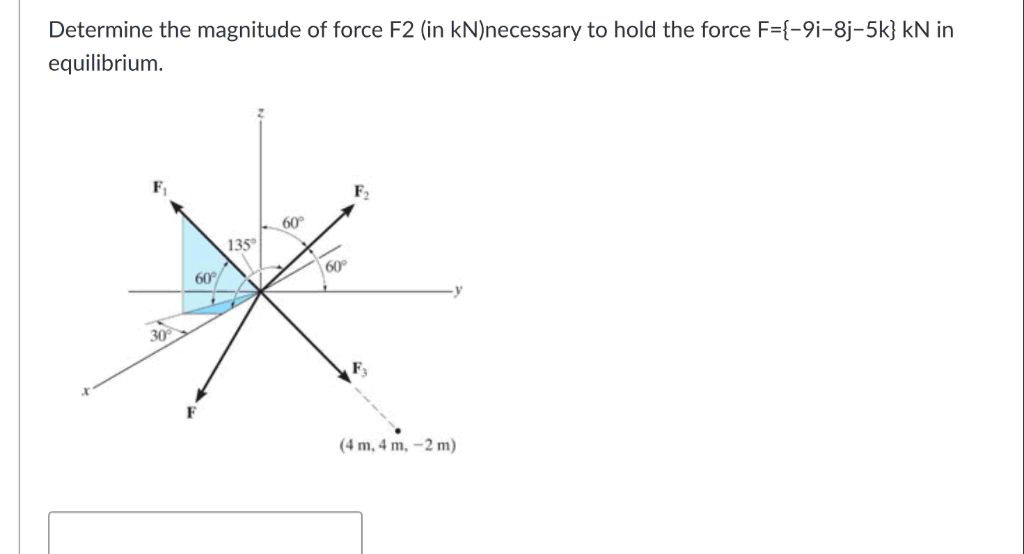 Determine the magnitude of force F2 (in kN)necessary to hold the force F={-9i-8j-5k} kN in
equilibrium.
¥ F.
I 60"
135° oa
le X y
0
F,
¥
(m.4m, 2m)
This is AI generated Response.
Asked by: manish kumar
Created at: 2025-09-10 07:36:48
Asked by: manish kumar
Created at: 2025-09-10 07:36:48
Final Answer:
Rendered
Raw Text
Did you like this answer?
Let's break this down step by step!
---
## **Step 1: Understanding the Problem**
We are given a force vector:
\[
\vec{F} = -9\hat{\imath} - 8\hat{\jmath} - 5\hat{k} \quad \text{(in kN)}
\]
We need to find the magnitude of **F₂** such that all forces (F, F₁, F₂, F₃) are in **equilibrium** (i.e., their vector sum is zero).
---
## **Step 2: Writing the Equilibrium Equation**
The **equilibrium condition**:
\[
\vec{F} + \vec{F}_1 + \vec{F}_2 + \vec{F}_3 = 0
\]
Or:
\[
\vec{F}_1 + \vec{F}_2 + \vec{F}_3 = -\vec{F}
\]
---
## **Step 3: Find Direction Cosines for F₂**
### **Given:**
- F₂ forms a **60° angle with each axis** (x, y, z).
#### **Direction cosines for such a vector:**
Let the magnitude be \( F_2 \).
Each component = \( F_2 \cdot \cos(60°) \)
So,
\[
\vec{F}_2 = F_2 \cdot \left(\cos 60° \hat{\imath} + \cos 60° \hat{\jmath} + \cos 60° \hat{k}\right)
\]
Since \( \cos 60° = 0.5 \):
\[
\vec{F}_2 = F_2 \cdot (0.5\hat{\imath} + 0.5\hat{\jmath} + 0.5\hat{k})
\]
---
## **Step 4: What Do We Need?**
- You need the direction and components of F₁ and F₃ as well (which should be given or can be deduced from the figure).
- If only F₂ is unknown and others known, you can solve for F₂.
---
## **Step 5: General Solution Approach**
### **Write All Force Components**
Let’s denote:
- \(\vec{F}_1 = F_1(\ldots)\)
- \(\vec{F}_2 = F_2(0.5, 0.5, 0.5)\)
- \(\vec{F}_3 = F_3(\ldots)\)
- \(\vec{F}\) is given.
Add all the i, j, k components, set their sum to zero, and solve for the unknown \(F_2\).
---
## **Step 6: Example Calculation for F₂ Only**
If only F₂ is unknown and the other forces' i, j, k components sum to a known vector (say, call it \( \vec{A} \)), then:
\[
\vec{A} + \vec{F}_2 = 0 \implies \vec{F}_2 = -\vec{A}
\]
But since \(\vec{F}_2 = F_2(0.5, 0.5, 0.5)\):
\[
F_2 \cdot (0.5, 0.5, 0.5) = -\vec{A}
\]
So:
\[
0.5 F_2 = -A_x \implies F_2 = -2A_x
\]
(Do similarly for y and z, and check consistency).
---
### **In This Problem:**
If all other forces are known, substitute their values, add to \(\vec{F}\), and solve as above.
---
## **Summary Table**
| Step | What to Do |
|-------------------|-------------------------------------------------------|
| 1. Write vectors | Express all forces in i, j, k components |
| 2. Add | Add all i, j, k components and set to zero |
| 3. Solve | Isolate and solve for the unknown \(F_2\) |
| 4. Plug in | Plug in direction cosines and solve for magnitude |
---
## **If you provide F₁ and F₃ vectors, we can finish the calculation together!**
Let me know if you want to proceed with sample values, or if you have F₁ and F₃'s components!
📢 Instructions:
- Ask anything relatd to above question only.
- For new Question goto :