 VIPSolutions
Act like a helpful tutor and exlain me :Determine the diene and dienophile. Label each, a attentions to stereospecificity. (20 pts) J J IL er @ (b)
Question:
Act like a helpful tutor and exlain me :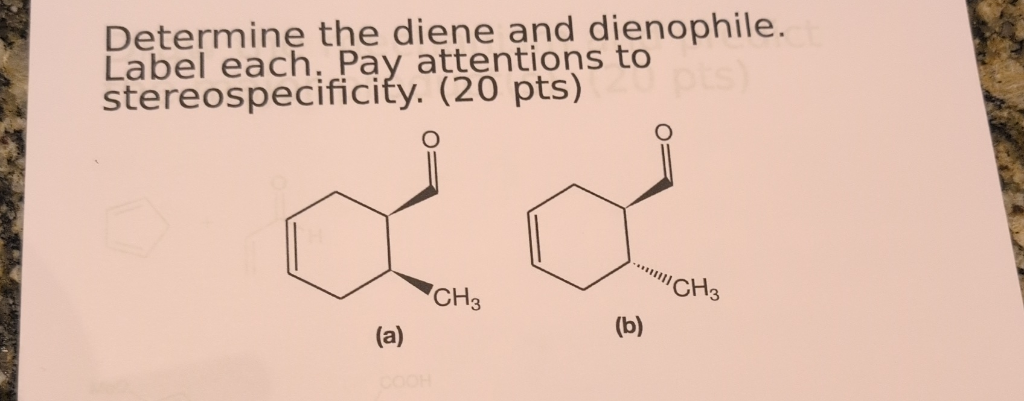 Determine the diene and dienophile.
Label each, a attentions to
stereospecificity. (20 pts)
J J
IL er
@ (b)
This is AI generated Response.
Asked by: Alok Kumar
Created at: 2026-01-31 06:50:24
Asked by: Alok Kumar
Created at: 2026-01-31 06:50:24
Final Answer:
Rendered
Raw Text
Did you like this answer?
## Diels-Alder Reaction: Diene and Dienophile
Let's break down what's happening in these structures and how to determine the **diene** and **dienophile** in a Diels-Alder reaction.
---
### **Step 1: Recognize the Diels-Alder Reaction**
- **Diels-Alder Reaction:**
- A [4+2] cycloaddition between a **diene** (compound with two conjugated double bonds) and a **dienophile** (compound with a double or triple bond that can react with the diene).
---
### **Step 2: Analyze the Products**
You are shown **two products** (labeled a and b) with structural differences at the position of the methyl (**CH₃**) group.
#### **Structure (a)**
- The CH₃ group is in a position **pointing up (wedged)**.
- The double bond inside the ring is on the left.
- The carbonyl (C=O) is attached to the ring.
#### **Structure (b)**
- The CH₃ group is in a position **pointing down (dashed)**.
- Otherwise, the structure is similar to (a).
---
### **Step 3: Assign Diene and Dienophile**
#### **Diene**
- The **diene** is the part that originally had two conjugated double bonds.
- In these products, the **ring** comes from the cycloaddition of a diene and a dienophile.
#### **Dienophile**
- The **dienophile** is usually an alkene or alkyne, often with an electron-withdrawing group (like a carbonyl, ester, etc.).
- Here, the **carbonyl group** (C=O) attached to the ring suggests that the dienophile had a C=O group adjacent to a double bond.
---
### **Step 4: Stereospecificity**
- The Diels-Alder reaction is **stereospecific**:
- **cis** substituents on the dienophile remain **cis** in the product.
- **trans** substituents remain **trans**.
- Here, the methyl group is either **up** (a) or **down** (b), indicating **stereochemistry** of the addition.
---
### **Summary Table**
| Product | Diene (reactant) | Dienophile (reactant) | Stereochemistry |
|---------|-------------------------|---------------------------------|--------------------------------|
| (a) | Conjugated diene | Alkene with C=O and CH₃ (cis) | CH₃ group is **up** (wedged) |
| (b) | Conjugated diene | Alkene with C=O and CH₃ (trans) | CH₃ group is **down** (dashed) |
---
### **Visual Summary**
- **Diene:** 1,3-butadiene (or similar conjugated diene)
- **Dienophile:** Methyl vinyl ketone (or similar; CH₂=CH-COCH₃), where the CH₃ could be up or down after the reaction
- **Stereospecificity:** The spatial arrangement of the CH₃ group in the product matches the arrangement in the dienophile due to the concerted nature of the Diels-Alder reaction.
---
### **Key Points**
- **Diene:** The 4-carbon conjugated system.
- **Dienophile:** Alkene (usually with electron-withdrawing groups, here a C=O and a CH₃).
- **Stereochemistry:** The Diels-Alder reaction is **stereospecific**; the orientation of groups on the dienophile is retained in the product.
---
#### **If you want to see the actual starting materials drawn out, let me know!**
📢 Instructions:
- Ask anything relatd to above question only.
- For new Question goto :