 VIPSolutions
Act like a helpful tutor and exlain me :Determine (a) the magnitude and (b) direction of the anchoring force needed to hold the horizontal elbow and nozzle combination shown in the figure below in place. Atmospheric pressure is 96.6 kPa. The gage pressure at section (1) is 104 kPa. At section (2), the water exits to the atmosphere. Assumep, = 104kPa, V, = 2 m/s. 160 mm p= I pr — 6/7 Section (2) 7 300 mm % =| Section (1) py IA CI : | N (b) v
Question:
Act like a helpful tutor and exlain me :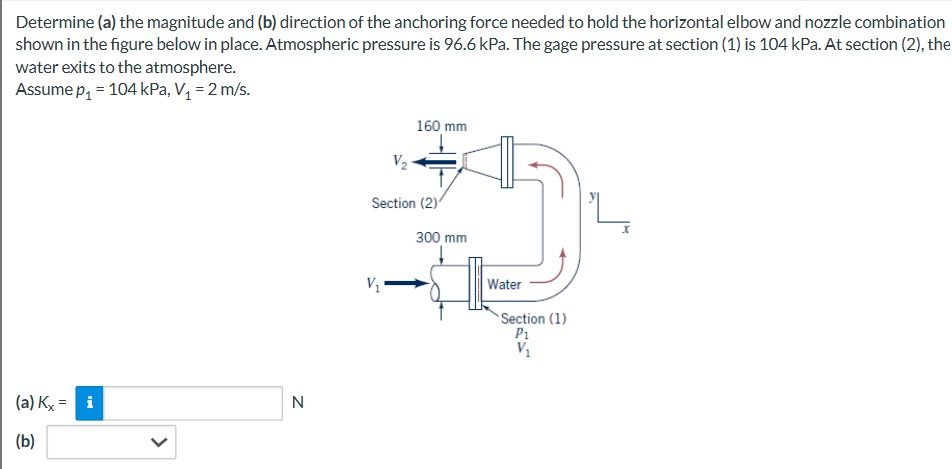 Determine (a) the magnitude and (b) direction of the anchoring force needed to hold the horizontal elbow and nozzle combination
shown in the figure below in place. Atmospheric pressure is 96.6 kPa. The gage pressure at section (1) is 104 kPa. At section (2), the
water exits to the atmosphere.
Assumep, = 104kPa, V, = 2 m/s.
160 mm
p= I
pr —
6/7
Section (2) 7
300 mm %
=|
Section (1)
py
IA
CI : | N
(b) v
This is AI generated Response.
Asked by: manish kumar
Created at: 2025-09-09 08:34:17
Asked by: manish kumar
Created at: 2025-09-09 08:34:17
Final Answer:
Rendered
Raw Text
Did you like this answer?
Sure! Let's break down the problem step by step:
---
### **Step 1: Understand the Problem**
We have a pipe elbow with water flowing through it. We are to find the force (**magnitude and direction**) needed to **anchor** the elbow so it doesn't move due to the water flow. We are given:
- **Inlet (1):**
- Pressure, \( p_1 = 104\, \text{kPa} \) (gage)
- Velocity, \( V_1 = 2\, \text{m/s} \)
- Diameter, \( D_1 = 300\, \text{mm} = 0.3\, \text{m} \)
- **Outlet (2):**
- Diameter, \( D_2 = 160\, \text{mm} = 0.16\, \text{m} \)
- Pressure is atmospheric (since it's open to atmosphere)
- **Atmospheric Pressure:** \( p_{\text{atm}} = 96.6\, \text{kPa} \)
---
### **Step 2: Find velocities and areas**
#### **Areas:**
\[
A_1 = \frac{\pi}{4} D_1^2 = \frac{\pi}{4} (0.3)^2 = 0.0707\, \text{m}^2
\]
\[
A_2 = \frac{\pi}{4} D_2^2 = \frac{\pi}{4} (0.16)^2 = 0.0201\, \text{m}^2
\]
#### **Flow Rate (Q):**
\[
Q = A_1 V_1 = 0.0707 \times 2 = 0.1414\, \text{m}^3/\text{s}
\]
#### **Velocity at outlet:**
\[
Q = A_2 V_2 \implies V_2 = \frac{Q}{A_2} = \frac{0.1414}{0.0201} = 7.04\, \text{m/s}
\]
---
### **Step 3: Control Volume and Forces**
We'll apply the **momentum equation** in the x-direction for the control volume.
#### **Forces acting:**
- Pressure at inlet (\(P_1\))
- Pressure at outlet (atmospheric, cancels with outside atmospheric pressure)
- Reaction (anchoring) force \(F_x\)
- Momentum change
#### **Momentum equation (x-direction):**
\[
\sum F_x = \dot{m} (V_{2x} - V_{1x})
\]
#### **Mass Flow Rate:**
\[
\dot{m} = \rho Q
\]
Assume water: \(\rho = 1000\, \text{kg/m}^3\)
---
#### **Inlet (1):**
- \(V_{1x} = V_1\) (to the right, positive x direction)
#### **Outlet (2):**
- \(V_{2x} = V_2\) (to the left, negative x direction)
---
#### **Pressure Force at Inlet:**
\[
F_{p1} = (p_1 + p_{\text{atm}}) \cdot A_1
\]
But \(p_1\) is **gauge pressure**, so **absolute pressure** at inlet:
\[
p_{1,\text{abs}} = p_1 + p_{\text{atm}} = 104 + 96.6 = 200.6\, \text{kPa}
\]
So,
\[
F_{p1} = 200600 \cdot 0.0707 = 14188\, \text{N}
\]
---
#### **No pressure force at the outlet** (since it's open to atmosphere, cancels with outside).
---
### **Step 4: Plug into Momentum Equation**
\[
F_x = F_{p1} - \dot{m}(V_{2x} - V_{1x})
\]
But since \(V_{2x}\) is to the left (negative x), and \(V_{1x}\) is to the right (positive x):
\[
F_x = F_{p1} - \dot{m} [(-V_2) - (V_1)]
\]
\[
F_x = F_{p1} + \dot{m} (V_2 + V_1)
\]
Plug in values:
- \(F_{p1} = 14188\, \text{N}\)
- \(\dot{m} = 1000 \times 0.1414 = 141.4\, \text{kg/s}\)
- \(V_2 = 7.04\, \text{m/s}\)
- \(V_1 = 2.0\, \text{m/s}\)
\[
F_x = 14188 + 141.4 \times (7.04 + 2.0)
\]
\[
F_x = 14188 + 141.4 \times 9.04
\]
\[
F_x = 14188 + 1278.3 = 15466.3\, \text{N}
\]
---
### **Step 5: Direction**
Since the result is **positive**, the force is to the **right** (positive x-direction).
---
## **Final Answers:**
### **(a) \( K_x = \boxed{15466}\, \text{N} \)**
### **(b) The force is to the right (positive x-direction).**
---
Let me know if you want to see the detailed steps for the y-direction or any other part!
📢 Instructions:
- Ask anything relatd to above question only.
- For new Question goto :