 VIPSolutions
Act like a helpful tutor and exlain me :Considering rotation around the bond highlighted in red, draw the Newman projection for the most stable and least stable conformations when viewed down the red bond in the direction of the arrow. Iss HC H Part 10f2 Draw the Newman projection for the most stable conformation. Select a template to begin.
Question:
Act like a helpful tutor and exlain me :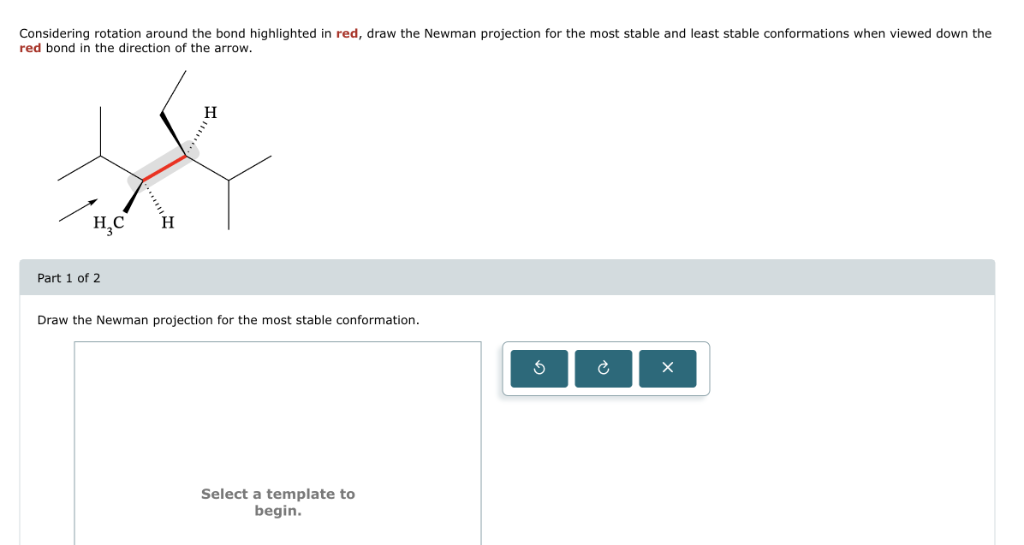 Considering rotation around the bond highlighted in red, draw the Newman projection for the most stable and least stable conformations when viewed down the
red bond in the direction of the arrow.
Iss
HC H
Part 10f2
Draw the Newman projection for the most stable conformation.
Select a template to
begin.
This is AI generated Response.
Asked by: Alok Kumar
Created at: 2026-01-31 04:41:27
Asked by: Alok Kumar
Created at: 2026-01-31 04:41:27
Final Answer:
Rendered
Raw Text
Did you like this answer?
Absolutely! Let's break down what you need to do step by step.
---
## Understanding the Problem
You are asked to **draw Newman projections** for the most stable and least stable conformations around the **red (highlighted) bond** in the molecule, looking along the direction of the arrow.
---
## Step-by-Step Explanation
### 1. **Identify the Groups Attached to Each Carbon**
- **Front Carbon (left side, closest to you):**
- **CH₃ (methyl group)**
- **H (hydrogen)**
- **The rest of the molecule (drawn as a line up in the structure)**
- **Back Carbon (right side, farther from you):**
- **CH₃ (methyl group)**
- **H (hydrogen)**
- **The rest of the molecule (drawn as a line up in the structure)**
### 2. **Draw the Newman Projection Circle**
- The front carbon is represented by a dot at the center.
- The bonds going out from this carbon are drawn as lines.
- The back carbon is represented by a larger circle, with its substituents drawn as lines coming out from the edge.
### 3. **Most Stable Conformation (Staggered/Energy Minimum)**
- To maximize stability, **bulky groups (CH₃)** should be as far apart as possible.
- This is the **anti conformation**, where the two CH₃ groups (one from the front carbon, one from the back) are 180° apart.
#### **How to Draw:**
- Place the **front carbon's CH₃** pointing straight down.
- Place its **H's** at 120° angles (upper right and upper left).
- On the **back carbon**, place its **CH₃** pointing straight up (anti to the front CH₃).
- Its **H's** should be at the remaining positions (lower left and right).
---
### 4. **Least Stable Conformation (Eclipsed/Energy Maximum)**
- This is when **bulky groups (CH₃)** are directly aligned (eclipsed) with each other.
- Highest repulsion (torsional strain).
#### **How to Draw:**
- Place the **front carbon's CH₃** pointing straight down.
- Place its **H's** at 120° angles (upper right and upper left).
- On the **back carbon**, place its **CH₃** also straight down (directly behind the front CH₃).
- Its **H's** are directly behind the front H's.
---
## **Summary Table**
| Conformation | CH₃-CH₃ relationship | Stability |
|----------------|----------------------|---------------|
| Staggered (Anti) | 180° apart | Most stable |
| Eclipsed | ° apart | Least stable |
---
## **Visual Aid**
Here's a basic schematic for the **most stable conformation**:
```
H H
\ /
C----C
/ \
CH3 CH3
```
- In Newman projection (viewed down the red bond):
- **Front carbon:** dot with CH₃ (down), H (left/right)
- **Back carbon:** circle with CH₃ (up), H (left/right, staggered)
---
If you'd like, I can draw or describe the specific arrangement for your structure! Would you like a hand-drawn sketch or further details?
📢 Instructions:
- Ask anything relatd to above question only.
- For new Question goto :